Results by title
72 books match the query 'Honor' and 3 start with p
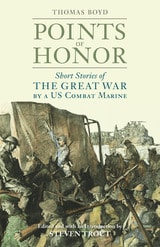
Points of Honor
Short Stories of the Great War by a US Combat MarineThomas Boyd, Edited and with an Introduction by Steven Trout
University of Alabama Press, 2018
A masterwork of World War I short stories portraying the experiences of Marines in battle.
Points of Honor: Short Stories of the Great War by a US Combat Marine is based on author Thomas Alexander Boyd’s personal experiences as an enlisted Marine. First published in 1925 and long out of print, this edition rescues from obscurity a vivid, kaleidoscopic vision of American soldiers, US Marines mostly, serving in a global conflict a century ago. It is a true forgotten masterpiece of World War I literature.
The stories in Points of Honor deal almost entirely with Marines in the midst of battle—or faced with the consequences of military violence. The eleven stories in this collection offer a panoramic view of war experience and its aftermath, what Boyd described as “a mass of more human happenings.” The themes are often antiheroic: dehumanization, pettiness, betrayal by loved ones at home, and the cruelty of military justice. But Boyd’s vision also accommodates courage and loyalty. Like all great works of war literature, this collection underscores the central paradox of armed conflict—its ability to bring out both the best and worst in human beings.
This reissue of Points of Honor is edited, annotated, and introduced by Steven Trout. Trout provides an overview of Thomas Boyd’s war experience and writing career and situates the stories within the broader context of World War I American literature.
Points of Honor received strong reviews at the time of its initial publication and remains an overwhelming reading experience today. While each of the stories is a freestanding work of art, when read together they carry the force of a novel.
[more]
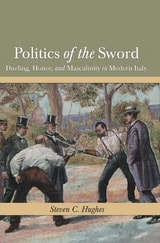
Politics of the Sword
Dueling, Honor, and Masculinity in Modern ItalySteven C. Hughes
The Ohio State University Press, 2007
Following its creation as a country in 1861, Italy experienced a wave of dueling that led commentators to bemoan a national “duellomania” evidenced by the sad spectacle of a duel a day. Pamphlets with titles like “Down with the Duel” and “The Shame of the Duel” all communicated the passion of those who could not believe that a people supposedly just returned to the path of progress and civilization had wholeheartedly embraced such a “barbaric” custom. Yet these critics were consistently countered by sober-minded men of rank and influence who felt that the duel was necessary for the very health of the new nation.
Steven C. Hughes argues that this extraordinary increase in chivalric combat occurred because the duel played an important role in the formation, consolidation, and functioning of united Italy. The code of honor that lay at the heart of the dueling ethic offered a common model and bond of masculine identity for those patriotic elites who, having created a country of great variety and contrast for often contradictory motives, had to then deal with the consequences. Thus dueling became an iconic weapon of struggle during the Risorgimento, and, as Italy performed poorly on the stage of great power politics, it continued to offer images of martial valor and manly discipline. It also enhanced the social and political power of the new national elites, whose monopoly over chivalric honor helped reinforce the disenfranchisement of the masses. Eventually, the duel fed into the hypermasculinity and cult of violence that marked the early fascist movement, but in the end it would prove too individualistic in its definition of honor to stand up to the emerging totalitarian state. Although Mussolini would himself fight five duels at the start of his career, the duel would disappear along with the liberal regime that had embraced it.
[more]
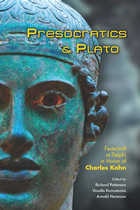
Presocratics and Plato
Festschrift at Delphi in Honor of Charles KahnRichard Patterson
Parmenides Publishing, 2012
This celebratory Festschrift dedicated to Charles Kahn comprises some 23 articles by friends, former students and colleagues, many of whom first presented their papers at the international "Presocratics and Plato" Symposium in his honor (European Cultural Center of Delphi, Greece, 3–7 June, 2009). The conference was organized and sponsored by the HYELE Institute for Comparative Studies, Parmenides Publishing, and Starcom AG, with endorsements from the International Plato Society, and the Dean of the School of Arts and Sciences, University of Pennsylvania. While Kahn's work reaches far beyond the Presocratics and Plato, it is in these subject areas that the distinction of his scholarship has come to be regarded as virtually unrivaled. The articles contributed to this volume are by some of the most renowned scholars working on these topics today, their breadth and depth bearing witness to his profound impact and influence on the discipline of Ancient Greek Philosophy.
Charles Kahn taught Classics and Philosophy at Columbia University from 1957 to 1965, and has since been teaching in the Philosophy Department of the University of Pennsylvania. He spent a year as Visiting Professor at the American School of Classical Studies in Athens, and had additional Visiting Fellowships at Balliol College, Oxford and Clare Hall, Cambridge, and a term as Visiting Professor at Harvard. He is the recipient of several prestigious research grants, from the American Council of Learned Societies (1963/64 and 1984/85), the National Endowment for the Humanities (1974/75 and 1990/91), and the Guggenheim Foundation (1979/80). In 2000 he was elected Fellow of the National Academy of Arts and Sciences. He is the author of Anaximander and the Origins of Greek Cosmology, The Verb “Be” in Ancient Greek, The Art and Thought of Heraclitus, Plato and the Socratic Dialogue, Pythagoras and the Pythagoreans, and Essays on Being. His latest book,Plato and the Post-Socratic Dialogue, is forthcoming from Cambridge University Press.
Charles Kahn taught Classics and Philosophy at Columbia University from 1957 to 1965, and has since been teaching in the Philosophy Department of the University of Pennsylvania. He spent a year as Visiting Professor at the American School of Classical Studies in Athens, and had additional Visiting Fellowships at Balliol College, Oxford and Clare Hall, Cambridge, and a term as Visiting Professor at Harvard. He is the recipient of several prestigious research grants, from the American Council of Learned Societies (1963/64 and 1984/85), the National Endowment for the Humanities (1974/75 and 1990/91), and the Guggenheim Foundation (1979/80). In 2000 he was elected Fellow of the National Academy of Arts and Sciences. He is the author of Anaximander and the Origins of Greek Cosmology, The Verb “Be” in Ancient Greek, The Art and Thought of Heraclitus, Plato and the Socratic Dialogue, Pythagoras and the Pythagoreans, and Essays on Being. His latest book,Plato and the Post-Socratic Dialogue, is forthcoming from Cambridge University Press.
Contributors:
Julia Annas
Sarah Broadie
Lesley Brown
Tomás Calvo-Martínez
Diskin Clay
John M. Dillon
Dorothea Frede
Arnold Hermann
Carl A. Huffman
Enrique Hülsz Piccone
D. M. Hutchinson
Paul Kalligas
Vassilis Karasmanis
Aryeh Kosman
Anthony A. Long
Richard McKirahan
Susan Sauvé Meyer
Alexander P.D.Mourelatos
Satoshi Ogihara
Richard Patterson
Christopher J. Rowe
David Sedley
Richard Sorabji
[more]