Results by title
101 books match the query 'Identity (Psychology)' and 5 start with p
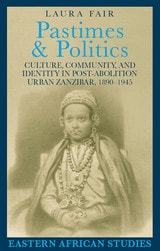
Pastimes and Politics
Culture, Community, and Identity in Post-Abolition Urban Zanzibar, 1890–1945Laura Fair
Ohio University Press, 2001
The first decades of the twentieth century were years of dramatic change in Zanzibar, a time when the social, economic, and political lives of island residents were in incredible flux, framed by the abolition of slavery, the introduction of colonialism, and a tide of urban migration. Pastimes and Politics explores the era from the perspective of the urban poor, highlighting the numerous and varied ways that recently freed slaves and other immigrants to town struggled to improve their individual and collective lives and to create a sense of community within this new environment. In this study Laura Fair explores a range of cultural and social practices that gave expression to slaves’ ideas of emancipation, as well as how such ideas and practices were gendered.
Pastimes and Politics examines the ways in which various cultural practices, including taarab music, dress, football, ethnicity, and sexuality, changed during the early twentieth century in relation to islanders’ changing social and political identities. Professor Fair argues that cultural changes were not merely reflections of social and political transformations. Rather, leisure and popular culture were critical practices through which the colonized and former slaves transformed themselves and the society in which they lived.
Methodologically innovative and clearly written, Pastimes and Politics is accessible to specialists and general readers alike. It is a book that should find wide use in courses on African history, urbanization, popular culture, gender studies, or emancipation.
Paul and the Resurrected Body
Social Identity and Ethical PracticeMatt O'Reilly
SBL Press, 2020
A new reading of Pauline theology, ethics, and eschatology grounded in social-identity theory and sociorhetorical criticism
Readers often think of Paul’s attitude toward the resurrection of the body in individual terms: a single body raised as the climax of an individual’s salvation. In Paul and the Resurrected Body: Social Identity and Ethical Practice, Matt O’Reilly makes the case that, for Paul, the social dimension of future bodily resurrection is just as important, if not more so. Through a close reading of key texts in the letters to the Corinthians, Romans, and Philippians, O’Reilly argues that resurrection is integral to Paul’s understanding of Christian social identity. In Paul’s theological reasoning, a believer’s hope for the future depends on being identified as part of the people of God who will be resurrected.
Features
- A clarification of the eschatological basis for Paul’s ethical expectations
- Exploration of the social significance of Paul’s theological reasoning
- An integration of ancient rhetorical theory with contemporary social-identity theory
Physics of Blackness
Beyond the Middle Passage EpistemologyMichelle M. Wright
University of Minnesota Press, 2015
What does it mean to be Black? If Blackness is not biological in origin but socially and discursively constructed, does the meaning of Blackness change over time and space? In Physics of Blackness: Beyond the Middle Passage Epistemology, Michelle M. Wright argues that although we often explicitly define Blackness as a “what,” it in fact always operates as a “when” and a “where.”
By putting lay discourses on spacetime from physics into conversation with works on identity from the African Diaspora, Physics of Blackness explores how Middle Passage epistemology subverts racist assumptions about Blackness, yet its linear structure inhibits the kind of inclusive epistemology of Blackness needed in the twenty-first century. Wright then engages with bodies frequently excluded from contemporary mainstream consideration: Black feminists, Black queers, recent Black African immigrants to the West, and Blacks whose histories may weave in and out of the Middle Passage epistemology but do not cohere to it.
Physics of Blackness takes the reader on a journey both known and unfamiliar—from Isaac Newton’s laws of motion and gravity to the contemporary politics of diasporic Blackness in the academy, from James Baldwin’s postwar trope of the Eiffel Tower as the site for diasporic encounters to theoretical particle physics’ theory of multiverses and superpositioning, to the almost erased lives of Black African women during World War II. Accessible in its style, global in its perspective, and rigorous in its logic, Physics of Blackness will change the way you look at Blackness.
Placing the Academy
Essays on Landscape, Work, and Identityedited by Jennifer Sinor and Rona Kaufman
Utah State University Press, 2007
Twenty-one writers answer the call for literature that addresses who we are by understanding where we are--where, for each of them, being in some way part of academia. In personal essays, they imaginatively delineate and engage the diverse, occasionally unexpected play of place in shaping them, writers and teachers in varied environments, with unique experiences and distinctive world views, and reconfiguring for them conjunctions of identity and setting, here, there, everywhere, and in between.
Contents
I Introduction Writing Place, Jennifer Sinor
II Here
Six Kinds of Rain: Searching for a Place in the Academy, Kathleen Dean Moore and Erin E. Moore
The Work the Landscape Calls Us To, Michael Sowder
Valley Language, Diana Garcia
What I Learned from the Campus Plumber, Charles Bergman
M-I-Crooked Letter-Crooked Letter, Katherine Fischer
On Frogs, Poems, and Teaching at a Rural Community College, Sean W. Henne
III There
Levittown Breeds Anarchists Film at 11:00, Kathryn T. Flannery
Living in a Transformed Desert, Mitsuye Yamada
A More Fortunate Destiny, Jayne Brim Box
Imagined Vietnams, Charles Waugh
IV Everywhere
Teaching on Stolen Ground, Deborah A. Miranda
The Blind Teaching the Blind: The Academic as Naturalist, or Not, Robert Michael Pyle
Where Are You From? Lee Torda
V In Between
Going Away to Think, Scott Slovic
Fronteriza Consciousness: The Site and Language of the Academy and of Life, Norma Elia Cantu
Bones of Summer, Mary Clearman Blew
Singing, Speaking, and Seeing a World, Janice M. Gould
Making Places Work: Felt Sense, Identity, and Teaching, Jeffrey M. Buchanan
VI Coda
Running in Place: The Personal at Work, in Motion, on Campus, and in the Neighborhood, Rona Kaufman

Puerto Rican Jam
Rethinking Colonialism and NationalismNegron-Muntaner, Frances
University of Minnesota Press, 1997