58 books match the query 'Identity (Psychology) in literature' and 5 start with p
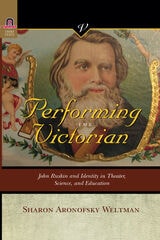
cover of PERFORMING THE VICTORIAN: JOHN RUSKIN AND IDENTITY IN THEATER, SCIENCE, AND EDUCATION

PERFORMING THE VICTORIAN

JOHN RUSKIN AND IDENTITY IN THEATER, SCIENCE, AND EDUCATION

SHARON ARONOFSKY WELTMAN

The Ohio State University Press, 2007
Performing the Victorian: John Ruskin and Identity in Theater, Science, and Education by Sharon Aronofsky Weltman is the first book to examine Ruskin’s writing on theater.
            In works as celebrated as Modern Painters and obscure as Love’s Meinie, Ruskin uses his voracious attendance at the theater to illustrate points about social justice, aesthetic practice, and epistemology. Opera, Shakespeare, pantomime, French comedies, juggling acts, and dance prompt his fascination with performed identities that cross boundaries of gender, race, nation, and species. These theatrical examples also reveal the primacy of performance to his understanding of science and education.
            In addition to Ruskin on theater, Performing the Victorian interprets recent theater portraying Ruskin (The Invention of Love, The Countess, the opera Modern Painters) as merely a Victorian prude or pedophile against which contemporary culture defines itself. These theatrical depictions may be compared to concurrent plays about Ruskin’s friend and student Oscar Wilde (Gross Indecency: The Three Trials of Oscar Wilde, The Judas Kiss). Like Ruskin, Wilde is misrepresented on the fin-de-millennial stage, in his case anachronistically as an icon of homosexual identity. These recent characterizations offer a set of static identity labels that constrain contemporary audiences more rigidly than the mercurial selves conjured in the prose of either Ruskin or Wilde.
[more]
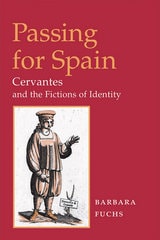
cover of Passing for Spain: CERVANTES AND THE FICTIONS OF IDENTITY

Passing for Spain

CERVANTES AND THE FICTIONS OF IDENTITY

Barbara Fuchs

University of Illinois Press, 2003

Passing for Spain charts the intersections of identity, nation, and literary representation in early modern Spain. Barbara Fuchs analyzes the trope of passing in Don Quijote and other works by Cervantes, linking the use of disguise to the broader historical and social context of Counter-Reformation Spain and the religious and political dynamics of the Mediterranean Basin.
 
In five lucid and engaging chapters, Fuchs examines what passes in Cervantes’s fiction: gender and race in Don Quijote and “Las dos doncellas”; religion in “El amante liberal” and La gran sultana; national identity in the Persiles and “La española inglesa.” She argues that Cervantes represents cross-cultural impersonation -- or characters who pass for another gender, nationality, or religion -- as challenges to the state’s attempts to assign identities and categories to proper Spanish subjects.
 
Fuchs demonstrates the larger implications of this challenge by bringing a wide range of literary and political texts to bear on Cervantes’s representations. Impeccably researched, Passing for Spain examines how the fluidity of individual identity in early modern Spain undermined a national identity based on exclusion and difference.
 
[more]
cover of Performing Identities on the Restoration Stage

Performing Identities on the Restoration Stage

Cynthia Lowenthal

Southern Illinois University Press, 2002

In Performing Identities on the Restoration Stage, Cynthia Lowenthal explores identity—especially masculinity and femininity, English and “foreign,” middle-class and aristocratic—as it is enacted, idealized, deployed, and redefined on the late-seventeenth-century British stage. Particular emphasis is placed on the ways the theatre contributed to new and often shifting early modern definitions of the boundaries of nation, status, and gender.

The first portion of the book focuses on the playwrights’ presentations of idealized men and the comic ridicule of male bodies and behaviors that fall short of the ideal. Of special interest are those moments when playwrights use stereotypes of national character, particularly the Spaniards and Turks, as examples of the worst in male behavior, judgments that are always inflected with elements of class or status inconsistency.

The second portion of Lowenthal’s discussion focuses on playwrights’ attempts to redefine the idealized woman. Lowenthal investigates the ways that an extratheatrical discourse surrounding the actresses, one that essentialized them as sexual bodies demanding scrutiny and requiring containment, also serves to secure for them an equally essential aristocratic status. Anchored by Manley’s Royal Mischief, Lowenthal’s reading reveals that even a woman playwright’s attempts to represent female subjectivity or interiority at odds with the surfaces of the body are doomed to return to those same surfaces.

By focusing on a new, early modern lability of identity and by reading less canonical women playwrights, such as Manley and Pix, alongside established male playwrights such as Dryden and Wycherley, Performing Identities on the Restoration Stage yields both a more accurate and a more compelling picture of the cultural dynamics at work on the early modern stage.

[more]
cover of Poetics of Visibility in the Contemporary Arab American Novel

Poetics of Visibility in the Contemporary Arab American Novel

Mazen Naous

The Ohio State University Press, 2020

How might art disrupt Arabophobia and Islamophobia in the US? In Poetics of Visibility in the Contemporary Arab American Novel, Mazen Naous argues that fiction is one of the ways in which Arab Americans can correct dominant narratives of themselves with representation of their lived realities. Looking at both the aesthetics and politics in contemporary Arab American novels, Naous demonstrates that the novels’ poetics cannot be extricated from or subsumed under political content. In his finely textured analyses of form and style, Naous uncovers crucial transcultural and transpoetic solidarities that extend beyond the politics of representation.
 
Naous’s book offers analyses of Diana Abu-Jaber’s Arabian Jazz and Crescent, Rabih Alameddine’s Koolaids: The Art of War, Laila Halaby’s Once in a Promised Land, and Mohja Kahf’s The Girl in the Tangerine Scarf as ways to answer this question. Naous explores how these novels negotiate queer desire, music, Western and Middle Eastern art, gender, and relationships between other minorities. These poetics enable readers to see the nuance and richness of Arab American experience. Naous ultimately argues that fiction creates crucial spaces for reimagining and redefining intercultural relationships.
 
[more]
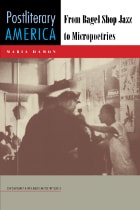
cover of Postliterary America: From Bagel Shop Jazz to Micropoetries

Postliterary America

From Bagel Shop Jazz to Micropoetries

Maria Damon

University of Iowa Press, 2011

In this capacious and challenging book, Maria Damon surveys the poetry and culture of the United States in two distinct but inextricably linked periods. In part 1, “Identity K/not/e/s,” she considers the America of the 1950s and early 1960s, when contentious and troubled alliances took shape between different marginalized communities and their respective but overlapping bohemias—Jews, African Americans, the Beats, and gays and lesbians. Using a rich trove of texts and artifacts—ranging from Gertrude Stein’s writings about her own Jewishness to transcripts from Lenny Bruce’s obscenity trial, Bob Kaufman’s Beat poetry—as well as her own stake in the material, Damon plumbs the complexities of social identity and expressive cultures to fascinating effect.
      Always erudite but never effete, Damon then turns to more contemporary issues and broader topics of poetics: micropoetries, cyberpoetics, spoken-word poets, performance poets, and their communities. Echoing many of the themes of the first section of the book, including poetic identity and the troubled nature of the poetic “I,” part 2’s “Poetics for a Postliterary America” goes on to paint a wider picture, dwelling less on close readings of individual poems and more on asking questions about the nature of poetry itself and its role in community formation and individual survival. Discussions of counterperformance, kinetics, the Nuyoricans, Latino identity, and electronic poetics enliven this section.
      Never reluctant to acknowledge the deeply personal origins of the work at hand, Damon cleaves to the subject matter, be it questions of identity, matters of poetry, or what it means to live in a postliterary culture. In doing so, she dares to ask what it means to be a member of the “shadow people”—those who occupy marginalized, nocturnal counterculture—creating verbal art.
[more]