60 books match the query 'Image' and 5 start with p
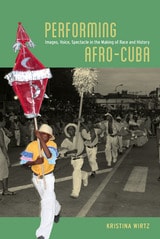
cover of Performing Afro-Cuba: Image, Voice, Spectacle in the Making of Race and History

Performing Afro-Cuba

Image, Voice, Spectacle in the Making of Race and History

Kristina Wirtz

University of Chicago Press, 2014

Visitors to Cuba will notice that Afro-Cuban figures and references are everywhere: in popular music and folklore shows, paintings and dolls of Santería saints in airport shops, and even restaurants with plantation themes. In Performing Afro-Cuba, Kristina Wirtz examines how the animation of Cuba’s colonial past and African heritage through such figures and performances not only reflects but also shapes the Cuban experience of Blackness. She also investigates how this process operates at different spatial and temporal scales—from the immediate present to the imagined past, from the barrio to the socialist state.
           
Wirtz analyzes a variety of performances and the ways they construct Cuban racial and historical imaginations. She offers a sophisticated view of performance as enacting diverse revolutionary ideals, religious notions, and racial identity politics, and she outlines how these concepts play out in the ongoing institutionalization of folklore as an official, even state-sponsored, category. Employing Bakhtin’s concept of “chronotopes”—the semiotic construction of space-time—she examines the roles of voice, temporality, embodiment, imagery, and memory in the racializing process. The result is a deftly balanced study that marries racial studies, performance studies, anthropology, and semiotics to explore the nature of race as a cultural sign, one that is always in process, always shifting.  
[more]
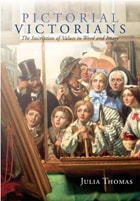
cover of Pictorial Victorians: The Inscription of Values in Word and Image

Pictorial Victorians

The Inscription of Values in Word and Image

Julia Thomas

Ohio University Press, 2005

The Victorians were image obsessed. The middle decades of the nineteenth century saw an unprecedented growth in the picture industry. Technological advances enabled the Victorians to adorn with images the pages of their books and the walls of their homes. But this was not a wholly visual culture. Pictorial Victorians focuses on two of the most popular mid-nineteenth-century genres—illustration and narrative painting—that blurred the line between the visual and textual.

Illustration negotiated text and image on the printed page, while narrative painting juxtaposed the two media in its formulation of pictorial stories. Author Julia Thomas reassesses mid-nineteenth-century values in the light of this interplay. The dialogue between word and image generates meanings that are intimately related to the Victorians' image of themselves. Illustrations in Victorian publications and the narrative scenes that lined the walls of the Royal Academy reveal the Victorians' ideas about the world in which they lived and their notions of gender, class, and race.

Pictorial Victorians surveys a range of material, from representations of the crinoline, to the illustrations that accompanied Harriet Beecher Stowe’s novel Uncle Tom's Cabin and Tennyson's poetry, to paintings of adultery. It demonstrates that the space between text and image is one in which values are both constructed and questioned.
[more]
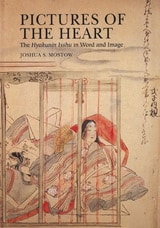
cover of Pictures of the Heart: The <em>Hyakunin Isshu</em> in Word and Image

Pictures of the Heart

The <em>Hyakunin Isshu</em> in Word and Image

Joshua S. Mostow

University of Michigan Press, 2015
The Hyakunin Isshu, or One Hundred Poets, One Poem Each collection, is a sequence of one hundred Japanese poems in the tanka form, selected by the famous poet and scholar Fujiwara no Teika (1162-1241) and arranged, in part, to represent the history of Japanese poetry from the seventh century down to Teika's own day. The anthology is, without doubt, the most popular and widely known collection of poetry in Japan - a distinction it has maintained for hundreds of years. In this study, Joshua Mostow challenges the idea of a final or authoritative reading of the Hyakunin Isshu and presents a refreshing, persuasive case for a reception history of this seminal work.
In addition to providing a new translation of this classic text and biographical information on each poet, Mostow examines issues relating to text and image that are central to the Japanese arts from the Heian into the early modern period. By using Edo-period woodblock illustrations as pictorializations of the poems - as "pictures of the heart," or meaning, of the poems - text and image are pieced together in a holistic approach that will stand as a model for further research in the interrelationship between Japanese visual and verbal art. [A/GB]
[more]
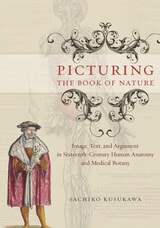
cover of Picturing the Book of Nature: Image, Text, and Argument in Sixteenth-Century Human Anatomy and Medical Botany

Picturing the Book of Nature

Image, Text, and Argument in Sixteenth-Century Human Anatomy and Medical Botany

Sachiko Kusukawa

University of Chicago Press, 2012

Because of their spectacular, naturalistic pictures of plants and the human body, Leonhart Fuchs’s De historia stirpium and Andreas Vesalius’s De humani corporis fabrica are landmark publications in the history of the printed book. But as Picturing the Book of Nature makes clear, they do more than bear witness to the development of book publishing during the Renaissance and to the prominence attained by the fields of medical botany and anatomy in European medicine. Sachiko Kusukawa examines these texts, as well as Conrad Gessner’s unpublished Historia plantarum, and demonstrates how their illustrations were integral to the emergence of a new type of argument during this period—a visual argument for the scientific study of nature.
 
To set the stage, Kusukawa begins with a survey of the technical, financial, artistic, and political conditions that governed the production of printed books during the Renaissance. It was during the first half of the sixteenth century that learned authors began using images in their research and writing, but because the technology was so new, there was a great deal of variety of thought—and often disagreement—about exactly what images could do: how they should be used, what degree of authority should be attributed to them, which graphic elements were bearers of that authority, and what sorts of truths images could and did encode. Kusukawa investigates the works of Fuchs, Gessner, and Vesalius in light of these debates, scrutinizing the scientists’ treatment of illustrations and tracing their motivation for including them in their works. What results is a fascinating and original study of the visual dimension of scientific knowledge in the sixteenth century.
[more]
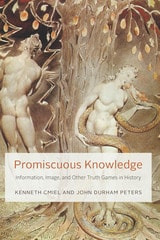
cover of Promiscuous Knowledge: Information, Image, and Other Truth Games in History

Promiscuous Knowledge

Information, Image, and Other Truth Games in History

Kenneth Cmiel and John Durham Peters

University of Chicago Press, 2020

Sergey Brin, a cofounder of Google, once compared the perfect search engine to “the mind of God.” As the modern face of promiscuous knowledge, however, Google’s divine omniscience traffics in news, maps, weather, and porn indifferently. This book, begun by the late Kenneth Cmiel and completed by his close friend John Durham Peters, provides a genealogy of the information age from its early origins up to the reign of Google. It examines how we think about fact, image, and knowledge, centering on the different ways that claims of truth are complicated when they pass to a larger public. To explore these ideas, Cmiel and Peters focus on three main periods—the late nineteenth century, 1925 to 1945, and 1975 to 2000, with constant reference to the present. Cmiel’s original text examines the growing gulf between politics and aesthetics in postmodern architecture, the distancing of images from everyday life in magical realist cinema, the waning support for national betterment through taxation, and the inability of a single presentational strategy to contain the social whole. Peters brings Cmiel’s study into the present moment, providing the backstory to current controversies about the slipperiness of facts in a digital age.  A hybrid work from two innovative thinkers, Promiscuous Knowledge enlightens our understanding of the internet and the profuse visual culture of our time.
[more]