Results by title
433 books match the query 'Immigrants' and 16 start with p
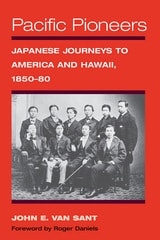
Pacific Pioneers
Japanese Journeys to America and Hawaii, 1850-80John E. Van Sant
University of Illinois Press, 2019
Although Japanese immigrants did not start arriving in substantial numbers in the West until after 1880, in the previous thirty years a handful of key encounters helped shape relations between Japan and the United States. John E. Van Sant explores the motivations and accomplishments of these resourceful, sometimes visionary individuals who made important inroads into a culture quite different from their own and paved the way for the Issei and Nisei.
Pacific Pioneers presents detailed biographical sketches of Japanese such as Joseph Heco, Niijima Jo, and the converts to the Brotherhood of the New Life and introduces the American benefactors, such as William Griffis, David Murray, and Thomas Lake Harris, who built relationships with their foreign visitors. Van Sant also examines the uneasy relations between Japanese laborers and sugar cane plantation magnates in Hawaii during this period and the shortlived Wakamatsu colony of Japanese tea and silk producers in California.
A valuable addition to the literature, Pacific Pioneers brings to life a cast of colorful, long-forgotten characters while forging a critical link between Asian and Asian American studies.
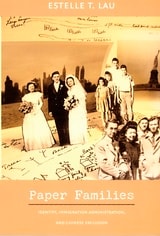
Paper Families
Identity, Immigration Administration, and Chinese ExclusionEstelle T. Lau
Duke University Press, 2006
Drawing on these documents as well as immigration case files, legislative materials, and transcripts of interviews and court proceedings, Lau reveals immigration as an interactive process. Chinese immigrants and their U.S. families were subject to regulation and surveillance, but they also manipulated and thwarted those regulations, forcing the U.S. government to adapt its practices and policies. Lau points out that the Exclusion Acts and the pseudo-familial structures that emerged in response have had lasting effects on Chinese American identity. She concludes with a look at exclusion’s legacy, including the Confession Program of the 1960s that coerced people into divulging the names of paper family members and efforts made by Chinese American communities to recover their lost family histories.
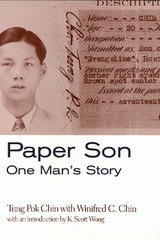
Paper Son
One Man's StoryTung Chin
Temple University Press, 2000
Chin's story begins in the early 1930s, when he followed the example of his father and countless other Chinese who bought documents that falsely identified them as children of Chinese Americans. Arriving in Boston and later moving to New York City, he worked and lived in laundries. Chin was determined to fit into American life and dedicated himself to learning English. But he also became an active member of key organizations -- a church, the Chinese Hand Laundrymen's Alliance, and the Chinese Consolidated Benevolent Association -- that anchored him in the community. A self-reflective and expressive man, Chin wrote poetry commenting on life in China and the hardships of being an immigrant in the United States. His work was regularly published in the China Daily News and brought him to the attention of the FBI, then intent on ferreting out communists and illegal immigrants. His vigorous narrative speaks to the day-to-day anxieties of living as a Paper Son as well as the more universal immigrant experiences of raising a family in modest circumstances and bridging cultures.
Historian K. Scott Wong introduces Chin's memoir, discussing the limitations on immigration from China and what is known about Exclusion-era Chinese American communities. Set in historical context, Tung Pok Chin's unique story offers and engaging account of a twentieth-century Paper Son.
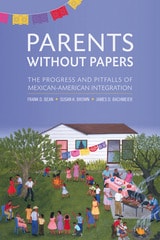
Parents Without Papers
The Progress and Pitfalls of Mexican American IntegrationFrank D. Bean is Distinguished Professor of Sociology and Director of the Center for Research on International Migration at the University of California, Irvine. Susan K. Brown is associate professor of sociology at the University of California, Irvine. James D. Bachmeier is assistant professor of sociology at Temple University.
Russell Sage Foundation, 2015
Parents Without Papers provides both a general conceptualization of immigrant integration and an in-depth examination of the Mexican American case. The authors draw upon unique retrospective data to shed light on three generations of integration. They show in particular that the “membership exclusion” experienced by unauthorized Mexican immigrants—that is, their fear of deportation, lack of civil rights, and poor access to good jobs—hinders the education of their children, even those who are U.S.-born. Moreover, they find that children are hampered not by the unauthorized entry of parents itself but rather by the long-term inability of parents, especially mothers, to acquire green cards.
When unauthorized parents attain legal status, the disadvantages of the second generation begin to disappear. These second-generation men and women achieve schooling on par with those whose parents come legally. By the third generation, socioeconomic levels for women equal or surpass those of native white women. But men reach parity only through greater labor-force participation and longer working hours, results consistent with the idea that their integration is delayed by working-class imperatives to support their families rather than attend college.
An innovative analysis of the transmission of advantage and disadvantage among Mexican Americans, Parents Without Papers presents a powerful case for immigration policy reforms that provide not only realistic levels of legal less-skilled migration but also attainable pathways to legalization. Such measures, combined with affordable access to college, are more important than ever for the integration of vulnerable Mexican immigrants and their descendants.
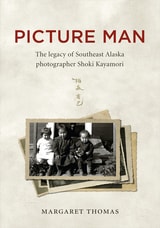
Picture Man
The Legacy of Southeast Alaska Photographer Shoki KayamoriMargaret Thomas
University of Alaska Press, 2015
In Picture Man, Margaret Thomas views Kayamori’s life through multiple lenses. Using Kayamori’s original photos, she explores the economic and political realities that sent Kayamori and thousands like him out of Japan toward opportunity and adventure in the United States, especially the Pacific Northwest. She reveals the tensions around Asian immigrants on the West Coast and the racism that sent many young men north to work in the canneries of Alaska. And she illuminates the intersecting—and at times conflicting—lives of villagers and migrants in a time of enormous change. Part history, part biography, part photographic showcase, Picture Man offers a fascinating new view of Alaska history.

Picturing Immigration
Photojournalistic Representation of Immigrants in Greek and Spanish PressAthanasia Batziou
Intellect Books, 2011
Pinnick Kinnick Hill
An American StoryBy G. W. González, Edited by Mark Brazaitis, with a Preface by Suronda González, with a Spanish translation Las colinas sueñan en español by Daniel Ferreras
West Virginia University Press, 2006
Nearly a century ago, hundreds of families journeyed from Spain to the United States, to search for a better life in the growing zinc-industry towns of Harrison County, West Virginia. As they created a new culture and a new home in this strange land, they added another thread to the rich fabric of our nation. Writing from his perspective as a first-generation son of this immigrant community, González recounts his childhood memories of his neighborhood, where these immigrants raised their families, worked in the often insufferable conditions of the zinc factories, and celebrated "romerias" and feast days with their neighbors.
Pinoy Capital
The Filipino Nation in Daly CityBenito M. Vergara, Jr.
Temple University Press, 2009
Home to 33,000 Filipino American residents, Daly City, California, located just outside of San Francisco, has been dubbed “the Pinoy Capital of the United States.” In this fascinating ethnographic study of the lives of Daly City residents, Benito Vergara shows how Daly City has become a magnet for the growing Filipino American community.
Vergara challenges rooted notions of colonialism here, addressing the immigrants’ identities, connections and loyalties. Using the lens of transnationalism, he looks at the “double lives” of both recent and established Filipino Americans. Vergara explores how first-generation Pinoys experience homesickness precisely because Daly City is filled with reminders of their homeland’s culture, like newspapers, shops and festivals. Vergara probes into the complicated, ambivalent feelings these immigrants have—toward the Philippines and the United States—and the conflicting obligations they have presented by belonging to a thriving community and yet possessing nostalgia for the homeland and people they left behind.
Pobre Raza!
Violence, Justice, and Mobilization among México Lindo Immigrants, 1900-1936By F. Arturo Rosales
University of Texas Press, 1999
Fleeing the social and political turmoil spawned by the Mexican Revolution, massive numbers of Mexican immigrants entered the southwestern United States in the early decades of the twentieth century. But instead of finding refuge, many encountered harsh, anti-Mexican attitudes and violence from an Anglo population frightened by the influx of foreigners and angered by anti-American sentiments in Mexico.
This book examines the response of Mexican immigrants to Anglo American prejudice and violence early in the twentieth century. Drawing on archival sources from both sides of the border, Arturo Rosales traces the rise of "México Lindo" nationalism and the efforts of Mexican consuls to help poor Mexican immigrants defend themselves against abuses and flagrant civil rights violations by Anglo citizens, police, and the U.S. judicial system. This research illuminates a dark era in which civilian and police brutality, prejudice in the courtroom, and disproportionate arrest, conviction, and capital punishment rates too often characterized justice for Mexican Americans.
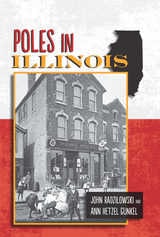
Poles in Illinois
John Radzilowski and Ann Hetzel Gunkel
Southern Illinois University Press, 2020
Authors John Radzilowski and Ann Hetzel Gunkel look at family life among Polish immigrants, their role in the economic development of the state, the working conditions they experienced, and the development of their labor activism. Close-knit Polish American communities were often centered on parish churches but also focused on fraternal and social groups and cultural organizations. Polish Americans, including waves of political refugees during World War II and the Cold War, helped shape the history and culture of not only Chicago, the “capital” of Polish America, but also the rest of Illinois with their music, theater, literature, food.
With forty-seven photographs and an ample number of extensive excerpts from first-person accounts and Polish newspaper articles, this captivating, highly readable book illustrates important and often overlooked stories of this ethnic group in Illinois and the changing nature of Polish ethnicity in the state over the past two hundred years. Illinoisans and Midwesterners celebrating their connections to Poland will treasure this rich and important part of the state’s history.
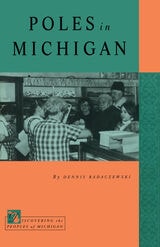
Poles in Michigan
Dennis Badaczewski
Michigan State University Press, 2002
One of the most vibrant and influential ethnic groups in Michigan, Poles have a long history of migration and settlement in the Great Lakes State. From Michigan’s earliest Polish marriage (in 1762) to the most recent post-Cold War migrations, each successive wave of settlement has enriched and enlivened Michigan culture. Yet, Paczki Day and Polish festivals represent a relatively small portion of the Polish experience. Commitments both to religious and ethnic identity, and a belief in the American vision of landownership and success, have combined to create a mainstream ethnic community abundant in ethnic pride. Poles’ success in Michigan continues to attract Polish immigrants from Europe, just as Polonia continues to make its mark on Michigan’s culture.
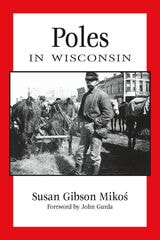
Poles in Wisconsin
Susan Gibson Mikos
Wisconsin Historical Society Press, 2012
In this all-new addition to the People of Wisconsin series, author Susan Mikos traces the history of Polish immigrants as they settled in America’s northern heartland. The second largest immigrant population after Germans, Poles put down roots in all corners of the state, from the industrial center of Milwaukee to the farmland around Stevens Point, in the Cutover, and beyond. In each locale, they brought with them a hunger to own land, a willingness to work hard, and a passion for building churches.
Included is a first person memoir from Polish immigrant Maciej Wojda, translated for the first time into English, and historical photographs of Polish settlements around our state.
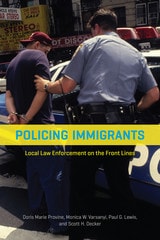
Policing Immigrants
Local Law Enforcement on the Front LinesDoris Marie Provine, Monica W. Varsanyi, Paul G. Lewis, and Scott H. Decker
University of Chicago Press, 2016
Policing Immigrants traces the transition of immigration enforcement from a traditionally federal power exercised primarily near the US borders to a patchwork system of local policing that extends throughout the country’s interior. Since federal authorities set local law enforcement to the task of bringing suspected illegal immigrants to the federal government’s attention, local responses have varied. While some localities have resisted the work, others have aggressively sought out unauthorized immigrants, often seeking to further their own objectives by putting their own stamp on immigration policing. Tellingly, how a community responds can best be predicted not by conditions like crime rates or the state of the local economy but rather by the level of conservatism among local voters. What has resulted, the authors argue, is a system that is neither just nor effective—one that threatens the core crime-fighting mission of policing by promoting racial profiling, creating fear in immigrant communities, and undermining the critical community-based function of local policing.
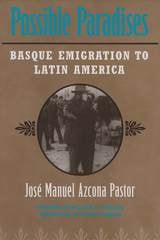
Possible Paradises
Basque Emigration to Latin AmericaAzcona Pastor
University of Nevada Press, 2003
Possible Paradises, José Manuel Azcona Pastor's engaging and meticulously researched study of Basque emigration to the Americas, is a path breaking work of monumental importance. Ranging over the entire former Spanish American empire from Tierra del Fuego to the U.S. Southwest and covering over five centuries of history, Azcona examines the roles and fates of the Basques who came to the New World. He also studies the impact of the New World on the Basque Country, from the importance in the modern Basque diet of such American foodstuffs as corn and beans to the encouragement given to traditional Basque industries by the colonizers' demand for ships and iron tools. He considers the role of Basques in the Spanish imperial expeditions of exploration and conquest; their participation in transatlantic commerce and communication.
The Basque diaspora, although worldwide in dimension, has had its greatest presence and importance in the Americas. Azcona's pioneering study views the Basque presence in the New World through the broadest possible lens, linking Basque communities and activities from Argentina to the North American West.
Foreword by William A. Douglass. Translation by Roland Vazquez.
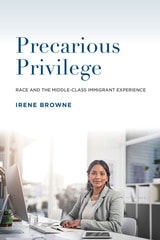
Precarious Privilege
Race and the Middle-Class Immigrant ExperienceIrene Browne
Russell Sage Foundation, 2024
Browne finds that when asked to identify themselves by race, these immigrants either reject racial identities entirely or draw on belief systems from Mexico and the Dominican Republic that emphasize European-indigenous mixed race identities. When branded as typical Latines in the U.S., Mexican middle-class immigrants emphasize their social class or explain that a typical Latine can be middle-class, while Dominicans simply indicate that they are not Mexican. Rather than blame systemic racism, both Mexican and Dominican middle-class immigrants often attribute misperceptions of their identity to non-Latines’ ignorance or to individual Latines’ lack of effort in trying to assimilate.
But these middle-class Latine immigrants do not simply seek to position themselves on par with the U.S.-born white middle class. Instead, they leverage their cosmopolitanism—for example, their multilingualism or their children’s experiences traveling abroad—to engage in what Browne calls “one-up assimilation,” a strategy that aims to position them above the white middle class, who are often monolingual and unaware of the world outside the United States. Middle-class Latines’ cosmopolitanism and valuing of diversity also lead them to have cordial relations with African Americans, but these immigrants do not see themselves as sharing African Americans’ status as oppressed minorities.
Although the stereotype of the typical Latine has made middle-class Latine immigrants susceptible to stigma, they insist that this stigma does not play a significant role in their lives. In many cases, they view the stereotype as a minor issue, feel that opportunities for upward mobility outweigh any negative experiences, or downplay racism by emphasizing their class privilege. Browne observes that while downplaying racism may help middle-class Latine immigrants maintain their dignity, it also perpetuates inequality by reinforcing the lower status of working-class undocumented immigrants. It is thus imperative, Browne argues, to repeal harsh anti-immigration policies, a move that will not only ease the lives of the undocumented but also send a message about who belongs in the country.
Offering a nuanced exploration of how race, social class, and immigration status intersect, Precarious Privilege provides a complex portrait of middle-class Latine immigrants in the United States today.
Precarity and Belonging
Labor, Migration, and NoncitizenshipCatherine S. Ramírez
Rutgers University Press, 2021