Results by title
112 books match the query 'Immigration' and 6 start with p
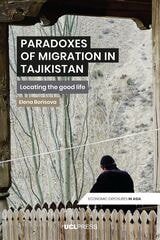
Paradoxes of Migration in Tajikistan
Locating the Good LifeElena Borisova
University College London, 2024
Tajikistan is one of the most remittance-dependent countries in the world. Moving beyond economistic push-pull narratives about post-Soviet migration, Paradoxes of Migration in Tajikistan foregrounds the experiences of those who “stay put” in the sending society and struggle to reproduce their moral communities. In this first book-length ethnography of migration in Tajikistan, Elena Borisova examines the role of mobility through historical and cultural ideas about the good life. She demonstrates how mobility becomes entwined with people’s efforts to become good, moral, and modern subjects. Addressing the complex relationship between the economic, imaginative, and moral aspects of (im)mobility, Borisova shows that mass migration from Tajikistan is as much a project of navigating ethical personhood as it is a quest for economic resources.
This book is a beautifully crafted ethnographic account that reveals how transnational regimes and structures of mobility, citizenship, and histories map out in the intimate spheres of the body, the person, and the family. It is a major contribution to contemporary migration research, which is mostly centered on Europe and North America, and to the field of Central Asian studies. Highly readable, it will be of interest to researchers of migration, (im)mobility and citizenship, and to scholars of all disciplines working on Central Asia.
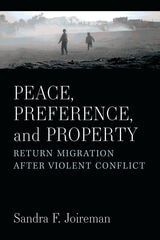
Peace, Preference, and Property
Return Migration after Violent ConflictSandra F. Joireman
University of Michigan Press, 2022
Growing numbers of people are displaced by war and violent conflict. In Ukraine, Afghanistan, Ethiopia, Myanmar, Syria, and elsewhere violence pushes civilian populations from their homes and sometimes from their countries, making them refugees. In previous decades, millions of refugees and displaced people returned to their place of origin after conflict or were resettled in countries in the Global North. Now displacements last longer, the number of people returning home is lower, and opportunities for resettlement are shrinking. More and more people spend decades in refugee camps or displaced within their own countries, raising their children away from their home communities and cultures. In this context, international policies encourage return to place of origin.
Using case studies and first-person accounts from interviews and fieldwork in post-conflict settings such as Uganda, Liberia, and Kosovo, Sandra F. Joireman highlights the divergence between these policies and the preferences of conflict-displaced people. Rather than looking from the top down, at the rights that people have in international and domestic law, the perspective of this text is from the ground up—examining individual and household choices after conflict. Some refugees want to go home, some do not want to return, some want to return to their countries of origin but live in a different place, and others are repatriated against their will when they have no other options. Peace, Preference, and Property suggests alternative policies that would provide greater choice for displaced people in terms of property restitution and solutions to displacement.
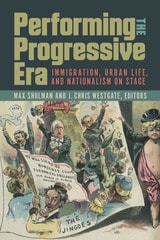
Performing the Progressive Era
Immigration, Urban Life, and Nationalism on StageMax Shulman and J. Chris Westgate
University of Iowa Press, 2019
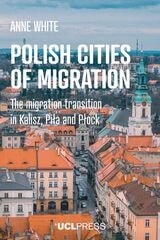
Polish Cities of Migration
The Migration Transition in Kalisz, Pila and PlockAnne White
University College London, 2024
Polish Cities of Migration analyzes Poland’s transition to become a “country of immigration.” Incorporating in-depth interviews with thirty-seven Polish returned migrants, seventy Ukrainians, and seventeen foreigners living in Kalisz, Plock, and Pila, the book explores two interconnected puzzles: how Poland’s migration transition is influenced by its current status as an emigration country, and why migrants are spreading out beyond the metropolises. It argues that migrants’ feelings of comfort in such locations are explained by network and lifestyle considerations, as well as the social acceptance of migration by former migrant Poles.
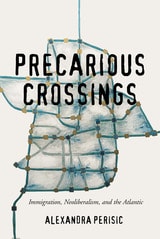
Precarious Crossings
Immigration, Neoliberalism, and the AtlanticAlexandra Perisic
The Ohio State University Press, 2019
Perisic argues that in traveling beyond the postcolonial route that connects former colonizer and former colonized, these authors also shift their focus from cultural difference and national belonging to precarity—a condition characterized by a lack of economic and social stability and protection—as a shared characteristic under global neoliberalization. She demonstrates how contemporary Atlantic narratives reveal the contradictions inherent in neoliberalism as an ideology—thereby showing how they further participate in Atlantic literary and cultural dialogues and push against literary conventions of various genre as they explore the complexities of a globalized Atlantic.
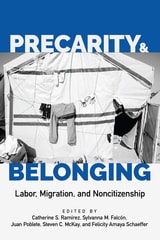
Precarity and Belonging
Labor, Migration, and NoncitizenshipCatherine S. Ramírez
Rutgers University Press, 2021