221 books match the query 'Imperialism' and 10 start with p
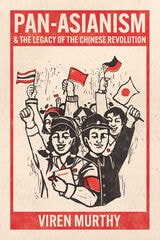
cover of Pan-Asianism and the Legacy of the Chinese Revolution

Pan-Asianism and the Legacy of the Chinese Revolution

Viren Murthy

University of Chicago Press, 2023

An intellectual history of pan-Asianist discourse in the twentieth century.

Recent proposals to revive the ancient Silk Road for the contemporary era and ongoing Western interest in China’s growth and development have led to increased attention to the concept of pan-Asianism. Most of that discussion, however, lacks any historical grounding in the thought of influential twentieth-century pan-Asianists. In this book, Viren Murthy offers an intellectual history of the writings of theorists, intellectuals, and activists—spanning leftist, conservative, and right-wing thinkers—who proposed new ways of thinking about Asia in their own historical and political contexts. Tracing pan-Asianist discourse across the twentieth century, Murthy reveals a stronger tradition of resistance and alternative visions than the contemporary discourse on pan-Asianism would suggest. At the heart of pan-Asianist thinking, Murthy shows, were the notions of a unity of Asian nations, of weak nations becoming powerful, and of the Third World confronting the “advanced world” on equal terms—an idea that grew to include non-Asian countries into the global community of Asian nations. But pan-Asianists also had larger aims, imagining a future beyond both imperialism and capitalism. The fact that the resurgence of pan-Asianist discourse has emerged alongside the dominance of capitalism, Murthy argues, signals a profound misunderstanding of its roots, history, and potential.

[more]
cover of Picturing Empire: Photography and the Visualization of the British Empire

Picturing Empire

Photography and the Visualization of the British Empire

James R. Ryan

University of Chicago Press, 1997

Coinciding with the extraordinary expansion of Britain's overseas empire under Queen Victoria, the invention of photography allowed millions to see what they thought were realistic and unbiased pictures of distant peoples and places. This supposed accuracy also helped to legitimate Victorian geography's illuminations of the "darkest" recesses of the globe with the "light" of scientific mapping techniques.

But as James R. Ryan argues in Picturing Empire, Victorian photographs reveal as much about the imaginative landscapes of imperial culture as they do about the "real" subjects captured within their frames. Ryan considers the role of photography in the exploration and domestication of foreign landscapes, in imperial warfare, in the survey and classification of "racial types," in "hunting with the camera," and in teaching imperial geography to British schoolchildren.

Ryan's careful exposure of the reciprocal relation between photographic image and imperial imagination will interest all those concerned with the cultural history of the British Empire.
[more]
cover of Politics of James Connolly

Politics of James Connolly

Kieran Allen

Pluto Press, 1990

Born in 1868 and executed by the British in 1916 for his role in the Easter Rising, the work of Irish national hero James Connolly has long been misunderstood. From Fianna Fáil and Sinn Féin, to conservative Irish nationalists and the Church, many groups have claimed Connolly as their own, his ideas and strategies used and distorted to justify particular political positions.

Kieran Allen breaks this mould, assessing the founder of the Irish Marxist movement ideas from a revolutionary socialist perspective. Allen considers the strengths and weaknesses of Connolly’s revolutionary strategy, the effect of his commitment to international socialism on his nationalist loyalties and arguing that, ultimately, Connolly's enduring relevance derives from his anti-imperialism. Any socialist movement today ignores this book at its peril.
[more]
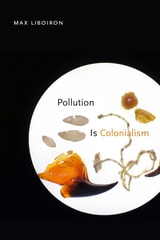
cover of Pollution Is Colonialism

Pollution Is Colonialism

Max Liboiron

Duke University Press, 2021
In Pollution Is Colonialism Max Liboiron presents a framework for understanding scientific research methods as practices that can align with or against colonialism. They point out that even when researchers are working toward benevolent goals, environmental science and activism are often premised on a colonial worldview and access to land. Focusing on plastic pollution, the book models an anticolonial scientific practice aligned with Indigenous, particularly Métis, concepts of land, ethics, and relations. Liboiron draws on their work in the Civic Laboratory for Environmental Action Research (CLEAR)—an anticolonial science laboratory in Newfoundland, Canada—to illuminate how pollution is not a symptom of capitalism but a violent enactment of colonial land relations that claim access to Indigenous land. Liboiron's creative, lively, and passionate text refuses theories of pollution that make Indigenous land available for settler and colonial goals. In this way, their methodology demonstrates that anticolonial science is not only possible but is currently being practiced in ways that enact more ethical modes of being in the world.
[more]
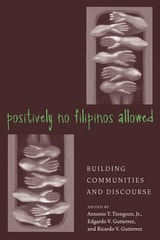
cover of Positively No Filipinos Allowed: Building Communities and Discourse

Positively No Filipinos Allowed

Building Communities and Discourse

edited by Antonio T. Tiongson, Jr., Edgardo V. Gutierrez and Ricardo V. Gutierrez, foreword by Lisa Lowe

Temple University Press, 2006
From the perspectives of ethnic studies, history, literary criticism, and legal studies, the original essays in this volume examine the ways in which the colonial history of the Philippines has shaped Filipino American identity, culture, and community formation. The contributors address the dearth of scholarship in the field as well as show how an understanding of this complex history provides a foundation for new theoretical frameworks for Filipino American studies.
[more]
cover of Postcolonial Grief: The Afterlives of the Pacific Wars in the Americas

Postcolonial Grief

The Afterlives of the Pacific Wars in the Americas

Jinah Kim

Duke University Press, 2019

In Postcolonial Grief Jinah Kim explores the relationship of mourning to transpacific subjectivities, aesthetics, and decolonial politics since World War II. Kim argues that Asian diasporic subjectivity exists in relation to afterlives because the deaths of those killed by U.S. imperialism and militarism in the Pacific remain unresolved and unaddressed. Kim shows how primarily U.S.-based Korean and Japanese diasporic writers, artists, and filmmakers negotiate the necropolitics of Asia and how their creative refusal to heal from imperial violence may generate transformative antiracist and decolonial politics. She contests prevalent interpretations of melancholia by engaging with Frantz Fanon's and Hisaye Yamamoto's decolonial writings; uncovering the noir genre's relationship to the U.S. war in Korea; discussing the emergence of silenced colonial histories during the 1992 Los Angeles riots; and analyzing the 1996 hostage takeover of the Japanese ambassador's home in Peru. Kim highlights how the aesthetic and creative work of the Japanese and Korean diasporas offers new insights into twenty-first-century concerns surrounding the state's erasure of military violence and colonialism and the difficult work of remembering histories of war across the transpacific.
[more]
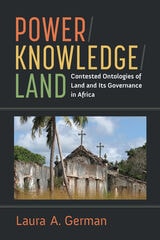
cover of Power / Knowledge / Land: Contested Ontologies of Land and Its Governance in Africa

Power / Knowledge / Land

Contested Ontologies of Land and Its Governance in Africa

Laura A. German

University of Michigan Press, 2022

The 2008 outcry over the “global land grab” made headlines around the world, leading to a sustained interest in the dynamics and fate of customary land among both academics and development practitioners. In Power/Knowledge/Land, author Laura German profiles the consolidation of a global knowledge regime surrounding land and its governance within international development circles in the decade following this outcry, and the growing enrollment of previously antagonistic actors within it. Drawing theoretical insights on the inseparability of power and knowledge, German reveals the dynamics of knowledge practices that have enabled the longstanding project of commodifying customary land – and the more contemporary interests in acquiring and financializing it – to be advanced and legitimated by capturing the energies of socially progressive forces. By bringing theories of change from the emergent land governance orthodoxy into dialogue with the ethnographic evidence from across the African continent and beyond, concepts masquerading as universal and self-evident truths are provincialized, and their role in commodifying customary land and entrenching colonial futurities put on display. In doing so, the volume brings wider academic debates surrounding productive forms of power into the heart of the land grab debate, while enhancing their accessibility to a wider audience.

Power/Knowledge/Land takes current scholarly debates surrounding land grabs beyond their theoretical moorings in critical agrarian studies, political economy and globalization into contemporary debates surrounding the politics of knowledge—from theories of coloniality to ontological anthropology, thereby enabling new dynamics of the phenomenon to be revealed. The book deploys a pioneering epistemology integrating deconstructionist approaches (to reveal the tactics, truth claims and ontological assumptions of global knowledge brokers), with systematic qualitative reviews and comparative study (to contrast these dominant constructs with the evidence and reveal alternative ways of knowing “land” and practicing “security” from the ethnographic literature). This helps to reveal the Western and modernist biases in the narratives that have been advanced about women, custom, and security, revealing how the coloniality of knowledge works to grease the wheels of land takings by advancing highly provincialized constructs aligned with western interests as universal truths.
[more]
cover of Power and Identity at the Margins of the Ancient Near East

Power and Identity at the Margins of the Ancient Near East

Sara Mohr

University Press of Colorado, 2022

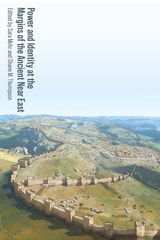
Power and Identity at the Margins of the Ancient Near East rethinks the dichotomy between antiquated terms such as “core” and “periphery,” explores lived realities in the margins of central authority, and centers those margins as places of resistance and power in their own right.
 
The borderlands of hegemonic entities within the Near East and Egypt pressed against each other, creating cities and societies with influence from several competing polities. The peoples, cities, and cultures that resulted present a unique lens by which to examine how states controlled and influenced the lives, political systems, and social hierarchies of these subjects (and vice versa). This volume addresses the distinct traditions and experiences of areas beyond the core; terminology used when discussing empire, core, periphery, borderlands, and frontiers; conceptualization of space; practices and consequences of warfare, captive-taking, and slavery; identity- and secondary state–formation; economy and society; ritual; diplomacy; and the negotiation of claims to power.
 
It is imperative that historians and social scientists understand the ways in which these cultures developed, spread, and interacted with others along frontier edges. Using an intersectional approach across disciplines, Power and Identity at the Margins of the Ancient Near East brings together professionals from archaeology, religious studies, history, sociology, and anthropology to make new contributions to the study of the frontier.
 
Contributors: Alexander Ahrens, Peter Dubovský, Avraham Faust, Daniel E. Fleming, Mahri Leonard-Fleckman, Alvise Matessi, Ellen Morris, Valeria Turriziani, Eric M. Trinka
 
[more]
cover of Projections of Power: The United States and Europe in Colonial Southeast Asia, 1919-1941

Projections of Power

The United States and Europe in Colonial Southeast Asia, 1919-1941

Anne L. Foster

Duke University Press, 2010
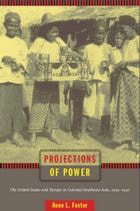
Throughout its history, the United States has been both imperialistic and anticolonial: imperialistic in its expansion across the continent and across oceans to colonies such as the Philippines, and anticolonial in its rhetoric and ideology. How did this contradiction shape its interactions with European colonists and Southeast Asians after the United States joined the ranks of colonial powers in 1898? Anne L. Foster argues that the actions of the United States functioned primarily to uphold, and even strengthen, the colonial order in Southeast Asia. The United States participated in international agreements to track and suppress the region’s communists and radical nationalists, and in economic agreements benefiting the colonial powers. Yet the American presence did not always serve colonial ends; American cultural products (including movies and consumer goods) and its economic practices (such as encouraging indigenous entrepreneurship) were appropriated by Southeast Asians for their own purposes. Scholars have rarely explored the interactions among the European colonies of Southeast Asia in the early twentieth century. Foster is the first to incorporate the United States into such an analysis. As she demonstrates, the presence of the United States as a colonial power in Southeast Asia after the First World War helps to explain the resiliency of colonialism in the region. It also highlights the inexorable and appealing changes that Southeast Asians perceived as possibilities for the region’s future.
[more]
cover of Psychiatric Contours: New African Histories of Madness

Psychiatric Contours

New African Histories of Madness

Nancy Rose Hunt and Hubertus Büschel, editors

Duke University Press, 2024

Psychiatric Contours investigates new histories of psychiatry, derangement, and agitated subjectivities in colonial and decolonizing Africa. The volume lets the multivalent term madness broaden perception, well beyond the psychiatric. Many chapters detect the mad or the psychiatric in unhinged persons, frantic collectives, and distressing situations. Others investigate individuals suffering from miscategorization. A key Foucauldian word, vivacity, illuminates how madness aligns with pathology, creativity, turbulence, and psychopolitics. The archives, patient-authored or not, speak to furies and fantasies inside asylums, colonial institutions, decolonizing missions, and slave ships. The frayed edges of politicized deliria open up the senses and optics of psychiatry’s history in Africa far beyond clinical spaces and classification. The volume also proposes fresh concepts, notably the vernacular, to suggest how to work with emic clues in a granular fashion and telescope the psychiatric within histories of madness. With chapters stretching across much of ex-British and ex-French colonial Africa, Psychiatric Contours attends to the words, autobiographies, and hallucinations of the stigmatized and afflicted as well as of the powerful. Expatriate psychiatrists with cameras, prying authorities, fearful missionaries, and colonial anthropologists enter these readings beside patients, asylums, and boarding schools via research on possession “hysteria” and schizophrenia. In brief, this book demonstrates novel ways of writing not only medical history but all subaltern and global histories.

Contributors. Hubertus Büschel, Raphaël Gallien, Matthew M. Heaton, Richard Hölzl, Nancy Rose Hunt, Richard C. Keller, Sloan Mahone, Nana Osei Quarshie, Jonathan Sadowsky, Romain Tiquet
[more]