Results by title
53 books match the query 'In art' and 6 start with p
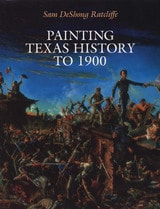
Painting Texas History to 1900
By Sam D. Ratcliffe
University of Texas Press, 1992
Certificate of Commendation, American Association for State and Local History, 1994
T. R. Fehrenbach Book Award, Texas Historical Commission, 1992
San Antonio Conservation Society Citation, 1993
Dramatic historical events have frequently provided subject matter for artists, particularly in pre-twentieth-century Texas, where works portraying historical, often legendary, events and individuals predominated. Until now, however, these paintings of Texas history have never received the kind of study given to historical, fictional, and film versions of the same events. Painting Texas History to 1900 fills this gap with an interdisciplinary approach that explores these paintings both as works of art and as historical documents.
The author examines the works of more than forty artists, including Henry McArdle, Theodore Gentilz, Robert Onderdonk, William Huddle, Frederic Remington, Friedrich Richard Petri, Arthur T. Lee, Seth Eastman, Sarah Hardinge, Frank Reaugh, W. G. M. Samuel, Carl G. von Iwonski, and Julius Stockfleth. He places each work within its historical and cultural context to show why such subject matter was chosen, why it was depicted in a particular way, and why such a depiction gained popular acceptance. For example, paintings of heroic events of the Texas Revolution were especially popular in the years following the Civil War, when, in Ratcliffe's view, Texans needed such images to assuage the loss of the war and the humiliation of Reconstruction.
Though the paintings cut across traditional art history categories—from the pictographs of early historic Indians to European-inspired oil paintings—they are bound together by their artists' intent for them to function as historically evocative documents. With their visual narratives of events that characterized all of America's westward expansion—Indian encounters, military battles, farming, ranching, surveying, and the closing of the frontier—these works add an important chapter to the story of the American West.
Performance Beyond the Pale
Meditations on Art, Activism, and Bodies in ExtremisJames M. Harding
University of Michigan Press, 2026
The metaphor “beyond the pale” refers to something that’s unacceptable and, as James M. Harding argues in this book, “almost always refers to something—an activity, an action, or an act—that is performed.” In this book, Harding recalls that historically the pale marked contested political boundaries and that what lay beyond the pale was considered to be a dangerous frontier. Siding with seemingly excessive and unreasonable acts and with the artists and activists who produce them, Harding brings together a series of ideas and performances that operate beyond the pale and asks readers to examine them on their own terms.
Drawing on political science, critical theory, and philosophy, Harding investigates instances of self-immolation, life-threatening journeys across deserts and seas, radical political hoaxes, extreme speech acts, and anti-police activism. The book’s five chapters consist of a series of meditations, each with an easily identifiable scholarly logic and clear argument, though the connections between the meditations are left up to the reader. Together these meditations urge readers to understand that “beyond the pale” acts are frequently the product of a sense of urgency that preempts the dictates of accepted reason, conventional logic, and safety.
Phantasmatic Indochina
French Colonial Ideology in Architecture, Film, and LiteraturePanivong Norindr
Duke University Press, 1996
Analyzing the first Exposition Coloniale Internationale, held in Paris in 1931, Norindr shows how the exhibition’s display of architecture gave a vision to the colonies that justified France’s cultural prejudices, while stimulating the desire for further expansionism. He critiques the Surrealist counter-exposition mounted to oppose the imperialist aims of the Exposition Coloniale, and the Surrealist incorporation and appropriation of native artifacts in avant-garde works. According to Norindr, all serious attempts at interrogating French colonial involvement in Southeast Asia are threatened by discourse, images, representations, and myths that perpetuate the luminous aura of Indochina as a place of erotic fantasies and exotic adventures. Exploring the resilience of French nostalgia for Indochina in books and movies, the author examines work by Malraux, Duras, and Claudel, and the films Indochine, The Lover, and Dien Bien Phu.
Certain to impact across a range of disciplines, Phantasmatic Indochina will be of interest to those engaged in the study of the culture and history of Vietnam, Cambodia, Thailand, and Laos, as well as specialists in the fields of French modernism, postcolonial studies, cultural studies, and comparative literature.
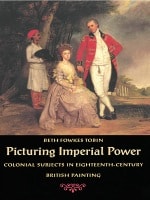
Picturing Imperial Power
Colonial Subjects in Eighteenth-Century British PaintingBeth Fowkes Tobin
Duke University Press, 1999
Informed by the varied perspectives of postcolonial theory, Tobin explores through close readings of colonial artwork the dynamic middle ground in which cultures meet. Linking specific colonial sites with larger patterns of imperial practice and policy, she examines paintings by William Hogarth, Benjamin West, Gilbert Stuart, Arthur William Devis, and Agostino Brunias, among others. These works include portraits of colonial officials, conversation pieces of British families and their servants, portraits of Native Americans and Anglo-Indians, and botanical illustrations produced by Calcutta artists for officials of the British Botanic Gardens. In addition to examining the strategies that colonizers employed to dominate and define their subjects, Tobin uncovers the tactics of negotiation, accommodation, and resistance that make up the colonized’s response to imperial authority. By focusing on the paintings’ cultural and political engagement with imperialism, she accounts for their ideological power and visual effect while arguing for their significance as agents in the colonial project.
Pointing to the complexity, variety, and contradiction within colonial art, Picturing Imperial Power contributes to an understanding of colonialism as a collection of social, economic, political, and epistemological practices that were not monolithic and inevitable, but contradictory and contingent on various historical forces. It will interest students and scholars of colonialism, imperial history, postcolonial history, art history and theory, and cultural studies.
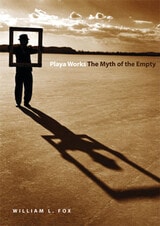
Playa Works
The Myth of the EmptyWilliam L. Fox
University of Nevada Press, 2024
In eight brilliant essays, Fox explores many of the major playas of the American West , examining locations as diverse as Nellis Air Force Base and Frenchman Flat, where the federal government has tested experimental aircraft and atomic weaponry; the Great Salt Lake Desert, where land-speed records have been broken; and the Black Rock Desert of Northern Nevada, site of the colorful Burning Man arts festival. He analyzes the geological and climatological conditions that created the playas and the historical role that playas played in the exploration and settlement of the West. And he offers lucid and keenly perceptive discussions of the ways that artists have responded to the playas, from the ancient makers of geoglyphs to the work of contemporary artists who have found inspiration in these enigmatic spaces, including earthworks builder Michael Heizer, photographer Richard Misrach, and painter Michael Moore. The ensemble is a compelling combination of natural history, philosophy, and art criticism, a thoughtful meditation on humankind's aversion to and fascination with the void.
Punctuations
How the Arts Think the PoliticalMichael J. Shapiro
Duke University Press, 2019