155 books match the query 'Indians of South America' and 6 start with p
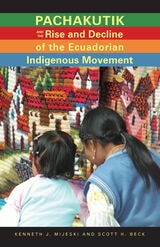
cover of Pachakutik and the Rise and Decline of the Ecuadorian Indigenous Movement

Pachakutik and the Rise and Decline of the Ecuadorian Indigenous Movement

Kenneth J. Mijeski

Ohio University Press, 2011

The mobilization of militant indigenous politics is one of the most important stories in Latin American studies today. In this critical work, Kenneth J. Mijeski and Scott H. Beck examine the rise and decline of Ecuador’s leading indigenous party, Pachakutik, as it tried to transform the state into a participative democracy.

Using in-depth interviews with political activists, as well as a powerful statistical analysis of election results, the authors show that the political election game failed to advance the causes of Ecuador’s poor or the movement’s own indigenous supporters. Pachakutik and the Rise and Decline of the Ecuadorian Indigenous Movement is an extraordinarily valuable case study of Ecuador’s indigenous movement and the challenges it still faces.
[more]
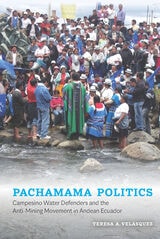
cover of Pachamama Politics: Campesino Water Defenders and the Anti-Mining Movement in Andean Ecuador

Pachamama Politics

Campesino Water Defenders and the Anti-Mining Movement in Andean Ecuador

Teresa A. Velásquez

University of Arizona Press, 2022

Ecuador became the first country in the world to grant the Pachamama, or Mother Earth, constitutional rights in 2008. This landmark achievement represented a shift to incorporate Indigenous philosophies of Sumak Kawsay or Buen Vivir (to live well) as a framework for social and political change. The extraordinary move coincided with the rise of neoextractivism, where the self-described socialist President Rafael Correa contended that Buen Vivir could be achieved through controversial mining projects on Indigenous and campesino territories, including their watersheds.

Pachamama Politics provides a rich ethnographic account of the tensions that follow from neoextractivism in the southern Ecuadorian Andes, where campesinos mobilized to defend their community-managed watershed from a proposed gold mine. Positioned as an activist-scholar, Teresa A. Velásquez takes the reader inside the movement—alongside marches, road blockades, and river and high-altitude wetlands—to expose the rifts between social movements and the “pink tide” government. When the promise of social change turns to state criminalization of water defenders, Velásquez argues that the contradictions of neoextractivism created the political conditions for campesinos to reconsider their relationship to indigeneity.

The book takes an intersectional approach to the study of anti-mining struggles and explains how campesino communities and their allies identified with and redeployed Indigenous cosmologies to defend their water as a life-sustaining entity. Pachamama Politics shows why progressive change requires a shift away from the extractive model of national development to a plurinational defense of community water systems and Indigenous peoples and their autonomy.
 
[more]
cover of Paracas Art and Architecture: Object and Context in South Coastal Peru

Paracas Art and Architecture

Object and Context in South Coastal Peru

Anne Paul

University of Iowa Press, 1991
The word "Paracas" evokes images of dazzling textiles, handsome, polychrome-crusted pottery painted with rich resin pigments, and extraordinarily thin, finely crafted monochrome pottery. These are the principal artistic manifestations of a 900-year-long cultural tradition that flourished many centuries ago on Peru's south coast.
During the past decade, an increasing number of scholars have devoted their studies to Paracas or to Paracas-related material. Paracas Art and Architecture is the first interdisciplinary collection of the current research results—historiographical, archaeological, cultural, architectural, technical, iconographic, and stylistic—of some of these path-breaking scholars. Bringing a much-needed well-roundedness to their media and data, the contributors include archaeologists, art historians, a fiber artist, and a fiber chemist, all of whose varied skills and approaches help unify our emerging view of this endlessly interesting area.
Anne Paul provides insightful notes of the social implications of the Paracas burials, while Kathryn Jakes outlines the methodology that can be used to determine patterns of textile degradation, preservation, and alteration. Through Mary Frame's meticulous analysis of the structure of Paracas headbands, abstract concepts of space, number, and order in this preliterate society are revealed.
Culture and influence are examined by Dwight Wallace, who demonstrates the Chavin culture's influence on the south coast's Carhua painted textiles, and by Sarah Massay, who provides a valuable description of late Paracas site distributions in the lower Ica Valley. Ann Peters interprets social and ecological relationships depicted on a group of textiles from Cerro Colorado on the Paracas Peninsula.
Richard Daggett gives an excellent overview of the discovery of the Paracas cemeteries, while Helaine Silverman provides insightful comments on the stylistic, cultural, and ethnic differences on the Paracas, Topará, and Nasca polities.
[more]
cover of Prehispanic Settlement Patterns in the Upper Mantaro and Tarma Drainages, Junín, Peru: The Tarama-Chinchaycocha Region, Vol. 1, Parts 1 and 2

Prehispanic Settlement Patterns in the Upper Mantaro and Tarma Drainages, Junín, Peru

The Tarama-Chinchaycocha Region, Vol. 1, Parts 1 and 2

Jeffrey R. Parsons, Charles M. Hastings, Ramiro Matos M.

University of Michigan Press, 2000
An archaeological study of ancient settlement patterns in Peru’s rugged and diverse central highlands.
[more]
cover of Prehispanic Settlement Patterns in the Upper Mantaro and Tarma Drainages, Junín, Peru: Volume 2, The Wanka Region

Prehispanic Settlement Patterns in the Upper Mantaro and Tarma Drainages, Junín, Peru

Volume 2, The Wanka Region

Edited by Jeffrey R. Parsons, Charles M. Hastings and Ramiro Matos M.

University of Michigan Press, 2000
This monograph is based on six months of systematic regional survey in the Wanka Region of Peru’s sierra central, carried out in two field seasons in 1975–1976 by the Junin Archaeological Research Project (JASP) under the co-direction of Jeffrey R. Parsons (University of Michigan) and Ramiro Matos Mendieta (Universidad Nacional Mayor de San Marcos).
[more]
cover of Prehistory of South America: Ancient Cultural Diversity on the Least Known Continent

Prehistory of South America

Ancient Cultural Diversity on the Least Known Continent

Jerry D. Moore

University Press of Colorado, 2014

A Prehistory of South America is an overview of the ancient and historic native cultures of the entire continent of South America based on the most recent archaeological investigations. This accessible, clearly written text is designed to engage undergraduate and beginning graduate students in anthropology.
 
For more than 12,000 years, South American cultures ranged from mobile hunters and gatherers to rulers and residents of colossal cities. In the process, native South American societies made advancements in agriculture and economic systems and created great works of art—in pottery, textiles, precious metals, and stone—that still awe the modern eye. Organized in broad chronological periods, A Prehistory of South America explores these diverse human achievements, emphasizing the many adaptations of peoples from a continent-wide perspective. Moore examines the archaeologies of societies across South America, from the arid deserts of the Pacific coast and the frigid Andean highlands to the humid lowlands of the Amazon Basin and the fjords of Patagonia and beyond.
 
Illustrated in full color and suitable for an educated general reader interested in the Precolumbian peoples of South America, A Prehistory of South America is a long overdue addition to the literature on South American archaeology. 
[more]