Results by title
129 books match the query 'Individual Philosophers' and 7 start with p
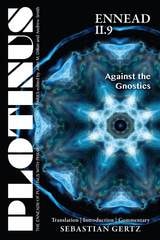
PLOTINUS Ennead II.9
Against the Gnostics: Translation, with an Introduction and CommentarySebastian Gertz
Parmenides Publishing, 2017
How was the universe created, and what is our place within it? These are the questions at the heart of Plotinus’ Against the Gnostics. For the Gnostics, the universe came into being as a result of the soul’s fall from intelligible reality—it is the evil outcome of a botched creation. Plotinus challenges this, and insists that the soul’s creation of the world is the necessary consequence of its contemplation of the ideal forms. While the Gnostics claim to despise the visible universe, Plotinus argues that such contempt displays their ignorance of the higher realities of which the cosmos is a beautiful image.
Against the Gnostics is a polemical text. It aims to show the superiority of Plotinus’ philosophy over that of his Gnostic rivals, and poses unique challenges: Plotinus nowhere identifies his opponents by name, he does not set out their doctrines in any great detail, and his arguments are frequently elliptical. The detailed commentary provides a guide through these difficulties, making Plotinus’ meandering train of thought in this important treatise accessible to the reader.
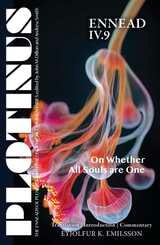
PLOTINUS Ennead IV.9
On Whether All Souls are One: Translation | Introduction | CommentaryEyjólfur K. Emilsson
Parmenides Publishing, 2026
This short, early treatise undertakes to explain the controversial thesis that all souls—this includes individual human souls and the world-soul—are in some sense just one soul. Plotinus considers a number of objections that can be raised against the thesis. For instance, if the thesis is true, it may seem to follow that that everything that holds for one soul also holds for every other soul. Plotinus seeks to explain that such objections are off the mark, which also shows that the thesis about the unity of soul is not a claim about strict identity of all souls. He then (chapter 5) considers and rejects two materialistic hypotheses about the relationship between individual souls and the world-soul. In the final chapter he presents his own solution: the individual souls and the world-soul are all the soul hypostasis. He likens the relationship between the hypostatic soul and the individual souls with that between a science and the theorems of the science: each theorem potentially contains the whole science and can in a sense be said to be it.

Perjury and Pardon, Volume I
Jacques Derrida
University of Chicago Press, 2022
“One only ever asks forgiveness for what is unforgivable.” From this contradiction begins Perjury and Pardon, a two-year series of seminars given by Jacques Derrida at the École des hautes études en sciences sociales in Paris in the late 1990s. In these sessions, Derrida focuses on the philosophical, ethical, juridical, and political stakes of the concept of responsibility. His primary goal is to develop what he calls a “problematic of lying” by studying diverse forms of betrayal: infidelity, denial, false testimony, perjury, unkept promises, desecration, sacrilege, and blasphemy.
Although forgiveness is a notion inherited from multiple traditions, the process of forgiveness eludes those traditions, disturbing the categories of knowledge, sense, history, and law that attempt to circumscribe it. Derrida insists on the unconditionality of forgiveness and shows how its complex temporality destabilizes all ideas of presence and even of subjecthood. For Derrida, forgiveness cannot be reduced to repentance, punishment, retribution, or salvation, and it is inseparable from, and haunted by, the notion of perjury. Through close readings of Kant, Kierkegaard, Shakespeare, Plato, Jankélévitch, Baudelaire, and Kafka, as well as biblical texts, Derrida explores diverse notions of the “evil” or malignancy of lying while developing a complex account of forgiveness across different traditions.
Plastic Materialities
Politics, Legality, and Metamorphosis in the Work of Catherine MalabouBrenna Bhandar and Jonathan Goldberg-Hiller, editors
Duke University Press, 2015
Contributors. Brenna Bhandar, Silvana Carotenuto, Jonathan Goldberg-Hiller, Jairus Victor Grove, Catherine Kellogg, Catherine Malabou, Renisa Mawani, Fred Moten, Alain Pottage, Michael J. Shapiro, Alberto Toscano
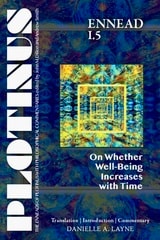
Plotinus Ennead I.5
On Whether Well-Being Increases with Time: Translation with an Introduction and CommentaryDanielle A. Layne
Parmenides Publishing, 2023

Plotinus Ennead I.8
On the Nature and Source of Evil: Translation with an Introduction and CommentaryAnne Sheppard
Parmenides Publishing, 2025

Pretexts for Writing
German Romantic Prefaces, Literature, and PhilosophyWilliams, Seán M
Bucknell University Press, 2019
Published by Bucknell University Press. Distributed worldwide by Rutgers University Press.