Results by title
130 books match the query 'Indonesia' and 5 start with p
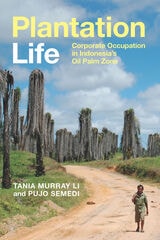
Plantation Life
Corporate Occupation in Indonesia's Oil Palm ZoneTania Murray Li and Pujo Semedi
Duke University Press, 2021
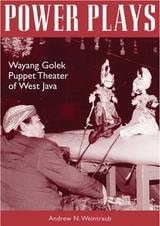
Power Plays
Wayang Golek Puppet Theater of West JavaAndrew N. Weintraub
Ohio University Press, 2004
Using interviews with performers, musical transcriptions, translations of narrative and song texts, and archival materials, author Andrew N. Weintraub analyzes the shifting and flexible nature of a set of performance practices called Padalangan, the art of the puppeteer. He focuses on “superstar” performers and the musical troupes that dominated wayang golek during the New Order political regime of former president Suharto (1966-98) and the ensuing three years of the post-Suharto period. Studies of actual performances illuminate stylistic and formal elements and situate wayang golek as a social process in Sundanese culture and society. Power Plays includes an interactive multimedia CD-ROM of wayang golek.
Power Plays shows how meanings about identity, citizenship, and community are produced through theater, music, language, and discourse. While based in ethnographic theory and methods, this book is at the center of a new synthesis emerging among ethnomusicology, anthropology, and cultural studies. Its cross-disciplinary approach will inspire researchers studying similar struggles over cultural authority and popular representation in culture and the performing arts.
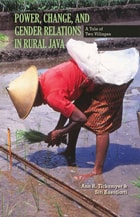
Power, Change, and Gender Relations in Rural Java
A Tale of Two VillagesAnn R. Tickamyer
Ohio University Press, 2012
Women’s status in rural Java can appear contradictory to those both inside and outside the culture. In some ways, women have high status and broad access to resources, but other situations suggest that Javanese women lack real power and autonomy. Javanese women have major responsibilities in supporting their families and controlling household finances. They may also own and manage their own property. Yet these symbols and potential sources of independence and influence are determined by a culturally prescribed, state-reinforced, patriarchal gender ideology that limits women’s autonomy. Power, Change, and Gender Relations in Rural Java examines this contradiction as well as sources of stability and change in contemporary Javanese gender relations.
The authors conducted their research in two rural villages in Yogyakarta, Indonesia, during three important historical and political periods: the end of the New Order regime; the transitional period of reformation; and the subsequent establishment of a democratic government. Their collaboration brings a unique perspective, analyzing how gender is constructed and reproduced and how power is exercised as Indonesia faces the challenges of building a new social order.
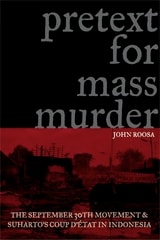
Pretext for Mass Murder
The September 30th Movement and Suharto's Coup d'Etat in IndonesiaJohn Roosa
University of Wisconsin Press, 2006
In the early morning hours of October 1, 1965, a group calling itself the September 30th Movement kidnapped and executed six generals of the Indonesian army, including its highest commander. The group claimed that it was attempting to preempt a coup, but it was quickly defeated as the senior surviving general, Haji Mohammad Suharto, drove the movement’s partisans out of Jakarta. Riding the crest of mass violence, Suharto blamed the Communist Party of Indonesia for masterminding the movement and used the emergency as a pretext for gradually eroding President Sukarno’s powers and installing himself as a ruler. Imprisoning and killing hundreds of thousands of alleged communists over the next year, Suharto remade the events of October 1, 1965 into the central event of modern Indonesian history and the cornerstone of his thirty-two-year dictatorship.
Despite its importance as a trigger for one of the twentieth century’s worst cases of mass violence, the September 30th Movement has remained shrouded in uncertainty. Who actually masterminded it? What did they hope to achieve? Why did they fail so miserably? And what was the movement’s connection to international Cold War politics? In Pretext for Mass Murder, John Roosa draws on a wealth of new primary source material to suggest a solution to the mystery behind the movement and the enabling myth of Suharto’s repressive regime. His book is a remarkable feat of historical investigation.
Finalist, Social Sciences Book Award, the International Convention of Asian Scholars
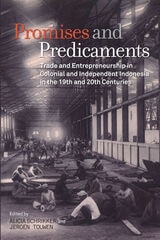
Promises and Predicaments
Trade and Entrepreneurship in Colonial and Independent Indonesia in the 19th and 20th CenturiesEdited by Alicia Schrikker and Jeroen Touwen
National University of Singapore Press, 2015
The authors deal with entrepreneurship and economic specialization within different ethnic groups, the geographical distribution of exports and resource drains from exporting regions, and connections between an export economy and mass poverty. One recurring issue is the way actors from different ethnic groups occupied complementary niches, highlighting the rich variety of roles played by Asian entrepreneurs. A study of the international sugar trade shows how regime change fostered co-operation between different ethnic groups and nationalities involved with trading networks, inter-island shipping, urban public transport, and the construction sector. A comparison of export earnings and population groups involved in trade before and after 1900 shows that unexpected agricultural and industrial transitions could underpin a fundamental shift in income growth, with improved living standards for broad sectors of the population.