167 books match the query 'Iowa' and 6 start with p

cover of Patchwork: Iowa Quilts and Quilters

Patchwork

Iowa Quilts and Quilters

Jacqueline Andre Schmeal

University of Iowa Press, 2003
Frugal, thrifty, enduring, colorful, comforting, warm. These words capture both the spirit of Iowa quilters through the centuries and the fabrics they stitched together. In Patchwork, Jacqueline Schmeal celebrates the lives of Iowa quilters and the enduring beauty of historic Iowa quilts.
Drawing on written records by and interviews with contemporary quilters, many of whom were born in the early years of the twentieth century, Schmeal presents the life histories of these hard-working yet inspired artists. Sisters Elsie Ball and Mary Ball Jay of Fairfield—charging one and a quarter cents per yard of thread—kept meticulous records of each of the 135 quilts they stitched between 1935 and 1970. Ivan Johnson plowed his fields by day and quilted vivid designs by night. Cloth scraps were so precious to Barbara Chupp, an Amish quilter, that she became known for her mosaic piecing. Members of the Sunshine Circle, organized in 1912 in a Quaker church in Earlham, still quilt together today. Mennonite quilter Sara Miller became famous nationwide for her fabric store, Kalona Kountry Kreations. Their stories—of impoverished childhoods, hardscrabble work, and strong families—are enhanced by over seventy color photographs of an unbelievably rich collection of historic quilts ranging from the early 1800s to the 1950s.
Offering both a glimpse into the daily lives of twentieth-century quiltmakers and an amazing treasury of Iowa's historic quilts, Patchwork is a loving tribute to the creative spirit that links modern-day quilters to the patterns and traditions of their predecessors.
[more]
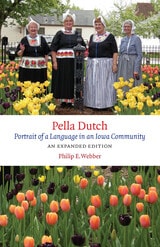
cover of Pella Dutch: Portrait of a Language in an Iowa Community, An Expanded Edition

Pella Dutch

Portrait of a Language in an Iowa Community, An Expanded Edition

Philip E. Webber

University of Iowa Press, 1988

Founded in 1847 by religious separatists, the town of Pella in central Iowa is the state’s oldest Dutch American colony, and its crafts, architecture, and celebrations reflect and perpetuate the Dutch heritage of its earlier residents. Through his intriguing blend of sociolinguistic research, regional history, and interviews with current speakers of Pella Dutch, Philip Webber examines the town’s rich cultural and linguistic traditions.
 
Drawing upon formal and informal interviews and conversations with more than 150 speakers of Pella Dutch, Webber uses the methods of language research to trace the vestiges of Dutch heritage left on the English spoken by local residents; to explain attitudes toward language and ethnicity that emerged in the twentieth century; and to document the vocabulary, linguistic forms, humor, and conversational patterns that characterize contemporary Pella Dutch. In addition, desiring to let his informants speak for themselves, he includes the playful jokes, proverbial observations, folk wisdom, children’s rhymes, riddles, and puzzles influenced by Pella Dutch.
 
Webber’s introduction to this expanded paperback edition provides new photographs, updated information about recent research and publications, examples of how Dutch continues to be spoken, and descriptions of the ways in which Pella continues to commemorate its linguistic and cultural heritage. Linguists, anthropologists, and historians—as well as all those who enjoy Pella’s Tulip Time festival, its summertime fair or kermis, the Dutch letters in its bakeries, and the early winter visit of Sinterklaas—will appreciate Webber’s informed and engaging study of this unique Iowa community.
[more]
cover of Picturing Utopia: Bertha Shambaugh and the Amana Photographers

Picturing Utopia

Bertha Shambaugh and the Amana Photographers

Abigail Foerstner

University of Iowa Press, 2005
More than a hundred years ago, Bertha Shambaugh set out to photograph the Amana Colonies, the utopian religious community twenty miles northwest of Iowa City. Following her example, several Amana members ignored their community's prohibition against photography and took up cameras to record the people and events around them. Picturing Utopia celebrates their artistic vision and offers a rare glimpse into a 19th-century religious utopia, providing an unbroken photographic record beginning with Shambaugh's work in the 1890s and continuing through the Colonies' transition to mainstream American life with the Great Change in 1932.Abigail Foerstner, whose great uncle was one of the Amana photographers included in this book, brings together this stunning collection of photographs along with the stories of the photographers who took them. Together the pictures and text fill in an untold chapter in American photographic history and provide an insider's view of life in Amana.
[more]
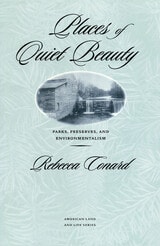
cover of Places of Quiet Beauty: Parks, Preserves, and Environmentalism

Places of Quiet Beauty

Parks, Preserves, and Environmentalism

Rebecca Conard

University of Iowa Press, 1997

Resource protection and public recreation policies have always been subject to the shifting winds of management philosophy governing both national and state parks. Somewhere in the balance, however, parks and preserves have endured as unique places of mind as well as matter. Places of Quiet Beauty allows us to see parks and preserves, forests and wildlife refuges—all those special places that the term “park” conjures up—as measures of our own commitment to caring for the environment. In this broad-ranging book, historian Rebecca Conard examines the complexity of American environmentalism in the twentieth century as manifest in Iowa's state parks and preserves.
[more]
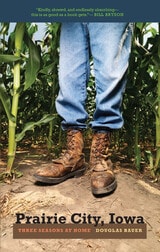
cover of Prairie City, Iowa: Three Seasons at Home

Prairie City, Iowa

Three Seasons at Home

Douglas Bauer

University of Iowa Press, 1979

Weary from the journalistic treadmill of "going from one assignment to the next, like an itinerant fieldworker moving to his harvests" and healing from a divorce, Douglas Bauer decided it was time to return to his hometown. Back in Prairie City, he helped on his father's farm, scooped grains at the Co-op, and tended bar at the Cardinal. The resultant memoir is a classic picture of an adult experiencing one's childhood roots as a grown-up and testing whether one can ever truly go home again.
    Bauer grew up "awkward with soil and with machines" in a small town east of Des Moines,  As a teenager, he left the farm for college life twenty miles away and, after graduation, took a job with Better Homes and Gardens in Des Moines, writing in the junk-mail fictional persona of "Barbara Joyce,"asking millions of people to subscribe. After a few years he  moved to Chicago to work as an editor and writer for Playboy and eventually as a freelance journalist. In the summer of 1975, he returned home to attend his grandmother's funeral and by autumn he moved back to Prairie City, where he stayed for the next three seasons.
    Bauer's book is neither a wistful nostalgia about returning to a simpler time and place nor a patronizing look at those who never leave the town in which they were born. What emerges is an unsentimental yet loving account of life in the Midwest. Not just a portrait of Prairie City, Iowa, but of everyone's small town, everywhere.
[more]
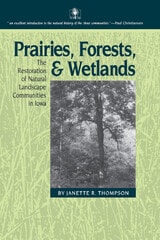
cover of Prairies Forests And Wetlands: Natural Landscape Communities

Prairies Forests And Wetlands

Natural Landscape Communities

Janette R. Thompson

University of Iowa Press, 1992

Before Euro-American settlement, graceful prairies and prairie-wetland complexes dominated Iowa's rolling landscape, with forest communities hugging rivers and streams and savannas or forests covering the southern and eastern portions of the state. During the last 150 years these original natural communities have nearly been eliminated by conversion of over 95 percent of the land to agricultural and urban uses.

This timely, practical book combines a nontechnical natural history of each native community with a how-to manual for lay restorationists dedicated to reconstructing prairies, forests, and wetlands. Thompson intelligently presents the collective experience of professionals active in restoring the splendid natural areas of Iowa and the greater Midwest—discussing site selection, site preparation, plant species, planting techniques, costs, and maintenance of restoration areas. She includes a useful list of sources for plant materials in and near Iowa as well as information on the birds and mammals, reptiles and amphibians of these landscapes. Prairies, Forests, and Wetlands will help individual landowners, farmers, landscape architects, D.O.T. engineers, teachers, botanists, county conservation boards, and wildlife area managers in their private and professional campaigns to reclaim Iowa's land.

[more]