Results by title
87 books match the query 'Iraq' and 5 start with p
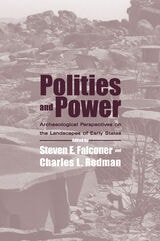
Polities and Power
Archaeological Perspectives on the Landscapes of Early StatesEdited by Steven E. Falconer and Charles L. Redman
University of Arizona Press, 2009
This distinctive book is the first to address the topic of landscape archaeology in early states from a truly global perspective. It provides an excellent introduction to—and overview of—the discipline today. The volume grew out of the Fifth Biennial Meeting of the Complex Societies Group, whose theme, States and the Landscape, paid tribute to the work of Robert McC. Adams. When Adams began publishing in the 1960s, the interdependence of cities and their countrysides, and the information revealed through the spatial patterning of communities, went largely unrecognized. Today, as this useful collection makes clear, these interpretive insights are fundamental to all archaeologists who investigate the roles of complex polities in their landscapes.
Polities and Power features detailed studies from an intentionally disparate array of regions, including Mesoamerica, Andean South America, southwestern Asia, East Africa, and the Indian subcontinent. Each chapter or pair of chapters is followed by a critical commentary. In concert, these studies strive to infer social, political, and economic meaning from archaeologically discerned landscapes associated with societies that incorporate some expression of state authority. The contributions engage a variety of themes, including the significance of landscapes as they condition and reflect complex polities; the interplay of natural and cultural elements in defining landscapes of state; archaeological landscapes as ever-dynamic entities; and archaeological landscapes as recursive structures, reflected in palimpsests of human activity.
Individually, many of these contributions are provocative, even controversial. Taken together, they reveal the contours of landscape archaeology at this particular evolutionary moment.
[more]
Post-Ethical Society
The Iraq War, Abu Ghraib, and the Moral Failure of the SecularDouglas V. Porpora, Alexander G. Nikolaev, Julia Hagemann May, and Alexander Jenkins
University of Chicago Press, 2013
We’ve all seen the images from Abu Ghraib: stress positions, US soldiers kneeling on the heads of prisoners, and dehumanizing pyramids formed from black-hooded bodies. We have watched officials elected to our highest offices defend enhanced interrogation in terms of efficacy and justify drone strikes in terms of retribution and deterrence. But the mainstream secular media rarely addresses the morality of these choices, leaving us to ask individually: Is this right?
In this singular examination of the American discourse over war and torture, Douglas V. Porpora, Alexander Nikolaev, Julia Hagemann May, and Alexander Jenkins investigate the opinion pages of American newspapers, television commentary, and online discussion groups to offer the first empirical study of the national conversation about the 2003 invasion of Iraq and the revelations of prisoner abuse at Abu Ghraib a year later. Post-Ethical Society is not just another shot fired in the ongoing culture war between conservatives and liberals, but a pensive and ethically engaged reflection of America’s feelings about itself and our actions as a nation. And while many writers and commentators have opined about our moral place in the world, the vast amount of empirical data amassed in Post-Ethical Society sets it apart—and makes its findings that much more damning.
In this singular examination of the American discourse over war and torture, Douglas V. Porpora, Alexander Nikolaev, Julia Hagemann May, and Alexander Jenkins investigate the opinion pages of American newspapers, television commentary, and online discussion groups to offer the first empirical study of the national conversation about the 2003 invasion of Iraq and the revelations of prisoner abuse at Abu Ghraib a year later. Post-Ethical Society is not just another shot fired in the ongoing culture war between conservatives and liberals, but a pensive and ethically engaged reflection of America’s feelings about itself and our actions as a nation. And while many writers and commentators have opined about our moral place in the world, the vast amount of empirical data amassed in Post-Ethical Society sets it apart—and makes its findings that much more damning.
[more]
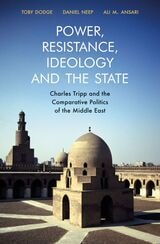
Power, Resistance, Ideology and the State
Charles Tripp and the Comparative Politics of the Middle EastEdited by Daniel Neep, Toby Dodge, and Ali M. Ansari
Gingko, 2025
A wide-ranging, innovative, and essential exploration of the politics of today’s Middle East.
Power, Resistance, Ideology and the State: Charles Tripp and the Comparative Politics of the Middle East seeks to present a new understanding of a region of unprecedented volatility, where postcolonial projects of state-driven development have now expired, old ruling elites have been delegitimized, and political Islam discredited. The work of Charles Tripp, professor at the School of Oriental and African Studies (SOAS) for over three decades, has shaped a distinct approach to the study of Middle East politics with an analytical sensibility that is empirically rich, theoretically insightful, and historically sensitive. This volume brings together contributions from ten political scientists and historians from across Europe, the United States, and the Middle East, each of which takes Tripp’s work as an intellectual point of departure for studying Middle East politics.
Against this background, the contributors explore the contemporary developments that have emerged to fill the intellectual and material shortcomings created by the systemic failures of economics and politics in the region.
The contributions focus on four themes that are central to an understanding of Middle East politics—power, resistance, ideology, and the state—to examine political trends in cases ranging from Iran and Iraq to Jordan, Lebanon, and Syria. Each chapter combines extensive field research and a knowledge of regional politics with methodological and philosophical reflexivity to produce a collection of papers at the cutting edge of contemporary Middle East Studies.
[more]
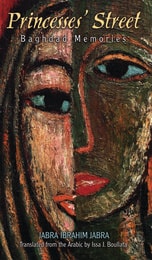
Princesses' Street
Baghdad MemoriesJabra Ibrahim Jabra
University of Arkansas Press, 2005
This book continues the personal story of Jabra Ibrahim Jabra (1920–1994) that began with The First Well: A Bethlehem Boyhood. Jabra was one of the Middle East’s leading novelists, poets, critics, painters, and translators (he was the first to translate The Sound and the Fury into Arabic), and is the writer who is given credit for modernizing the Arabic novel. This book not only helps us understand Jabra as a writer and human being but also his times in post–World War II Baghdad when Iraq was enjoying an unprecedented period of creativity in literature and the arts. As a bright and inquisitive young man he became friends with the archeologist Max Mallowan and his wife, who, he later learned, was Agatha Christie (she wrote The Mousetrap during this period, in a little mud brick room). Jabra’s intellectual autobiography quickly developed as he traveled to Jerusalem, Oxford, and Harvard University, where he studied with I. A. Richards and Archibald MacLeish. A number of different teaching posts in Baghdad provided him opportunities to become friends with many leading poets, such as Buland al-Haydari and Tawfiq Sayigh; historians like George Antonius; and the renowned translators of Arabic literature Desmond Stewart and Denys Johnson-Davies. But this book is not only about matters of the mind, it is about matters of the heart as well. Jabra beautifully describes his lengthy love affair with a young Muslim woman, the beautiful Lamica, whom he first met near Princesses’ Street and whom he eventually married. He recounts all of the difficulties they had to surmount, and the pleasures to be had. This is the last book that Jabra published during his lifetime. Not only is Jabra’s life an outstanding example of the circumstances—and fate—of the Palestinian in the twentieth century, but it also provides countless interesting insights into the cultural life of the Middle East in general and its modes of interconnection with the West.
[more]
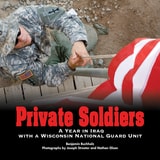
Private Soldiers
A Year in Iraq with a Wisconsin National Guard UnitBenjamin Buchholz
Wisconsin Historical Society Press, 2007
In April 2005 they received the official alert: The Wisconsin Army National Guard's 2-127th Infantry Battalion was being mobilized. After training at Camp Shelby, Mississippi, the 620 soldiers of the Gator Battalion would serve in Operation Iraqi Freedom, providing armed convoy escort and route security throughout all of Iraq, from Umm Qasr in the south to Mosul in the far north. Their mission would take them into the most dangerous regions of Iraq, and during the next year the battalion would withstand hundreds of attacks, see dozens wounded, and lose three members killed in action.
Private Soldiers chronicles the 2-127th's year-long deployment from the unique perspective of the soldiers themselves. Written and photographed by three battalion members, the book provides a rare first-hand account of war and life in Iraq. Fascinating soldier interviews reveal the effects of deployment on the troops and on their families back home, and interviews with Iraqi civilians describe the Iraqis' perceptions of life, war, and working alongside Wisconsin troops. Brilliant photography illuminates the 2-127th's year, from training to "boots on the ground" to their return home. And candid photos taken by battalion members capture the soldiers' day-to-day lives and camaraderie.
An extremely timely and relevant account of soldiers' lives, Private Soldiers honors Wisconsin's participants in the Iraq war and helps readers understand the war's human side.
All royalties from sales of Private Soldiers will go to the 2-127th's family support groups and to funds established in memoriam of the battalion members who gave their lives in the Iraq war.
[more]