Results by title
54 books match the query 'Islamic Studies' and 3 start with p
Pakistan’s Blasphemy Laws
From Islamic Empires to the TalibanBy Shemeem Burney Abbas
University of Texas Press, 2013
Under the guise of Islamic law, the prophet Muhammad’s Islam, and the Qur’an, states such as Pakistan, Afghanistan, Egypt, Saudi Arabia, and Bangladesh are using blasphemy laws to suppress freedom of speech. Yet the Prophet never tried or executed anyone for blasphemy, nor does the Qur’an authorize the practice. Asserting that blasphemy laws are neither Islamic nor Qur‘anic, Shemeem Burney Abbas traces the evolution of these laws from the Islamic empires that followed the death of the Prophet Muhammad to the present-day Taliban. Her pathfinding study on the shari’a and gender demonstrates that Pakistan’s blasphemy laws are the inventions of a military state that manipulates discourse in the name of Islam to exclude minorities, women, free thinkers, and even children from the rights of citizenship.
Abbas herself was persecuted under Pakistan’s blasphemy laws, so she writes from both personal experience and years of scholarly study. Her analysis exposes the questionable motives behind Pakistan’s blasphemy laws, which were resurrected during General Zia-ul-Haq’s regime of 1977–1988—motives that encompassed gaining geopolitical control of the region, including Afghanistan, in order to weaken the Soviet Union. Abbas argues that these laws created a state-sponsored “infidel” ideology that now affects global security as militant groups such as the Taliban justify violence against all “infidels” who do not subscribe to their interpretation of Islam. She builds a strong case for the suspension of Pakistan’s blasphemy laws and for a return to the Prophet’s peaceful vision of social justice.
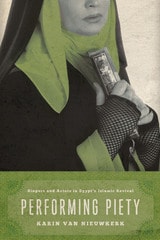
Performing Piety
Singers and Actors in Egypt's Islamic RevivalBy Karin van Nieuwkerk
University of Texas Press, 2013
In the 1980s, Egypt witnessed a growing revival of religiosity among large sectors of the population, including artists. Many pious stars retired from art, “repented” from “sinful” activities, and dedicated themselves to worship, preaching, and charity. Their public conversions were influential in spreading piety to the Egyptian upper class during the 1990s, which in turn enabled the development of pious markets for leisure and art, thus facilitating the return of artists as veiled actresses or religiously committed performers.
Revisiting the story she began in “A Trade like Any Other”: Female Singers and Dancers in Egypt, Karin van Nieuwkerk draws on extensive fieldwork among performers to offer a unique history of the religious revival in Egypt through the lens of the performing arts. She highlights the narratives of celebrities who retired in the 1980s and early 1990s, including their spiritual journeys and their influence on the “pietization” of their fans, among whom are the wealthy, relatively secular, strata of Egyptian society. Van Nieuwkerk then turns to the emergence of a polemic public sphere in which secularists and Islamists debated Islam, art, and gender in the 1990s. Finally, she analyzes the Islamist project of “art with a mission” and the development of Islamic aesthetics, questioning whether the outcome has been to Islamize popular art or rather to popularize Islam. The result is an intimate thirty-year history of two spheres that have tremendous importance for Egypt—art production and piety.
Privately Empowered
Expressing Feminism in Islam in Northern Nigerian FictionShirin Edwin
Northwestern University Press, 2016