92 books match the query 'Judges' and 11 start with p
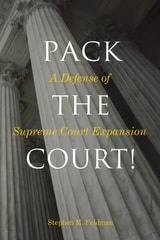
cover of Pack the Court!: A Defense of Supreme Court Expansion

Pack the Court!

A Defense of Supreme Court Expansion

Stephen M. Feldman

Temple University Press, 2021

The United States Supreme Court has numbered nine justices for the past 150 years. But that number is not fixed. With the Democrats controlling the House and Senate during the Biden presidency, they could add justices to the Supreme Court. But would court packing destroy the Court as an apolitical judicial institution? This is the crucial question Stephen Feldman addresses in his provocative book, Pack the Court! He uses a historical, analytical, and political argument to justify court-packing in general and Democratic court-packing more specifically.

Republicans and Democrats alike profess to worry that court-packing will destroy the legitimacy of the Supreme Court as a judicial institution by injecting politics into a purely legal adjudicative process. But as Feldman’s insightful book shows, law and politics are forever connected in judicial interpretation and decision making. Pack the Court! insists that court packing is not the threat to the Supreme Court’s institutional legitimacy that many fear. Given this, Feldman argues that Democrats should pack the Court while they have the opportunity. Doing so might even strengthen the American people’s faith in the Court.
[more]
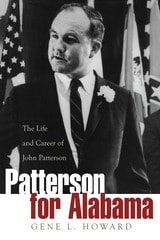
cover of Patterson for Alabama: The Life and Career of John Patterson

Patterson for Alabama

The Life and Career of John Patterson

Gene Howard

University of Alabama Press, 2013
John Patterson, Alabama governor from 1959 to 1963, was thrust into the Alabama political arena after the brutal murder of his father, attorney general Albert Patterson in 1954. Allowed by the Democratic Party to take his father’s place and to complete the elder’s goal of cleaning up corruption in his hometown Phenix City, Patterson made a young, attractive, and sympathetic candidate. Patterson for Alabama details his efforts to clean up his hometown, oppose corruption in the administration of Governor Big Jim Folsom, and to resist school desegregation. Popular on all three counts, Patterson went on to defeat rising populist George Wallace for governor.
 
Patterson’s term as governor was marked by rising violence as segregationists violently resisted integration.  His role as a champion of resistance has clouded his reputation to this day. Patterson left office with little to show for f his efforts and opposed for one reason or another by nearly all sectors of Alabama. Stymied in efforts to reclaim the governorship or a seat on the Alabama state Supreme Court, Patterson was appointed by Wallace to the state court of criminal appeals in 1984 and served on that body until retiring in 1997. In 2004, he served as one of the justices who removed the Chief Justice of the Alabama Supreme Court Roy Moore for ignoring a federal court order.
[more]
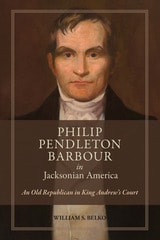
cover of Philip Pendleton Barbour in Jacksonian America: An Old Republican in King Andrew’s Court

Philip Pendleton Barbour in Jacksonian America

An Old Republican in King Andrew’s Court

William S. Belko

University of Alabama Press, 2016

William S. Belko’s Philip Pendleton Barbour in Jacksonian America provides the first comprehensive biography of a pivotal yet nearly forgotten statesman who made numerous key contributions to a transformative period of early American history.
 
Barbour, a Virginia lawyer, participated in America’s transition from a mostly republican government to a truer majority democracy, notably while serving as the twelfth Speaker of the United States House of Representatives and later as an associate justice of the United States Supreme Court. After being elected to the US Congress during the War of 1812, Barbour also emerged as one of the foremost champions of states’ rights, consistently and energetically fighting against expansions of federal powers. He, along with other Jeffersonian Old Republicans, opposed federal plans for a national tariff and internal improvements. Later, Barbour became one of the first Jeffersonian politicians to join the Jacksonian Democrats in Jackson’s war against a national bank.
 
Barbour continued to make crucial strides in support of states’ rights after taking his seat on the United States Supreme Court in 1836 under Chief Justice Roger Taney. He contributed to the Charles River Bridge v. Warren Bridge and Briscoe v. Bank of Kentucky decisions, which bolstered states’ rights. He also delivered the opinion of the court in New York v. Miln, which provided the basis for the State Police Powers Doctrine.
 
Expertly interweaving biography, history, political science, and jurisprudence, Philip Pendleton Barbour in Jacksonian America remembers the man whose personal life and career were emblematic of the decades in which the United States moved from the Age of Jefferson to the Age of Jackson, contributing to developments that continue to animate American politics today. 
[more]
cover of Plea Bargaining: The Experiences of Prosecutors, Judges, and Defense Attorneys

Plea Bargaining

The Experiences of Prosecutors, Judges, and Defense Attorneys

Milton Heumann

University of Chicago Press, 1978
"That relatively few criminal cases in this country are resolved by full Perry Mason-style strials is fairly common knowledge. Most cases are settled by a guilty plea after some form of negotiation over the charge or sentence. But why? The standard explanation is case pressure: the enormous volume of criminal cases, to be processed with limited staff, time and resources. . . . But a large body of new empirical research now demands that we re-examine plea negotiation. Milton Heumann's book, Plea Bargaining, strongly and explicitly attacks the case-pressure argument and suggests an alternative explanation for plea bargaining based on the adaptation of attorneys and judges to the local criminal court. The book is a significant and welcome addition to the literature. Heumann's investigation of case pressure and plea negotiation demonstrates solid research and careful analysis."—Michigan Law Review
[more]
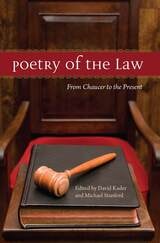
cover of Poetry of the Law: From Chaucer to the Present

Poetry of the Law

From Chaucer to the Present

David Kader

University of Iowa Press, 2010

Since the time of Blackstone's "Farewell," poetry has been seen as celestial, pastoral, solitary, and mellifluous; law as venerable, social, urban, and cacophonous. This perception has persisted even to the present, with the bourgeoning field of law and literature focusing almost exclusively on fiction and drama. Poetry of the Law, however, reveals the richness of poetry about the law.

Poetry of the Law is the first serious anthology of law-related poetry ever published in the United States. As the editors make clear, though, serious need not imply solemn. Instead, David Kader and Michael Stanford have assembled a surprisingly capacious collection of 100 poems from the 1300s to the present.

Set in courtrooms, lawyers’ offices, law-school classrooms, and judges’ chambers; peopled with attorneys, the imprisoned (both innocent and guilty), judges, jurors, witnesses, and law-enforcement officers; based on real events (think “Scottsboro”) or exploring the complexity of abstract legal ideas; the poems celebrate justice or decry the lack of it, ranging in tone from witty to wry, sad to celebratory, funny to infuriating. Poetry of the Law is destined to become an authoritative source for years to come.

 
Contributors Include:

W. H. Auden

Robert Burns

Lewis Carroll

John Ciardi

Daniel Defoe

Emily Dickinson

John Donne

Rita Dove

Ralph Waldo Emerson

Martín Espada

Thomas Hardy

Seamus Heaney

A. E. Housman

Langston Hughes

Ben Jonson

X. J. Kennedy

Yusef Komunyakaa

Ted Kooser

D. H. Lawrence

Edgar Lee Masters

W. S. Merwin

Edna St. Vincent Millay

Sir Walter Raleigh

Muriel Rukeyser

Carl Sandburg

William Shakespeare

Jonathan Swift

Mona Van Duyn

Oscar Wilde

William Carlos Williams

from “The Hanging Judge” by Eavan Boland

Come to the country where justice is seen to be done,

Done daily. Come to the country where

Sentence is passed by word of mouth and raw

Boys split like infinitives. Look, here

We hanged our son, our only son

And hang him still and still we call it law.

[more]
cover of Poets and Murder: A Judge Dee Mystery

Poets and Murder

A Judge Dee Mystery

Robert van Gulik

University of Chicago Press, 1968

A double murder confounds everyone in this mystery--but not the beloved detective Judge Dee, whom the Los Angeles Times ranked with Sherlock Holmes

Judge Dee, the master detective of seventh-century China, sets out to solve a puzzling double murder and discovers complex passions lurking beneath the placid surface of academic life. A mild-mannered student is rumored to have been slain by a fox-demon, while a young dancer meets her death as she dresses to perform for the magistrate's illustrious dinner guests—an obese Zen monk revered for his calligraphy, a beautiful poetess accused of murder, and the past president of the imperial academy. To connect the present crimes with betrayals and adulteries from decades past, the clever judge must visit a high-class brothel and the haunted shrine of the Black Fox. From the moment the young scholar is found dead on the eve of the Autumn Festival, the pace never lets up.
[more]
cover of Politicians, Judges, and City Schools: Reforming School Finance in New York

Politicians, Judges, and City Schools

Reforming School Finance in New York

Joel S. Berke

Russell Sage Foundation, 1984
During the 1970s, a nationwide school finance reform movement—fueled by litigation challenging the constitutionality of state education funding laws—brought significant changes to the way many states finance their public elementary and secondary school systems. School finance reform poses difficult philosophical questions: what is the meaning of equality in educational opportunity and of equity in the distribution of tax burdens? But it also involves enormous financial complexity (for example, dividing resources among competing special programs) and political risk (such as balancing local control with the need for statewide parity). For those states (like New York) that were slow to make changes a new decade has brought new constraints and complications. Sluggish economic growth, taxpayer revolts, reductions in federal aid, all affect education revenues. And the current concern with educational excellence may obscure the needs of the poor and educationally disadvantaged. This book will provide New York's policy makers and other concerned specialists with a better understanding of the political, economic, and equity issues underlying the school finance reform debate. It details existing inequities, evaluates current financing formulas, and presents options for change. Most important, for all those concerned with education and public policy in New York and elsewhere, it offers a masterful assessment of the trade-offs involved in developing reform programs that balance the conflicting demands of resource equalization, political feasibility, and fiscal responsibility. "Synthesizes the political and fiscal research [on school finance reform] and applies it to the New York Context....A blueprint for how to redesign state school finance....A fine book." —Public Administration Review "This is a book that lucidly discusses the issues in school finance and provides valuable reference material." —American Political Science Review
[more]
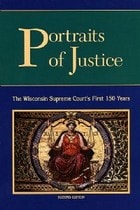
cover of Portraits of Justice: The Wisconsin Supreme Court's First 150 Years

Portraits of Justice

The Wisconsin Supreme Court's First 150 Years

Trina E. Gray

Wisconsin Historical Society Press, 2003
First published in 1998 to commemorate the sesquicentennial of Wisconsin statehood, this book has been updated to mark the Wisconsin Supreme Court's 150th anniversary and the 125th anniversary of the State Bar of Wisconsin, both celebrated in 2003. It contains profiles of all those who have served as Wisconsin Supreme Court justices and a new introduction by Chief Justice Abrahamson summarizing the court's history and its vision for the future. This book is an excellent reference for students, attorneys, and all interested in the state's legal history.
[more]
cover of Postclassical Greek and Septuagint Lexicography

Postclassical Greek and Septuagint Lexicography

William A. Ross

SBL Press, 2022
A long-standing tradition within biblical scholarship sets the Greek text of the Septuagint constantly in relationship with its supposed Hebrew or Aramaic Vorlage, examining the two together in terms of their grammatical alignment as a standard. Yet another tradition frames the discussion in different terms, preferring instead to address the Septuagint first of all in light of its contemporary Greek linguistic environment and only then attempting to describe its language and style as a text. It is this latter approach that William A. Ross employs in this textually based study of the Greek versions of Judges, a so-called double text in the textual history of the Septuagint. The results of his study offer a window into the Old Greek translation and its later revision, two distinct stages of Greek Judges with numerous instances of divergent vocabulary choices that reflect deliberateness in both the original selection and the subsequent change within the textual development of the book. Ross’s study illustrates the practicalities and payoff of a Greek-oriented lexicographical method that situates the language of the Septuagint squarely within its contemporary historical and linguistic context.

[more]
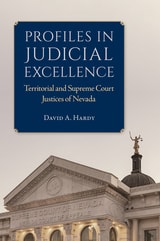
cover of Profiles in Judicial Excellence: Territorial and Supreme Court Justices of Nevada

Profiles in Judicial Excellence

Territorial and Supreme Court Justices of Nevada

David A. Hardy

University of Nevada Press, 2025

The Nevada judiciary began with territorial judges appointed by President Abraham Lincoln and transitioned to elected judges after statehood in 1864. The courts officiated by these judges have influenced the evolution of Nevada from a territory created in the chaos of mining litigation; through the expansion of divorce, gaming, and tourism jurisprudence; to what is now a vibrant venue for commercial development and corporate law. Along the way, the state’s judges weighed in on issues of civil liberties, water rights, personal injury, and a variety of other legal subjects affecting all Nevada citizens. The collective work of these courts has solidified the rule of law and allowed Nevadans to live peacefully.

Until the publication of Judge David A. Hardy’s Profiles in Judicial Excellence: Territorial and Supreme Court Justices of Nevada, there has been no single source containing biographies of these influential figures from the state’s history from 1861 to 1997. Hardy curates various sources and presents profiles of these judges in sequential order of their service. He also examines the influence of territorial judges in the 1864 vote for statehood. The Nevada judiciary has played an integral, but often unrecognized, role in shaping the unique character of the Silver State.
 
[more]
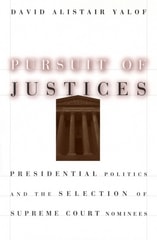
cover of Pursuit of Justices: Presidential Politics and the Selection of Supreme Court Nominees

Pursuit of Justices

Presidential Politics and the Selection of Supreme Court Nominees

David Alistair Yalof

University of Chicago Press, 1999

Although the Senate confirmation of Supreme Court nominees is the most public part of the nomination process, the most critical phase—the initial selection of nominees—is usually hidden from view. In Pursuit of Justices, David Yalof takes the reader behind the scenes of what happens before the Senate hearings to show how presidents go about deciding who will sit on the highest court in the land. As Yalof shows, an intricate web of forces—competing factions within the executive branch, organized interests, and the president's close associates—all vie for influence during this phase of presidential decisionmaking.

Yalof draws on the papers of seven modern presidents, from Truman to Reagan, and firsthand interviews with key figures, such as Ramsey Clark, Edwin Meese, and President Gerald Ford. He documents and analyzes the selection criteria these presidents used, the pool of candidates from which they chose, their strategies, and the political pressures affecting their decisions, both successes and failures. Yalof also disputes much conventional wisdom about the selection process, including the widely held view that presidents choose nominees primarily to influence future decisions of the high court. In a substantial epilogue, Yalof offers insightful observations about the selections of Presidents George Bush and Bill Clinton.

By focusing on a neglected area of presidential politics, Yalof offers a fascinating and unprecedented glimpse into the intricate world of executive branch decisionmaking and the Supreme Court appointment process as a whole.
Winner of the 2000 Richard E. Neustadt Award for Best Book on the American Presidency
[more]