Results by title
50 books match the query 'Justice, Administration of' and 4 start with p

Papal Justice
Subjects and Courts in the Papal State, 1500-1750Irene Fosi
Catholic University of America Press, 2011
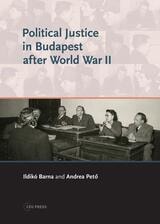
Political Justice in Budapest after World War II
Andrea Peto
Central European University Press, 2015
In Hungary, which fell under Soviet influence at the end of World War II, those who had participated in the wartime atrocities were tried by so called people’s courts. This book analyses this process in an objective, quantitative way, contributing to the present timely discussion on the Hungarian war guilt. The authors apply a special focus on the gender aspect of the trials.
Political justice had a specific nature in Hungary. War criminals began to be brought to trial while fighting was still underway in the western part of the country, well before the Nuremberg trials. Not only crimes committed during the war were tried in the same frame but also post-war ones. As far as the post-war period is concerned, legal proceedings regarding these crimes were most often launched on the basis of Act VII of 1946. This act of law concerned “the criminal law protection of the democratic constitutional order and the republic” and its basic aim was to facilitate the creation of a communist dictatorship and to deal with perceived or real enemies of the regime.
Provisional Authority
Police, Order, and Security in IndiaBeatrice Jauregui
University of Chicago Press, 2016
Jauregui explores the paradoxical demands placed on Indian police, who are at once routinely charged with abuses of authority at the same time that they are asked to extend that authority into any number of both official and unofficial tasks. Her ethnography of their everyday life and work demonstrates that police authority is provisional in several senses: shifting across time and space, subject to the availability and movement of resources, and dependent upon shared moral codes and relentless instrumental demands. In the end, she shows that police authority in India is not simply a vulgar manifestation of raw power or the violence of law but, rather, a contingent and volatile social resource relied upon in different ways to help realize human needs and desires in a pluralistic, postcolonial democracy.
Provocative and compelling, Provisional Authority provides a rare and disquieting look inside the world of police in India, and shines critical light on an institution fraught with moral, legal and political contradictions.
Pursuing Justice in Africa
Competing Imaginaries and Contested PracticesJessica Johnson
Ohio University Press, 2018
Pursuing Justice in Africa focuses on the many actors pursuing many visions of justice across the African continent—their aspirations, divergent practices, and articulations of international and vernacular idioms of justice. The essays selected by editors Jessica Johnson and George Hamandishe Karekwaivanane engage with topics at the cutting edge of contemporary scholarship across a wide range of disciplines. These include activism, land tenure, international legal institutions, and postconflict reconciliation.
Building on recent work in sociolegal studies that foregrounds justice over and above concepts such as human rights and legal pluralism, the contributors grapple with alternative approaches to the concept of justice and its relationships with law, morality, and rights. While the chapters are grounded in local experiences, they also attend to the ways in which national and international actors and processes influence, for better or worse, local experiences and understandings of justice. The result is a timely and original addition to scholarship on a topic of major scholarly and pragmatic interest.
Contributors:
Felicitas Becker, Jonathon L. Earle, Patrick Hoenig, Stacey Hynd, Fred Nyongesa Ikanda, Ngeyi Ruth Kanyongolo, Anna Macdonald, Bernadette Malunga, Alan Msosa, Benson A. Mulemi, Holly Porter, Duncan Scott, Olaf Zenker.