Results by title
301 books match the query 'Knowledge' and 10 start with p
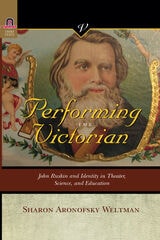
PERFORMING THE VICTORIAN
JOHN RUSKIN AND IDENTITY IN THEATER, SCIENCE, AND EDUCATIONSHARON ARONOFSKY WELTMAN
The Ohio State University Press, 2007
Performing the Victorian: John Ruskin and Identity in Theater, Science, and Education by Sharon Aronofsky Weltman is the first book to examine Ruskin’s writing on theater.
In works as celebrated as Modern Painters and obscure as Love’s Meinie, Ruskin uses his voracious attendance at the theater to illustrate points about social justice, aesthetic practice, and epistemology. Opera, Shakespeare, pantomime, French comedies, juggling acts, and dance prompt his fascination with performed identities that cross boundaries of gender, race, nation, and species. These theatrical examples also reveal the primacy of performance to his understanding of science and education.
In addition to Ruskin on theater, Performing the Victorian interprets recent theater portraying Ruskin (The Invention of Love, The Countess, the opera Modern Painters) as merely a Victorian prude or pedophile against which contemporary culture defines itself. These theatrical depictions may be compared to concurrent plays about Ruskin’s friend and student Oscar Wilde (Gross Indecency: The Three Trials of Oscar Wilde, The Judas Kiss). Like Ruskin, Wilde is misrepresented on the fin-de-millennial stage, in his case anachronistically as an icon of homosexual identity. These recent characterizations offer a set of static identity labels that constrain contemporary audiences more rigidly than the mercurial selves conjured in the prose of either Ruskin or Wilde.
[more]
Pharmocracy
Value, Politics, and Knowledge in Global BiomedicineKaushik Sunder Rajan
Duke University Press, 2017
Continuing his pioneering theoretical explorations into the relationships among biosciences, the market, and political economy, Kaushik Sunder Rajan introduces the concept of pharmocracy to explain the structure and operation of the global hegemony of the multinational pharmaceutical industry. He reveals pharmocracy's logic in two case studies from contemporary India: the controversial introduction of an HPV vaccine in 2010, and the Indian Patent Office's denial of a patent for an anticancer drug in 2006 and ensuing legal battles. In each instance health was appropriated by capital and transformed from an embodied state of well-being into an abstract category made subject to capital's interests. These cases demonstrate the precarious situation in which pharmocracy places democracy, as India's accommodation of global pharmaceutical regulatory frameworks pits the interests of its citizens against those of international capital. Sunder Rajan's insights into this dynamic make clear the high stakes of pharmocracy's intersection with health, politics, and democracy.
[more]
Poe's Critical Theory
THE MAJOR DOCUMENTSEdgar Allan Poe
University of Illinois Press, 2007
Edgar Allan Poe’s reputation as an enduring and influential American literary critic rests mainly upon the pieces in this edition. Editors Stuart Levine and Susan F. Levine provide reading texts, detailed explanatory footnotes, variant readings, and introductions to show context. They also face frankly the contradictions in Poe’s critical dicta. Poetry is for pleasure, not truth, Poe says, but argues that poetic inspiration leads to truth. Great works, Poe says, result from studied calculation, but also from irrational, supernal sources. Both biting critic and doughty defender of American artistic achievement, Poe was contemptuous of democratic art, except when he manned the barricades in its defense. Critical Theory highlights such conflicting ideas and suggests why they are present.
This edition shows that what is consistent in Poe is not any single theory. Rather, always present are wit, playfulness, concern for the strong effect, a bin of recyclable allusions, anecdotes and quotations, and a writer’s discipline. His writing on theory is of a piece with his fiction, poetry, and journalism. The Levines explain how these pieces also tie in tightly to the social, political, economic, and technological history of the world in which Poe lived.
This edition shows that what is consistent in Poe is not any single theory. Rather, always present are wit, playfulness, concern for the strong effect, a bin of recyclable allusions, anecdotes and quotations, and a writer’s discipline. His writing on theory is of a piece with his fiction, poetry, and journalism. The Levines explain how these pieces also tie in tightly to the social, political, economic, and technological history of the world in which Poe lived.
[more]
Poe, Fuller, and the Mesmeric Arts
Transition States in the American RenaissanceBruce Mills
University of Missouri Press, 2005
In Poe, Fuller, and the Mesmeric Arts, Bruce Mills examines how the writings of Edgar Allan Poe and Margaret Fuller draw from representations of and theories concerning animal magnetism, somnambulism, or hypnosis rendered in newspapers, literary and medical journals, pamphlets, and books. Although some recent studies have begun to consider the relevance of animal magnetism or mesmerism to nineteenth-century literature and culture, this book moves more deeply into what might be termed the canon of mesmeric study.
Through the works of Poe and Fuller, Mills argues, we can more fully understand the era’s response to dynamic cultural forces. Rather than simply using “American” subject matter as demanded in early calls for a national literature, Poe and Fuller, as well as Lydia Maria Child and Walt Whitman, increasingly rooted their epistemology and literary forms in psychological findings that accommodated the fluidity of democratic realities and principles.
For many influential writers of the period, then, the call for a national literature had evolved into attention to the state of one’s own mind, to those manifestations of the highest states of mind, and to the effects of literary choices on readers’ psychological states. In the history and philosophy of mesmeric consciousness, Poe, Fuller, and others discerned those principles that offered the promise of answering a central question: how does one create an aesthetic that effectively explores, accommodates, and fosters the harmonious interplay of transition states in a democratic culture?
Given its content and approach, Poe, Fuller, and the Mesmeric Arts should evoke interest among Poe and Fuller scholars as well as teachers, students, and historians intent upon understanding the emerging democratic sensibilities of the American Renaissance.
[more]
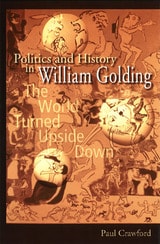
Politics and History in William Golding
The World Turned Upside DownPaul Crawford
University of Missouri Press, 2002
Politics and History in William Golding provides a much needed politicized and historicized reading of William Golding’s novels as a counter to previous, universalizing criticism. Paul Crawford argues that an understanding of fantastic and carnivalesque modes in Golding’s work is vital if we are to appreciate fully his interrogation of twentieth-century life.
Golding’s early satirical novels question English constructions of national identity in opposition to Nazism and the “totalitarian personality.” For Crawford, Golding can and must be studied in the wider European tradition of “literature of atrocity.” His early novels, especially Lord of the Flies, are preoccupied with atrocity, whereas the later work betrays a greater concern for the status of language and literature.
In Golding’s later fiction, such as Darkness Visible, the fantastic and carnivalesque are used in an increasingly nonsatirical manner to complement first modernist and then postmodernist self-consciousness and indeterminacy. Even his critique of class and religious authority, which carries through all of his fiction, gives way to more lighthearted productions—a symptom of which is his crude, absurd attack against the English literary industry in The Paper Men. This reduction of satire marks a decline in Golding’s political commitment and the production of more complex and arguably less satisfying novels.
The fantastic and carnivalesque are foundational to both the satirical and nonsatirical approaches that mark Golding’s early and late fiction. No previous study has analyzed this structure that is so central to his work. Politics and History in William Golding examines this writer’s work more fully than it has been studied within the convoluted context of the last half of the twentieth century. Crawford directly links Golding’s various deployments of the fantastic and carnivalesque to historical, political, and social change.
[more]
Politics and Scholarship
Feminist Academic Journals and the Production of KnowledgePatrice McDermott
University of Illinois Press, 1994
"Well argued and documented, Politics and Scholarship is a fascinating reading of a broader historical perspective of feminist concerns than just the three journals of focus: Feminist Studies, Frontiers, and Signs. The author's historical framework establishes an important overview that should have greater visibility."
-- J'nana Morse Sellery, coauthor of Elizabeth Bowen: A Bibliography
-- J'nana Morse Sellery, coauthor of Elizabeth Bowen: A Bibliography
[more]
Pound in Purgatory
From Economic Radicalism to Anti-SemitismLeon Surette
University of Illinois Press, 1999
Pound in Purgatory, available now in paperback, overturns all previous explanations of Ezra Pound's anti-Semitism by uncovering its roots in economic and conspiracy theory. Leon Surette demonstrates that, contrary to popular opinion, Pound was not a life-long anti-Semite and consistently ignored or resisted anti-Semitic comments from his correspondents until after 1931.
From 1931 to 1945 Pound's poetry took a back seat to his activities as an economic reformer and propagandist for the corporate state. Pound believed he had a simple and practical solution for the economic woes of the world brought on by the Great Depression, and he became increasingly preoccupied with capturing political power for the economic reform he envisioned.
As the world spiraled toward war, Pound's program of economic reform foundered and he gradually succumbed to a paranoid belief in a Jewish conspiracy. Through an incisive analysis of Pound's correspondence and writings, much of it previously unexamined, Surette shows how this belief fostered the virulent anti-Semitism that pervades his work-–both poetry and prose-–from this time forward.
[more]
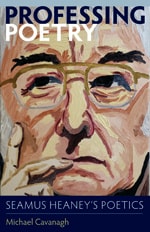
Professing Poetry
Seamus Heaney’s PoeticsMichael Cavanagh
Catholic University of America Press, 2009
The first full-length study of Heaney's poetics, Professing Poetry explores Heaney's unusual concept of influence and the various ways in which Heaney interacts with other writers
[more]
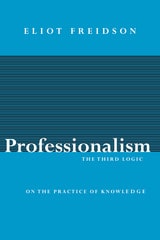
Professionalism, the Third Logic
On the Practice of KnowledgeEliot Freidson
University of Chicago Press, 2021
This new work explores the meaning and implications of professionalism as a form of social organization. Eliot Freidson formalizes professionalism by treating it as an ideal type grounded in the political economy; he presents the concept as a third logic, or a more viable alternative to consumerism and bureaucracy. He asks us to imagine a world where workers with specialized knowledge and the ability to provide society with especially important services can organize and control their own work, without directives from management or the influence of free markets.
Freidson then appraises the present status of professionalism, exploring how traditional and national variations in state policy and organization are influencing the power and practice of such professions as medicine and law. Widespread attacks by neoclassical economists and populists, he contends, are obscuring the social value of credentialism and monopolies. The institutions that sustain professionalism in our world are simply too useful to both capital and state to dismiss.
Freidson then appraises the present status of professionalism, exploring how traditional and national variations in state policy and organization are influencing the power and practice of such professions as medicine and law. Widespread attacks by neoclassical economists and populists, he contends, are obscuring the social value of credentialism and monopolies. The institutions that sustain professionalism in our world are simply too useful to both capital and state to dismiss.
[more]
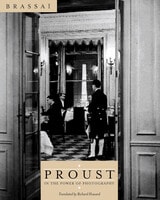
Proust in the Power of Photography
Brassaï
University of Chicago Press, 2001
One of the most original and memorable photographers of the twentieth century, Brassaï was also a journalist, sculptor, and writer. He took great pride in his writing, and he loved literature and language-French most of all. When he arrived in Paris in 1924, Brassaï began teaching himself French by reading Proust. Captured by the sensuality and visual strategies of Proust's writing, Brassaï soon became convinced that he had discovered a kindred spirit. Brassaï wrote: "In his battle against Time, that enemy of our precarious existence, ever on the offensive though never openly so, it was in photography, also born of an age-old longing to halt the moment, to wrest it from the flux of duration in order to 'fix' it forever in a semblance of eternity, that Proust found his best ally." He quoted Proust in his own writing, and from the annotated books in his library, we know that he spent a lifetime studying and dissecting Proust's prose, often line by line.
Drawing on his own experience as a photographer and author, Brassaï discovers a neglected aspect of Proust's interests, offering us a fascinating study of the role of photography both in Proust's oeuvre and in early-twentieth-century culture. Brassaï shows us how Proust was excessively interested in possessing portraits of his acquaintances and how the process by which he remembered and wrote was quite similar to the ways in which photographs register and reveal life's images. This book-beautifully translated by Richard Howard-features previously obscure photographs from Brassaï's High Society series and offers a rare glimpse into two of France's most fascinating artistic minds.
Drawing on his own experience as a photographer and author, Brassaï discovers a neglected aspect of Proust's interests, offering us a fascinating study of the role of photography both in Proust's oeuvre and in early-twentieth-century culture. Brassaï shows us how Proust was excessively interested in possessing portraits of his acquaintances and how the process by which he remembered and wrote was quite similar to the ways in which photographs register and reveal life's images. This book-beautifully translated by Richard Howard-features previously obscure photographs from Brassaï's High Society series and offers a rare glimpse into two of France's most fascinating artistic minds.
[more]