Results by title
108 books match the query 'Knowledge and learning' and 4 start with p
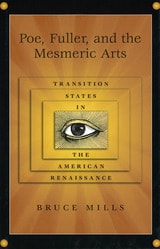
Poe, Fuller, and the Mesmeric Arts
Transition States in the American RenaissanceBruce Mills
University of Missouri Press, 2005
In Poe, Fuller, and the Mesmeric Arts, Bruce Mills examines how the writings of Edgar Allan Poe and Margaret Fuller draw from representations of and theories concerning animal magnetism, somnambulism, or hypnosis rendered in newspapers, literary and medical journals, pamphlets, and books. Although some recent studies have begun to consider the relevance of animal magnetism or mesmerism to nineteenth-century literature and culture, this book moves more deeply into what might be termed the canon of mesmeric study.
Through the works of Poe and Fuller, Mills argues, we can more fully understand the era’s response to dynamic cultural forces. Rather than simply using “American” subject matter as demanded in early calls for a national literature, Poe and Fuller, as well as Lydia Maria Child and Walt Whitman, increasingly rooted their epistemology and literary forms in psychological findings that accommodated the fluidity of democratic realities and principles.
For many influential writers of the period, then, the call for a national literature had evolved into attention to the state of one’s own mind, to those manifestations of the highest states of mind, and to the effects of literary choices on readers’ psychological states. In the history and philosophy of mesmeric consciousness, Poe, Fuller, and others discerned those principles that offered the promise of answering a central question: how does one create an aesthetic that effectively explores, accommodates, and fosters the harmonious interplay of transition states in a democratic culture?
Given its content and approach, Poe, Fuller, and the Mesmeric Arts should evoke interest among Poe and Fuller scholars as well as teachers, students, and historians intent upon understanding the emerging democratic sensibilities of the American Renaissance.
[more]
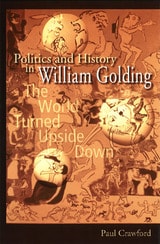
Politics and History in William Golding
The World Turned Upside DownPaul Crawford
University of Missouri Press, 2002
Politics and History in William Golding provides a much needed politicized and historicized reading of William Golding’s novels as a counter to previous, universalizing criticism. Paul Crawford argues that an understanding of fantastic and carnivalesque modes in Golding’s work is vital if we are to appreciate fully his interrogation of twentieth-century life.
Golding’s early satirical novels question English constructions of national identity in opposition to Nazism and the “totalitarian personality.” For Crawford, Golding can and must be studied in the wider European tradition of “literature of atrocity.” His early novels, especially Lord of the Flies, are preoccupied with atrocity, whereas the later work betrays a greater concern for the status of language and literature.
In Golding’s later fiction, such as Darkness Visible, the fantastic and carnivalesque are used in an increasingly nonsatirical manner to complement first modernist and then postmodernist self-consciousness and indeterminacy. Even his critique of class and religious authority, which carries through all of his fiction, gives way to more lighthearted productions—a symptom of which is his crude, absurd attack against the English literary industry in The Paper Men. This reduction of satire marks a decline in Golding’s political commitment and the production of more complex and arguably less satisfying novels.
The fantastic and carnivalesque are foundational to both the satirical and nonsatirical approaches that mark Golding’s early and late fiction. No previous study has analyzed this structure that is so central to his work. Politics and History in William Golding examines this writer’s work more fully than it has been studied within the convoluted context of the last half of the twentieth century. Crawford directly links Golding’s various deployments of the fantastic and carnivalesque to historical, political, and social change.
[more]
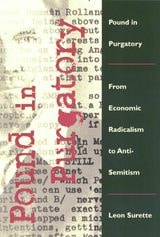
Pound in Purgatory
From Economic Radicalism to Anti-SemitismLeon Surette
University of Illinois Press, 1999
Pound in Purgatory, available now in paperback, overturns all previous explanations of Ezra Pound's anti-Semitism by uncovering its roots in economic and conspiracy theory. Leon Surette demonstrates that, contrary to popular opinion, Pound was not a life-long anti-Semite and consistently ignored or resisted anti-Semitic comments from his correspondents until after 1931.
From 1931 to 1945 Pound's poetry took a back seat to his activities as an economic reformer and propagandist for the corporate state. Pound believed he had a simple and practical solution for the economic woes of the world brought on by the Great Depression, and he became increasingly preoccupied with capturing political power for the economic reform he envisioned.
As the world spiraled toward war, Pound's program of economic reform foundered and he gradually succumbed to a paranoid belief in a Jewish conspiracy. Through an incisive analysis of Pound's correspondence and writings, much of it previously unexamined, Surette shows how this belief fostered the virulent anti-Semitism that pervades his work-–both poetry and prose-–from this time forward.
[more]
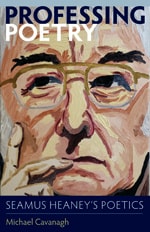
Professing Poetry
Seamus Heaney’s PoeticsMichael Cavanagh
Catholic University of America Press, 2009
The first full-length study of Heaney's poetics, Professing Poetry explores Heaney's unusual concept of influence and the various ways in which Heaney interacts with other writers
[more]