Results by title
112 books match the query 'Languages' and 4 start with p
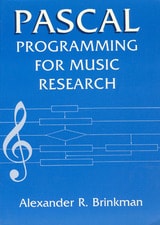
Pascal Programming for Music Research
Alexander R. Brinkman
University of Chicago Press, 1990
Pascal Programming for Music Research addresses those who wish to develop the programming skills necessary for doing computer-assisted music research, particularly in the fields of music theory and musicology. Many of the programming techniques are also applicable to computer assisted instruction (CAI), composition, and music synthesis. The programs and techniques can be implemented on personal computers or larger computer systems using standard Pascal compilers and will be valuable to anyone in the humanities creating data bases.
Among its useful features are:
-complete programs, from simple illustrations to substantial applications;
-beginning programming through such advanced topics as linked data structures, recursive algorithms, DARMS translation, score processing;
-bibliographic references at the end of each chapter to pertinent sources in music theory, computer science, and computer applications in music;
-exercises which explore and extend topics discussed in the text;
-appendices which include a DARMS translator and a library of procedures for building and manipulating a linked representation of scores;
-most algorithms and techniques that are given in Pascal programming translate easily to other computer languages.
Beginning, as well as advanced, programmers and anyone interested in programming music applications will find this book to be an invaluable resource.
[more]
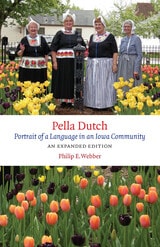
Pella Dutch
Portrait of a Language in an Iowa Community, An Expanded EditionPhilip E. Webber
University of Iowa Press, 1988
Founded in 1847 by religious separatists, the town of Pella in central Iowa is the state’s oldest Dutch American colony, and its crafts, architecture, and celebrations reflect and perpetuate the Dutch heritage of its earlier residents. Through his intriguing blend of sociolinguistic research, regional history, and interviews with current speakers of Pella Dutch, Philip Webber examines the town’s rich cultural and linguistic traditions.
Drawing upon formal and informal interviews and conversations with more than 150 speakers of Pella Dutch, Webber uses the methods of language research to trace the vestiges of Dutch heritage left on the English spoken by local residents; to explain attitudes toward language and ethnicity that emerged in the twentieth century; and to document the vocabulary, linguistic forms, humor, and conversational patterns that characterize contemporary Pella Dutch. In addition, desiring to let his informants speak for themselves, he includes the playful jokes, proverbial observations, folk wisdom, children’s rhymes, riddles, and puzzles influenced by Pella Dutch.
Webber’s introduction to this expanded paperback edition provides new photographs, updated information about recent research and publications, examples of how Dutch continues to be spoken, and descriptions of the ways in which Pella continues to commemorate its linguistic and cultural heritage. Linguists, anthropologists, and historians—as well as all those who enjoy Pella’s Tulip Time festival, its summertime fair or kermis, the Dutch letters in its bakeries, and the early winter visit of Sinterklaas—will appreciate Webber’s informed and engaging study of this unique Iowa community.
[more]
Piros and Prehistory
A Study in TanoanDavid Leedom Shaul
University of Utah Press, 2024
In Piros and Prehistory, David Leedom Shaul turns his attention to the Piro language, once spoken by the people of the Piro pueblos in New Mexico but extinct since approximately the year 1900. While arguments have been made in favor of Piro belonging to the Tiwa branch of the Tanoan family, Shaul counters this classification with a detailed rebuttal, firmly establishing Piro within the Tanoan family but outside of the Tiwa branch.
Shaul’s arguments use linguistic analyses coupled with historic and prehistoric records of migration and cultural interaction. Following the establishment of Piro as a Tanoan language, much of the linguistic analysis involves determining the aspects of Piro that were inherited from the earlier Proto-Tanoan versus those that were incorporated later as a result of borrowing from other languages through cultural interaction. This book lays out the linguistic argument that the similarities between Piro and Tiwan languages result from borrowing, not common ancestry, and it provides a record of contact between groups and linguistic evolution based on these movements.
Shaul’s arguments use linguistic analyses coupled with historic and prehistoric records of migration and cultural interaction. Following the establishment of Piro as a Tanoan language, much of the linguistic analysis involves determining the aspects of Piro that were inherited from the earlier Proto-Tanoan versus those that were incorporated later as a result of borrowing from other languages through cultural interaction. This book lays out the linguistic argument that the similarities between Piro and Tiwan languages result from borrowing, not common ancestry, and it provides a record of contact between groups and linguistic evolution based on these movements.
[more]
Politics, Language, and Thought
The Somali ExperienceDavid D. Laitin
University of Chicago Press, 1977
When the Somali Republic received independence, its parliamentary government decided to adopt three official languages: English, Italian, and Arabic—all languages of foreign contact. Since the vast majority of the nation's citizens spoke a single language, Somali, which then had no written form, this decision made governing exceedingly difficult. Selecting any one language was equally problematic, however, because those who spoke the official language would automatically become the privileged class.
Twelve years after independence, a military government was able to settle the acrimonious controversy by announcing that Somali would be the official language and Latin the basic script. It was hoped that this choice would foster political equality and strengthen the national culture. Politics, Language, and Thought is an exploration of how language and politics interrelate in the Somali Republic. Using both historical and experimental evidence, David D. Laitin demonstrates that the choice of an official language may significantly affect the course of a country's political development.
Part I of Laitin's study is an attempt to explain why the parliamentary government was incapable of reaching agreement on a national script and to assess the social and political consequences of the years of nondecision. Laitin shows how the imposition of nonindigenous languages produced inequalities which eroded the country's natural social basis of democracy.
Part 2 attempts to relate language to political thought and political culture. Analyzing interviews and role-playing sessions among Somali bilingual students, Laitin demonstrates that the impact of certain political concepts is quite different when expressed in different languages. He concludes that the implications of choosing a language are far more complex than previously thought, because to change the language of a people is to change the ways they think and act politically.
[more]