75 books match the query 'Latin' and 6 start with p
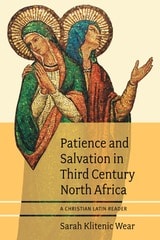
cover of Patience and Salvation in Third Century North Africa: A Christian Latin Reader

Patience and Salvation in Third Century North Africa

A Christian Latin Reader

Sarah Wear

Catholic University of America Press, 2022
Patience and Salvation in Third Century North Africa: A Christian Latin Reader features the entirety of Tertullian’s To Martyrs and The Passion of Perpetua and Felicity, with selections from Cyprian’s On the Good of Patience and a short appendix on Augustine’s Commentary on Psalm 121.6. The Latin text has facing vocabulary and theological, historical, philosophical, and grammatical notes. In the first three centuries, Roman Carthage produced some of the earliest literature composed originally in Latin by Christians. Tertullian’s Ad Martyras (197); Passio Perpetuae et Felicitatis (203), and Cyprian’s De Bono Patientiae (256) all embody the force of this new genre of Latin literature. With this literature, we see a variant of Latin often denoted “Christian Latin.” Christian Latin featured linguistic elements marked by characteristics of biblical Latin, later Latin, as well as vulgarisms. In addition to converging philologically, Tertullian, the author of the Passio, and Cyprian align themselves in topos: they all ask the question of how one can endure torment and anxiety in this world. Patience (patientia), derived from the verb for “to suffer” (patior), is a virtue that allows one to endure troubles, anxieties, and physical pains with the hope of eternal happiness and salvation in heaven. In this Reader, the student will find three different literary perspectives on this theme. The book also draws parallels to the works of Seneca and Cicero on patience and suffering.
[more]
cover of People, Personal Expression, and Social Relations in Late Antiquity, Volume II: Selected Latin Texts from Gaul and Western Europe

People, Personal Expression, and Social Relations in Late Antiquity, Volume II

Selected Latin Texts from Gaul and Western Europe

Ralph W. Mathisen

University of Michigan Press, 2003

Late Antiquity, which lies between Classical Antiquity and the Middle Ages (ca. A.D. 250-750), heralded the gradual decline of Mediterranean classical civilization, and the initial formation of a strictly western European, Christian society. During this period, three momentous developments threatened the paternalistic Roman social system: the rise of the Christian church, the disintegration of the Roman Empire in the west, and the establishment of the barbarian kingdoms.

The first of its type, this volume presents a collection of Latin source documents illustrating the social upheaval taking place in the Late Roman and early medieval worlds. The texts included in this volume provide the original Latin for the selections that are translated in People, Personal Expression, and Social Relations in Late Antiquity, Volume I. The 140 selected texts gathered from 70 different sources offer the reader firsthand experience with the ways that the Latin language was being used during the transformative period of Late Antiquity.

Ralph W. Mathisen is Professor of Ancient and Byzantine History; Louise Fry Scudder Professor of Humanities; and Director, Biographical Database for Late Antiquity at the University of South Carolina.
[more]
cover of Philodemus, On Death

Philodemus, On Death

W. Benjamin Henry

SBL Press, 2009
On Death, by the Epicurean philosopher Philodemus of Gadara, is among the most significant philosophical treatments of the theme surviving from the Greco-Roman world. The author was an influential figure in first-century B.C.E. Roman society, associated with poets such as Virgil and politicians such as the father-in-law of Julius Caesar. The surviving copies of his treatises were carbonized following the eruption of Vesuvius in 79 C.E. This edition contains the Greek text, newly reconstituted with the help of the infrared imaging technology that has revolutionized the study of Philodemus s works in the twenty-first century, and completely translated into English for the first time. An extensive introduction provides background on Philodemus and his writings, accompanying notes enrich the text, and forty-four pages of photographs illustrate the papyrus manuscript from which the translation is drawn.
[more]
cover of Philodemus, On Property Management

Philodemus, On Property Management

Voula Tsouna

SBL Press, 2013
Philodemus was an important Epicurean philosopher active in southern Italy in the first century B.C.E. His treatise On Property Management, whose surviving part is completely translated here into English for the first time, focuses primarily on the vices or virtues involved in the acquisition and preservation of property and wealth. The extant remains of the work contain the most extensive and thorough treatment of property management found in any Hellenistic author. Philodemus criticizes rival writings by Xenophon and Theophrastus on the subject of oikonomia, or property management, and defends his own Epicurean views on the topic. More systematic and philosophical than rival approaches, the treatise clarifies many moral issues pertaining to the possession and preservation of property and wealth and provides plausible answers to a cluster of moral questions.
[more]
cover of Princes and Political Cultures: The New Tiberian Senatorial Decrees

Princes and Political Cultures

The New Tiberian Senatorial Decrees

Greg Rowe

University of Michigan Press, 2002
An investigation of the transformation of the Roman state from Republic to dynastic monarchy
[more]
cover of Proverbs: An Eclectic Edition with Introduction and Textual Commentary

Proverbs

An Eclectic Edition with Introduction and Textual Commentary

Michael V. Fox

SBL Press, 2015

A new critical text for Proverbs drawing from many manuscripts

This first volume of The Hebrew Bible: A Critical Edition series, features a critical text of Proverbs with extensive text-critical introductions and commentaries. This and future HBCE volumes bring together a scholar’s critical decisions into a single text. construct an eclectic text, drawing from many manuscripts or placing entirely variant texts side by side. A common approach for critical editions of other ancient books, including the New Testament, the eclectic approach and scope used in the HBCE is a first of its kind for the Hebrew Bible.

Features:

  • Emendations set in context rather than singly and marginally
  • Introduction that sets out the method and purpose of the volume
  • Extensive list of abbreviations and sigla
[more]