Results by title
1993 books match the query 'Latin America' and 117 start with p
Pachacuti
World OverturnedLori Eshleman
Arizona Center for Medieval and Renaissance Studies, 2015
Pachakutik and the Rise and Decline of the Ecuadorian Indigenous Movement
Kenneth J. Mijeski
Ohio University Press, 2011
The mobilization of militant indigenous politics is one of the most important stories in Latin American studies today. In this critical work, Kenneth J. Mijeski and Scott H. Beck examine the rise and decline of Ecuador’s leading indigenous party, Pachakutik, as it tried to transform the state into a participative democracy.
Using in-depth interviews with political activists, as well as a powerful statistical analysis of election results, the authors show that the political election game failed to advance the causes of Ecuador’s poor or the movement’s own indigenous supporters. Pachakutik and the Rise and Decline of the Ecuadorian Indigenous Movement is an extraordinarily valuable case study of Ecuador’s indigenous movement and the challenges it still faces.
Paid to Care
Domestic Workers in Contemporary Latin American CultureRachel Randall
University of Texas Press, 2023
An insight into the struggles of paid domestic workers in Latin America through an exploration of films, texts, and digital media produced since the 1980s in collaboration with them or inspired by their experiences.
Paid domestic work in Latin America is often undervalued, underpaid, and underregulated. Exploring a wave of Latin American cultural texts since the 1980s that draw on the personal experiences of paid domestic work or intimate ties to domestic employees, Paid to Care offers insights into the struggles domestic workers face through an analysis of literary testimonials, documentary and fiction films, and works of digital media.
From domestic workers’ experiences of unionization in the 1980s to calls for their rights to be respected today, the cultural texts analyzed in Paid to Care provide additional insight into public debates about paid domestic work. Rachel Randall examines work made in Brazil, Argentina, Chile, Mexico, Peru, and Uruguay. The most recent of these texts respond to the Covid-19 pandemic, which put many domestic workers’ health and livelihoods at risk. Engaging with the legal histories of domestic work in multiple distinct national contexts, Randall demonstrates how the legacy of colonialism and slavery shapes the profession even today. Focusing on personal or coproduced cultural representations of domestic workers, Paid to Care explores complex ethical issues relating to consent, mediation, and appropriation.

Painting the Maya Universe
Royal Ceramics of the Classic PeriodDorie Reents-Budet
Duke University Press, 1994
Painting the Maya Universe is the first publication to present a definitive translation of the hieroglyphic texts painted on these objects. With many glyphs deciphered here for the first time, this analysis reveals much about how these vessels were perceived and used by the Maya, their owners’ names, and, in several cases, the names of the artists who created them. This information is combined with archaeological and other data, including nuclear chemical analyses, to correlate painting styles with specific Maya sites.
Published in conjunction with Duke University Museum of Art and an exhibition touring the United States, Painting the Maya Universe presents an astonishing visual record as well as a monumental scholarly achievement. With photographs by Justin Kerr, the foremost photographer of pre-Columbian art, it includes over 90 unique full-color rollout photographs, each showing the entire surface of an object in a single frame. The book also addresses the questions and controversy regarding the loss of information that occurs when objects are removed from their archaeological context to become part of public and private collections.
Painting the Maya Universe will energize discussion of Maya pottery, hieroglyphic texts, and iconography. Its photographs, a lasting resource on this great painting tradition, will stimulate and delight the eye. It is a breakthrough in art history and Latin American scholarship that will enrich general readers and scholars alike.
Palace Politics
How the Ruling Party Brought Crisis to MexicoBy Jonathan Schlefer
University of Texas Press, 2008
Bringing rare interviews and meticulous research to the cloaked world of Mexican politics in the mid-twentieth century, Palace Politics provides a captivating look at the authoritarian Mexican state—one of the longest-lived regimes of its kind in recent history—as well as the origins of political instability itself, with revelations that can be applied to a variety of contemporary political situations around the globe.
Culling a trove of remarkable firsthand accounts from former Mexican presidents, finance ministers, interior ministers, and other high officials from the 1950s through the 1980s, Jonathan Schlefer describes a world in which elite politics planted the seeds of a mammoth socioeconomic crisis. Palace Politics outlines the process by which political infighting among small rival factions of high officials drove Mexico to precarious situations at all levels of government. Schlefer also demonstrates how, earlier on, elite cooperation among these factions had helped sustain one of the most stable growth economies in Latin America, until all-or-nothing struggles began to tear the Mexican ruling party apart in the 1970s.
A vivid, seamlessly narrated history, Palace Politics is essential reading for anyone seeking to better understand not only the nation next door but also the workings of elite politics in general.
Palaces and Power in the Americas
From Peru to the Northwest CoastEdited by Jessica Joyce Christie and Patricia Joan Sarro
University of Texas Press, 2006
Ancient American palaces still captivate those who stand before them. Even in their fallen and ruined condition, the palaces project such power that, according to the editors of this new collection, it must have been deliberately drawn into their formal designs, spatial layouts, and choice of locations. Such messages separated palaces from other elite architecture and reinforced the power and privilege of those residing in them. Indeed, as Christie and Sarro write, "the relation between political power and architecture is a pervasive and intriguing theme in the Americas."
Given the variety of cultures, time periods, and geographical locations examined within, the editors of this book have grouped the articles into four sections. The first looks at palaces in cultures where they have not previously been identified, including the Huaca of Moche Site, the Wari of Peru, and Chaco Canyon in the U.S. Southwest. The second section discusses palaces as "stage sets" that express power, such as those found among the Maya, among the Coast Salish of the Pacific Northwest, and at El Tajín on the Mexican Gulf Coast. The third part of the volume presents cases in which differences in elite residences imply differences in social status, with examples from Pasado de la Amada, the Valley of Oaxaca, Teotihuacan, and the Aztecs. The final section compares architectural strategies between cultures; the models here are Farfán, Peru, under both the Chimú and the Inka, and the separate states of the Maya and the Inka.
Such scope, and the quality of the scholarship, make Palaces and Power in the Americas a must-have work on the subject.
Palma Africana
Michael Taussig
University of Chicago Press, 2018
Palm oil. Saturating everything from potato chips to nail polish, palm oil has made its way into half of the packaged goods in our supermarkets. By 2020, world production will be double what it was in 2000. In Colombia, palm oil plantations are covering over one-time cornucopias of animal, bird, and plant life. Over time, they threaten indigenous livelihoods and give rise to abusive labor conditions and major human rights violations. The list of entwined horrors—climatic, biological, social—is long. But Taussig takes no comfort in our usual labels: “habitat loss,” “human rights abuses,” “climate change.” The shock of these words has passed; nowadays it is all a blur. Hence, Taussig’s keen attention to words and writing throughout this work. He takes cues from precursors’ ruminations: Roland Barthes’s suggestion that trees form an alphabet in which the palm tree is the loveliest; William Burroughs’s retort to critics that for him words are alive like animals and don’t like to be kept in pages—cut them and the words are let free.
Steeped in a lifetime of philosophical and ethnographic exploration, Palma Africana undercuts the banality of the destruction taking place all around us and offers a penetrating vision of the global condition. Richly illustrated and written with experimental verve, this book is Taussig’s Tristes Tropiques for the twenty-first century.
Panama Odyssey
By William J. Jorden
University of Texas Press, 1984
The Panama Canal Treaties of 1977 were the most significant foreign policy achievement of the Carter administration. Most Latin American nations had regarded the 1903 treaty and its later minor modifications as vestiges of "American colonialism" and obstacles to any long-term, stable relationship with the United States. Hence, at a time when conflicts were mushrooming in Central America, the significance of the new Panama treaties cannot be overestimated.
Former Ambassador to Panama William J. Jorden has provided the definitive account of the long and often contentious negotiations that produced those treaties. It is a vividly written reconstruction of the complicated process that began in 1964 and ended with ratification of the new pacts in 1978. Based on his personal involvement behind the scenes in the White House (1972–1974) and in the United States Embassy in Panama (1974–1978), Jorden has produced a unique living history. Access to documents and the personalities of both governments and, equally important, Jorden's personal recollections of participants on both sides make this historical study an incomparable document of U. S. foreign relations.
Beyond the singular story of the treaties themselves—and how diplomats negotiate in the modern world—is the rare description of how the United States deals with a major foreign policy problem. How does a superpower cope with a tiny nation that happens to occupy a strategically critical position? And how does the U. S. Senate face up to its constitutionally assigned power to "advise and consent"? Once treaties are approved, does the House of Representatives help or hinder? Panama Odyssey also deals with another crucial element in the shaping of policy—public opinion: how is it informed or led astray?
In sum, this is a history, a handbook on diplomacy, a course in government, and a revelation of foreign policy in action, all based on a fascinating and controversial episode in the U. S. experience.
Panama in Black
Afro-Caribbean World Making in the Twentieth CenturyKaysha Corinealdi
Duke University Press, 2022

Panamanian Militarism
A Historical InterpretationCarlos Guevara Mann
Ohio University Press, 1996
Focusing on the causes that generated nineteenth-century predatory militarism, including political illegitimacy and US support, Guevara Mann analyzes the so-called professionalization of the armed forces — institutionalized militarism — and the polices developed by the 1968-89 military regime.
The author cautions that although Panamanian Defense Forces were abolished after the US invasion of December 1989, and although the state’s security apparatus has been placed under civilian direction, Panama’s stability remains threatened. Lack of legitimacy — the characteristic which informs military involvement in politics — still persists, and militarism could well reappear if the Panamanian polity fails to achieve legitimacy.
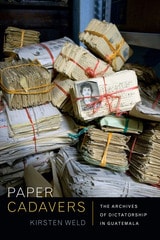
Paper Cadavers
The Archives of Dictatorship in GuatemalaKirsten Weld
Duke University Press, 2014
The unearthing of the archives renewed fierce debates about history, memory, and justice. In Paper Cadavers, Weld explores Guatemala's struggles to manage this avalanche of evidence of past war crimes, providing a firsthand look at how postwar justice activists worked to reconfigure terror archives into implements of social change. Tracing the history of the police files as they were transformed from weapons of counterinsurgency into tools for post-conflict reckoning, Weld sheds light on the country's fraught transition from war to an uneasy peace, reflecting on how societies forget and remember political violence.
Paracas Art and Architecture
Object and Context in South Coastal PeruAnne Paul
University of Iowa Press, 1991
Paraguay and the Triple Alliance
The Postwar Decade, 1869-1878By Harris Gaylord Warren
University of Texas Press, 1978
In the War of the Triple Alliance—the most terrible conflict in South American history—Paraguay was almost annihilated by the armed forces of Brazil, Argentina, and Uruguay. The chaotic postwar decade began with the Allied occupation of Asunción, which lasted seven years, and was marked by Brazilian-Argentine rivalry and interference in Paraguayan affairs and by the efforts of Paraguay’s governments to revive their stricken land, efforts often thwarted by corruption, factionalism, and revolutions. It ended with the arbitral award eliminating Argentina as a claimant to the Chaco Boreal and with the ascendancy of the Colorado Party, which dominated Paraguayan politics for most of the next century.
This is the first book in any language that examines political, economic, and social developments to provide a well-integrated study of this significant and eventful period. It is based on archival resources, largely unused before, in England, the United States, Brazil, Argentina, and Paraguay, as well as on newspapers, books, pamphlets, and published documents in many libraries. As one historian has said, the study is “a masterpiece of sleuthing and historical synthesis.” It will be of interest not only to students of Paraguay but also to those concerned with Brazilian, Argentine, and Latin American history.
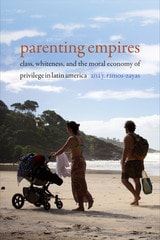
Parenting Empires
Class, Whiteness, and the Moral Economy of Privilege in Latin AmericaAna Yolanda Ramos-Zayas
Duke University Press, 2020

Park, Tenement, Slaughterhouse
Elite Imaginaries of Buenos Aires, 1852–1880Antonio Carbone
Campus Verlag, 2022
In the 1860s and 1870s, Buenos Aires was hit by a series of dramatic cholera and yellow fever epidemics that decimated its population and inspired extensive debates on urban space among its elites. The book takes readers into three intriguing spaces—the slaughterhouses, the tenements, and the park of Palermo—which found themselves at the center of the discussions about the causes of epidemic disease. The banning of industrial slaughterhouses from the city, reform of tenement houses, and construction of a major park promised to tackle the problem of disease while giving rise to new visions of the city. By analyzing the discussion on these spaces, the book illuminates critical spatial junctures at the crossroads of both local and global forces and reconstructs the interconnection between elite imaginaries and the production of space. Park, Tenement, Slaughterhouse reveals that the history of epidemic diseases can tell us a great deal about urban space, the relationships between different social classes in cities, and the articulations of global and local forces.
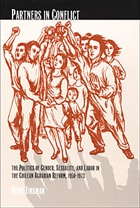
Partners in Conflict
The Politics of Gender, Sexuality, and Labor in the Chilean Agrarian Reform, 1950–1973Heidi Tinsman
Duke University Press, 2002
Tinsman restores women to a scholarly narrative that has been almost exclusively about men, recounting the centrality of women’s labor to the pre-Agrarian Reform world of the hacienda during the 1950s and recovering women’s critical roles in union struggles and land occupations during the Agrarian Reform itself. Providing a theoretical framework for understanding why the Agrarian Reform ultimately empowered men more than women, Tinsman argues that women were marginalized not because the Agrarian Reform ignored women but because, under both the Frei and Allende governments, it promoted the male-headed household as the cornerstone of a new society. Although this emphasis on gender cooperation stressed that men should have more respect for their wives and funneled unprecedented amounts of resources into women’s hands, the reform defined men as its protagonists and affirmed their authority over women.
This is the first monographic social history of Chile’s Agrarian Reform in either English or Spanish, and the first historical work to make sexuality and gender central to the analysis of the reforms.
Patients of the State
The Politics of Waiting in ArgentinaJavier Auyero
Duke University Press, 2012
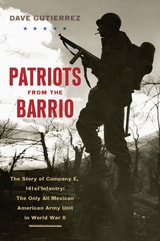
Patriots from the Barrio
The Story of Company E, 141st Infantry: The Only All Mexican American Army Unit in World War IIDave Gutierrez
Westholme Publishing, 2018
The Inspiring True Story of a Segregated Unit Whose Exploits Underscore the Forgotten Latino Contribution to the Allied Victory in World War II
As a child, Dave Gutierrez hung on every word his father recalled about his cousin Ramon, “El Sancudo” (the mosquito), and his service in World War II, where he earned a Silver Star, three Purple Hearts, and escaped from the Germans twice. Later, Dave decided to find out more about his father’s cousin, and in the course of his research he discovered that Ramon Gutierrez was a member of Company E, 141st Infantry, a part of the 36th “Texas” Division that was comprised entirely of Mexican Americans—the only such unit in the entire U.S. Army. The division landed at Salerno, Italy, in 1943, among first American soldiers to set foot in Europe. In the ensuing months, Company E and the rest of the 36th would battle their way up the mountainous Italian peninsula against some of Nazi Germany’s best troops. In addition to the merciless rain, mud, and jagged peaks, swift cold rivers crisscrossed the region, including the Rapido, where Company E would face its greatest challenge. In an infamous episode, the 36th Division was ordered to cross the Rapido despite reports that the opposite bank was heavily defended. In the ensuing debacle, the division was ripped apart, and Company E sustained appalling casualties. The company rebounded and made the storied landings at Anzio and ultimately invaded southern France for a final push into Germany. The men of Company E distinguished themselves as rugged fighters capable of warring amid the rubble of destroyed villages and in the devastated countryside.
Based on extensive archival research and veteran and family accounts, Patriots from the Barrio: The Story of Company E, 141st Infantry: The Only All Mexican American Army Unit in World War II brings to life the soldiers whose service should never have gone unrecognized for so long. With its memorable personalities, stories of hope and immigration, and riveting battle scenes, this beautifully written book is a testament to the shared beliefs of all who have fought for the ideals of the American flag.
Peasants In Arms
War and Peace in the Mountains of Nicaragua, 1979–1994Lynn Horton
Ohio University Press, 1999
Drawing on testimonies from contra collaborators and ex-combatants, as well as pro-Sandinista peasants, this book presents a dynamic account of the growing divisions between peasants from the area of Quilalí who took up arms in defense of revolutionary programs and ideals such as land reform and equality and those who opposed the FSLN.
Peasants in Arms details the role of local elites in organizing the first anti-Sandinista uprising in 1980 and their subsequent rise to positions of field command in the contras. Lynn Horton explores the internal factors that led a majority of peasants to turn against the revolution and the ways in which the military draft, and family and community pressures reinforced conflict and undermined mid-decade FSLN policy shifts that attempted to win back peasant support.
Peasants in Revolt
A Chilean Case Study, 1965–1971By James Petras and Hugo Zemelman Merino; translated by Thomas Flory
University of Texas Press, 1973
Based on extended interviews at the Culiprán fundo in Chile with peasants who recount in their own terms their political evolution, this is an in-depth study of peasants in social and political action. It deals with two basic themes: first, the authoritarian structure within a traditional latifundio and its eventual replacement by a peasant-based elected committee, and second, the events shaping the emergence of political consciousness among the peasantry. Petras and Zemelman Merino trace the careers of local peasant leaders, followers, and opponents of the violent illegal land seizure in 1965 and the events that triggered the particular action.
The findings of this study challenge the oft-accepted assumption that peasants represent a passive, traditional, downtrodden group capable only of following urban-based elites. The peasant militants, while differing considerably in their ability to grasp complex political and social problems, show a great deal of political skill, calculate rationally on the possibility of success, and select and manipulate political allies on the basis of their own primary needs. The politicized peasantry lend their allegiance to those forces with whom they anticipate they have the most to gain—and under circumstances that minimize social costs. The authors identify the highly repressive political culture within the latifundio—reinforced by the national political system—as the key factor inhibiting overt expressions of political demands.
The emergence of revolutionary political consciousness is found to be the result of cumulative experiences and the breakdown of traditional institutions of control. The violent illegal seizure of the farm is perceived by the peasantry as a legitimate act based on self-interest as well as general principles of justice—in other words, the seizure is perceived as a “natural act,” suggesting that perhaps two sets of moralities functioned within the traditional system.
The book is divided into two parts: the first part contains a detailed analysis of peasant behavior; the second contains transcriptions of peasant interviews. Combined, they give the texture and flavor of insurgent peasant politics.
Peasants on Plantations
Subaltern Strategies of Labor and Resistance in the Pisco Valley, PeruVincent Peloso
Duke University Press, 1999
Grounded in the theoretical perspectives of subaltern studies and drawing on an extremely complete archive of landed estates that includes detailed regular reports by plantation managers on all aspects of farming life, Peasants on Plantations reveals the intricate ways peasants, managers, and owners manipulated each other to benefit their own interests. As Peloso demonstrates, rather than a simple case of domination of the peasants by the owners, both parties realized that negotiation was the key to successful growth, often with the result that peasants cooperated with plantation growth strategies in order to participate in a market economy. Long-term contracts gave tenants and sharecroppers many opportunities to make farming choices, to assert claims on the land, compete among themselves, and participate in plantation expansion. At the same time, owners strove to keep the peasants in debt and well aware of who maintained ultimate control.
Peasants on Plantations offers a largely untold view of the monumental struggle between planters and peasants that was fundamental in shaping the agrarian history of Peru. It will interest those engaged in Latin American studies, anthropology, and peasant and agrarian studies.
Pedro de Rivera and the Military Regulations for Northern New Spain, 1724-1729
A Documentary History of His Frontier Inspection and the Reglamento de 1729Thomas H. Naylor
University of Arizona Press, 1989
Pentecostalism in Urban Oaxaca
Healing Patriarchy, Marriage, and MexicoMichelle Ramirez
University of Alabama Press, 2024
An ethnography focusing on a Pentecostal church community and their pursuit of healing marriages and prosperity
Pentecostalism in Urban Oaxaca is a timely feminist ethnography set in a Pentecostal church community in Oaxaca de Juarez. Based on extensive fieldwork, Michelle Ramirez skillfully melds medical anthropology with cultural analysis to reveal the Pentecostal movement’s dynamics in the contexts of faith healing, marital relations, and economic prosperity.
Ramirez takes stock of the problematic ways that Pentecostalism has played out for Mexican women today but also reminds readers of some of its successes. Within the context of Mexican patriarchy, some women parishioners in abusive relationships see the church as a way to improve their lot. Pentecostalism seeks to rupture with Mexico’s colonial heritage, and Ramirez provides novel ways for the reader to consider how Pentecostalism can provide healing for even the “endlessness of addiction.” One case study portrays a former abusive alcoholic womanizer who underwent a spiritual transformation as a result of his conversion. Through this example and more, Ramirez examines the complex relationship between gender, modernity, and Indigeneity in the context of marriage. The book also addresses the #MeToo movement as encountered in the Pentecostal church.
Finally, Ramirez investigates how Pentecostalism addresses the “curses” of illness and poverty, highlighting the paradoxical relationship between faith healing and curanderismo. The gospel of economic prosperity holds promise for a better life, breaking free from the “disease” of poverty. To this end, Ramirez profiles some parishioners’ involvement with Omnilife, a multilevel marketing company selling vitamins and natural health products that propounds ideals similar to those of Pentecostal Christianity.
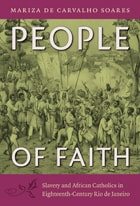
People of Faith
Slavery and African Catholics in Eighteenth-Century Rio de JaneiroMariza de Carvalho Soares
Duke University Press, 2011
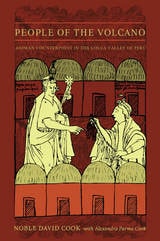
People of the Volcano
Andean Counterpoint in the Colca Valley of PeruNoble David Cook, with Alexandra Parma Cook
Duke University Press, 2007
Social structures, the domestic export and economies, and spiritual spheres within native Andean communities are key elements of analysis. Also highlighted is the persistence of duality in the Andean world: perceived dichotomies such as those between the coast and the highlands, Europeans and Indo-Peruvians. Even before the conquest, the Cabana and Collagua communities sharing the Colca Valley were divided according to kinship and location. The Incas, and then the Spanish, capitalized on these divisions, incorporating them into their state structure in order to administer the area more effectively, but Colca Valley peoples resisted total assimilation into either. Colca Valley communities have shown a remarkable tenacity in retaining their social, economic, and cultural practices while accommodating various assimilationist efforts over the centuries. Today’s population maintains similarities with their ancestors of more than five hundred years ago—in language, agricultural practices, daily rituals, familial relationships, and practices of reciprocity. They also retain links to ecological phenomena, including the volcanoes from which they believe they emerged and continue to venerate.
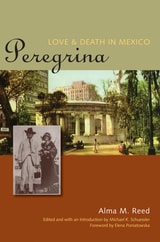
Peregrina
Love and Death in MexicoBy Alma M. Reed
University of Texas Press, 2007
In the Yucatán, they never forgot Alma Reed. She arrived for the first time in 1923, on assignment for the New York Times Sunday Magazine to cover an archaeological survey of Mayan ruins. It was a contemporary Maya, however, who stole her heart. Felipe Carrillo Puerto, said to be descended from Mayan kings, had recently been elected governor of the Yucatán on a platform emphasizing egalitarian reforms and indigenous rights. The entrenched aristocracy was enraged; Reed was infatuated—as was Carrillo Puerto. He and Reed were engaged within months. Yet less than a year later—only eleven days before their intended wedding—Carrillo Puerto was assassinated. He had earned his place in the history books, but Reed had won a place in the hearts of Mexicans: the bolero "La Peregrina" remains one of the Yucatán's most famous ballads.
Alma Reed recovered from her tragic romance to lead a long, successful life. She eventually returned to Mexico, where her work in journalism, archaeology, and art earned her entry into the Orden del Aguila Azteca (Order of the Aztec Eagle). Her time with Carrillo Puerto, however, was the most intense of her life, and when she was encouraged (by Hollywood, especially) to write her autobiography, she began with that special period. Her manuscript, which disappeared immediately after her sudden death in 1966, mingled her legendary love affair with a biography of Carrillo Puerto and the political history of the Yucatán. As such, it has long been sought by scholars as well as romantics. In 2001, historian Michael Schuessler discovered the manuscript in an abandoned apartment in Mexico City. An absolutely compelling memoir, Peregrina restores Reed's place in Mexican history in her own words.
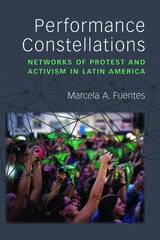
Performance Constellations
Networks of Protest and Activism in Latin AmericaMarcela A. Fuentes
University of Michigan Press, 2019
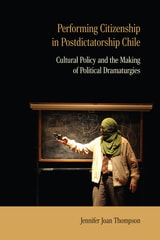
Performing Citizenship in Postdictatorship Chile
Cultural Policy and the Making of Political DramaturgiesJennifer Joan Thompson
Northwestern University Press, 2025
Offering a nuanced understanding of the performing arts’ relationship to politics
Through careful readings of key political performances in Chile's transition from military dictatorship to neoliberal democracy, Jennifer Joan Thompson examines how the production and aesthetics of theater are intertwined in processes of democratization, enactments of citizenship, and the development of cultural policy. Performing Citizenship in Postdictatorship Chile: Cultural Policy and the Making of Political Dramaturgies reveals how artists performed changing models of democratic citizenship. Thompson traces the ways artists confronted and resisted the military dictatorship of Augusto Pinochet, how they then reimagined the body politic during the early transitional period and challenged official constructions of history and memory as the transition to democracy progressed, how they critiqued Chile’s neoliberal economic model and its violence, and, finally, how they have made claims for feminist and Indigenous citizen subjectivities throughout Chile’s current social crisis. Incorporating archival and ethnographic research alongside readings of theatrical and political performances, this study offers a nuanced understanding of the performing arts’ relationship to politics, one that accounts for the ways artists and the state collaborate in the production of the political imagination.
Performing Human Rights
Contested Amnesia and Aesthetic Practices in the Global SouthEdited by Liliana Gómez
Diaphanes, 2021
Performing Women and Modern Literary Culture in Latin America
Intervening ActsBy Vicky Unruh
University of Texas Press, 2006
Women have always been the muses who inspire the creativity of men, but how do women become the creators of art themselves? This was the challenge faced by Latin American women who aspired to write in the 1920s and 1930s. Though women's roles were opening up during this time, women writers were not automatically welcomed by the Latin American literary avant-gardes, whose male members viewed women's participation in tertulias (literary gatherings) and publications as uncommon and even forbidding. How did Latin American women writers, celebrated by male writers as the "New Eve" but distrusted as fellow creators, find their intellectual homes and fashion their artistic missions?
In this innovative book, Vicky Unruh explores how women writers of the vanguard period often gained access to literary life as public performers. Using a novel, interdisciplinary synthesis of performance theory, she shows how Latin American women's work in theatre, poetry declamation, song, dance, oration, witty display, and bold journalistic self-portraiture helped them craft their public personas as writers and shaped their singular forms of analytical thought, cultural critique, and literary style. Concentrating on eleven writers from Argentina, Brazil, Cuba, Mexico, Peru, and Venezuela, Unruh demonstrates that, as these women identified themselves as instigators of change rather than as passive muses, they unleashed penetrating critiques of projects for social and artistic modernization in Latin America.
Peripheral Nerve
Health and Medicine in Cold War Latin AmericaAnne-Emanuelle Birn and Raúl Necochea López
Duke University Press, 2020
Contributors. Cheasty Anderson, Anne-Emanuelle Birn, Katherine E. Bliss, Gilberto Hochman, Jennifer L. Lambe, Nicole Pacino, Carlos Henrique Assunção Paiva, Jadwiga E. Pieper Mooney, Raúl Necochea López, Marco A. Ramos, Gabriela Soto Laveaga
Persistent Oligarchs
Elites and Politics in Chihuahua, Mexico 1910–1940Mark Wasserman
Duke University Press, 1993
Chihuahua boasted one of the strongest pre-revolutionary elite networks, the Terrazas-Creel family. Wasserman describes this group's efforts to maintain its power after the Revolution, including its use of economic resources and intermarriage to forge partnerships with the new, revolutionary elite. Together, the old and new elites confronted a national government that sought to reestablish centralized control over the states and the masses. Wasserman shows how the revolutionary government and the popular classes, joined in opposition to the challenge of the elites, finally formalized into a national political party during the 1930s.
Persistent Oligarchs concludes with an account of the Revolution's ultimate outcome, largely accomplished by 1940: the national government gaining central control over politics, the popular classes obtaining land redistribution and higher wages, and regional elites, old and new, availing themselves of the great opportunities presented by economic development. A complex analysis of revolution as a vehicle for both continuity and change, this work is essential to an understanding of Mexico and Latin America, as well as revolutionary politics and history.
Perspectives on War and Peace in Central America
Mis Lam#19Sung Ho Kim
Ohio University Press, 1992
Peru's Indian Peoples and the Challenge of Spanish Conquest
Huamanga to 1640Steve J. Stern
University of Wisconsin Press, 1993
This second edition of Peru’s Indian Peoples and the Challenge of Spanish Conquest includes Stern’s 1992 reflections on the ten years of historical interpretation that have passed since the book’s original publication—setting his analysis of Huamanga in a larger perspective.
“This book is a monument to both scholarship and comprehension, comparable in its treatment of the indigenous peoples after the conquest only to that of Charles Gibson for the Aztecs, and perhaps the best volume read by this reviewer in several years.”—Frederick P. Bowser, American Historical Review
“Peru’s Indian Peoples and the Challenge of Spanish Conquest is clearly indispensable reading for Andeanists and highly recommended to ethnohistorians generally. In technical respects it is a job done right, and conceptually it stands out as a handsome example of anthropology and history woven into one tight fabric of inquiry.”—Frank Salomon, Ethnohistory
Peruvian Lives across Borders
Power, Exclusion, and HomeM. Cristina Alcalde
University of Illinois Press, 2018
Alcalde draws on interviews, surveys, participant observation, and textual analysis to argue that to belong is to exclude. To that end, transnational Peruvians engage in both subtle and direct policing along the borders of belonging. These acts allow them to claim and maintain the social status they enjoyed in their homeland even as they profess their openness and tolerance. Alcalde details these processes and their origins in Peru's gender, racial, and class hierarchies. As she shows, the idea of return—whether desired or rejected, imagined or physical—spurs constructions of Peruvianness, belonging, and home.
Deeply researched and theoretically daring, Peruvian Lives across Borders answers fascinating questions about an understudied group of migrants.
Phenomenal Justice
Violence and Morality in ArgentinaEva van Roekel
Rutgers University Press, 2020
Short-listed for the Juan E. Méndez Book Award for Human Rights in Latin America from Duke University Libraries
How do victims and perpetrators of political violence caught up in a complicated legal battle experience justice on their own terms? Phenomenal Justice is a compelling ethnography about the reopened trials for crimes against humanity committed during the brutal military dictatorship that ruled Argentina between 1976 and 1983. Grounded in phenomenological anthropology and the anthropology of emotion, this book establishes a new theoretical basis that is faithful to the uncertainties of justice and truth in the aftermath of human rights violations. The ethnographic observations and the first-person stories about torture, survival, disappearance, and death reveal the enduring trauma, heartfelt guilt, happiness, battered pride, and scratchy shame that demonstrate the unreserved complexities of truth and justice in post-conflict societies. Phenomenal Justice will be an indispensable contribution to a better understanding of the military dictatorship in Argentina and its aftermath.
Philanthropic Foundations in Latin America
Ann Stromberg
Russell Sage Foundation, 1956
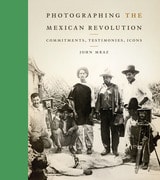
Photographing the Mexican Revolution
Commitments, Testimonies, IconsBy John Mraz
University of Texas Press, 2012
The Mexican Revolution of 1910–1920 is among the world’s most visually documented revolutions. Coinciding with the birth of filmmaking and the increased mobility offered by the reflex camera, it received extraordinary coverage by photographers and cineastes—commercial and amateur, national and international. Many images of the Revolution remain iconic to this day—Francisco Villa galloping toward the camera; Villa lolling in the presidential chair next to Emiliano Zapata; and Zapata standing stolidly in charro raiment with a carbine in one hand and the other hand on a sword, to mention only a few. But the identities of those who created the thousands of extant images of the Mexican Revolution, and what their purposes were, remain a huge puzzle because photographers constantly plagiarized each other’s images.
In this pathfinding book, acclaimed photography historian John Mraz carries out a monumental analysis of photographs produced during the Mexican Revolution, focusing primarily on those made by Mexicans, in order to discover who took the images and why, to what ends, with what intentions, and for whom. He explores how photographers expressed their commitments visually, what aesthetic strategies they employed, and which identifications and identities they forged. Mraz demonstrates that, contrary to the myth that Agustín Víctor Casasola was “the photographer of the Revolution,” there were many who covered the long civil war, including women. He shows that specific photographers can even be linked to the contending forces and reveals a pattern of commitment that has been little commented upon in previous studies (and completely unexplored in the photography of other revolutions).
Photopoetics at Tlatelolco
Afterimages of Mexico, 1968By Samuel Steinberg
University of Texas Press, 2016
In the months leading up to the 1968 Olympic games in Mexico City, students took to the streets, calling for greater democratization and decrying crackdowns on political resistance by the ruling PRI party. During a mass meeting held at the Plaza of the Three Cultures in the Tlatelolco neighborhood, paramilitary forces opened fire on the gathering. The death toll from the massacre remains a contested number, ranging from an official count in the dozens to estimates in the hundreds by journalists and scholars. Rereading the legacy of this tragedy through diverse artistic-political interventions across the decades, Photopoetics at Tlatelolco explores the state’s dual repression—both the massacre’s crushing effects on the movement and the manipulation of cultural discourse and political thought in the aftermath.
Examining artifacts ranging from documentary photography and testimony to poetry, essays, chronicles, cinema, literary texts, video, and performance, Samuel Steinberg considers the broad photographic and photopoetic nature of modern witnessing as well as the specific elements of light (gunfire, flares, camera flashes) that ultimately defined the massacre. Steinberg also demonstrates the ways in which the labels of “massacre” and “sacrifice” inform contemporary perceptions of the state’s blatant and violent repression of unrest. With implications for similar processes throughout the rest of Latin America from the 1960s to the present day, Photopoetics at Tlatelolco provides a powerful new model for understanding the intersection of political history and cultural memory.
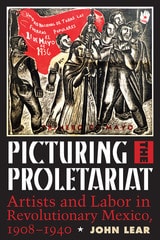
Picturing the Proletariat
Artists and Labor in Revolutionary Mexico, 1908–1940By John Lear
University of Texas Press, 2017
Thomas McGann Memorial Prize, Rocky Mountain Council on Latin American Studies, 2017
Runner-up, Humanities Book Prize, Mexico Section of the Latin American Studies Association, 2018
In the wake of Mexico’s revolution, artists played a fundamental role in constructing a national identity centered on working people and were hailed for their contributions to modern art. Picturing the Proletariat examines three aspects of this artistic legacy: the parallel paths of organized labor and artists’ collectives, the relations among these groups and the state, and visual narratives of the worker. Showcasing forgotten works and neglected media, John Lear explores how artists and labor unions participated in a cycle of revolutionary transformation from 1908 through the presidency of Lázaro Cárdenas (1934–1940). Lear shows how middle-class artists, radicalized by the revolution and the Communist Party, fortified the legacy of the prerevolutionary print artisan José Guadalupe Posada by incorporating modernist, avant-garde, and nationalist elements in ways that supported and challenged unions and the state. By 1940, the state undermined the autonomy of radical artists and unions, while preserving the image of both as partners of the “institutionalized revolution.”
This interdisciplinary book explores the gendered representations of workers; the interplay of prints, photographs, and murals in journals, in posters, and on walls; the role of labor leaders; and the discursive impact of the Spanish Civil War. It considers “los tres grandes”—Rivera, Siquieros, and Orozco—while featuring lesser-known artists and their collectives, including Saturnino Herrán, Leopoldo Méndez, Santos Balmori, and the League of Revolutionary Writers and Artists (LEAR). The result is a new perspective on the art and politics of the revolution.
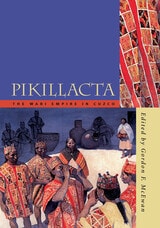
Pikillacta
The Wari Empire in CuzcoMcEwan, Gordon F.
University of Iowa Press, 2005
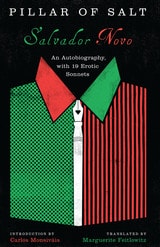
Pillar of Salt
An Autobiography, with 19 Erotic SonnetsBy Salvador Novo, Translated by Marguerite Feitlowitz, Introduction by Carlos Monsiváis
University of Texas Press, 2014
Written with exquisite sensitivity and wit, this memoir by one of Mexico’s foremost men of letters describes coming of age during the violence of the Mexican Revolution and “living dangerously” as an openly homosexual man in a brutally machista society.
Salvador Novo (1904–1974) was a provocative and prolific cultural presence in Mexico City through much of the twentieth century. With his friend and fellow poet Xavier Villaurrutia, he cofounded Ulises and Contemporáneos, landmark avant-garde journals of the late 1920s and 1930s. At once “outsider” and “insider,” Novo held high posts at the Ministries of Culture and Public Education and wrote volumes about Mexican history, politics, literature, and culture. The author of numerous collections of poems, including XX poemas, Nuevo amor, Espejo, Dueño mío, and Poesía 1915–1955, Novo is also considered one of the finest, most original prose stylists of his generation.
Pillar of Salt is Novo’s incomparable memoir of growing up during and after the Mexican Revolution; shuttling north to escape the Zapatistas, only to see his uncle murdered at home by the troops of Pancho Villa; and his initiations into literature and love with colorful, poignant, complicated men of usually mutually exclusive social classes. Pillar of Salt portrays the codes, intrigues, and dynamics of what, decades later, would be called “a gay ghetto.” But in Novo’s Mexico City, there was no name for this parallel universe, as full of fear as it was canny and vibrant. Novo’s memoir plumbs the intricate subtleties of this world with startling frankness, sensitivity, and potential for hilarity. Also included in this volume are nineteen erotic sonnets, one of which was long thought to have been lost.
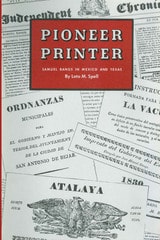
Pioneer Printer
Samuel Bangs in Mexico and TexasBy Lota M. Spell
University of Texas Press, 1963
Samuel Bangs, the first printer in the territory that is now Texas, once owed his life to his printing press. One of the few survivors of the Mina Expedition to Mexico in 1817, Bangs wrote to Servando de Mier, “I had the good fortune, through the will of God, to have my life saved, as I was a printer.”
Bangs was not always so fortunate. Losses and disappointments plagued him throughout his career, and he spent many miserable months in Mexican jails. But his ingenuity in the face of adversity, his courage and charm, stamped him not only as a storybook hero but as a man whose virtues were large enough to be their own reward.
Lota Spell’s fine biography of Samuel Bangs is at the same time a fascinating history of northern Mexico (including Texas) in the first half of the nineteenth century. Through the successes and failures of an individual it presents the facts about the operation of a business during a time of important political and economic change.
Even more important is its contribution to our knowledge of printing and of the contemporary periodical press. Although first of all a printer, Samuel Bangs was also involved in the production of newspapers, making this book a detailed history of journalism in the Mexico and Texas of his day. His printing office also functioned as a typographer’s school, through which he instituted the apprentice system in the Southwest; and as a result of his interest in presses as a commodity of trade, the first business for merchandising and servicing printing presses in the area was developed.
This narrative, combining the story of a man’s life, the history of his times, and the development of his profession, fills a gap in our knowledge of Mexico and Texas, and does it with perception and charm.
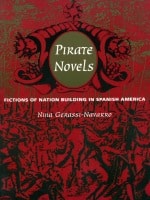
Pirate Novels
Fictions of Nation Building in Spanish AmericaNina Gerassi-Navarro
Duke University Press, 1999
Beginning with an overview of the history of piracy, Gerassi-Navarro traces the historical icon of the pirate through colonial-era chronicles before exploring a group of nineteenth-century Mexican, Colombian, and Argentine novels. She argues that the authors of these novels, in their reconstructions of the past, were less interested in accurate representations than in using their narratives to discuss the future of their own countries. In reading these pirate narratives as metaphors for the process of nation building in Spanish America, Gerassi-Navarro exposes the conflicting strains of a complex culture attempting to shape that future. She shows how these pirate stories reflect the on-going debates that marked the consolidation of nationhood, as well as the extent to which the narratives of national identity in Spanish America are structured in relation to European cultures, and the ways in which questions of race and gender were addressed.
Providing new readings of the cultural and political paradigms that marked the literary production of nineteenth-century Spanish America, Pirate Novels uniquely expands the range of texts usually examined in the study of nation-building. It will interest literary scholars generally as well as those engaged in Latin American, colonial, and postcolonial studies.
Plan Colombia
U.S. Ally Atrocities and Community ActivismJohn Lindsay-Poland
Duke University Press, 2018
Planetary Longings
Mary Louise Pratt
Duke University Press, 2022
Plantation Agriculture and Social Control in Northern Peru, 1875–1933
By Michael J. Gonzales
University of Texas Press, 1985
During the late nineteenth and early twentieth centuries, the social, economic, and political landscape of Peru was transformed profoundly. Within a decade of the country’s disastrous defeat by Chile during the War of the Pacific, the export economy was recovering on the strength of a variety of agricultural and mineral products. The sugar industry played a pivotal role in this process and produced wealthy and socially ambitious families who became prominent political leaders on the national level.
This study, based primarily on previously unavailable private records of sugarcane plantations, examines the external and internal dynamics of the sugar industry. It offers new insights into the process of land consolidation, the economics of sugar technology and production, the formation of the coastal elite, and the organization, recruitment, and control of labor. By focusing on the plantation Cayalti within a regional context, Gonzales presents one of the richest descriptions of the modern plantation for any region of Latin America. The book is a vivid social history of laborers from a variety of racial and ethnic backgrounds, from Chinese to Peruvians of Indian, mestizo, and black heritage.
Plants of the Petén Itza’ Maya
Plantas de los maya itza’ del PeténScott Atran, Ximena Lois and Edilberto Ucan Ek'
University of Michigan Press, 2004
Playing with Things
Engaging the Moche Sex PotsBy Mary Weismantel
University of Texas Press, 2021
Winner, Association for Latin American Art-Arvey Foundation Book Award, 2022
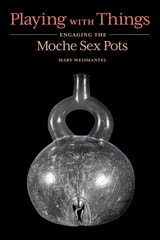
More than a thousand years ago on the north coast of Peru, Indigenous Moche artists created a large and significant corpus of sexually explicit ceramic works of art. They depicted a diversity of sex organs and sex acts, and an array of solitary and interconnected human and nonhuman bodies. To the modern eye, these Moche “sex pots,” as Mary Weismantel calls them, are lively and provocative but also enigmatic creations whose import to their original owners seems impossible to grasp.
In Playing with Things, Weismantel shows that there is much to be learned from these ancient artifacts, not merely as inert objects from a long-dead past but as vibrant Indigenous things, alive in their own inhuman temporality. From a new materialist perspective, she fills the gaps left by other analyses of the sex pots in pre-Columbian studies, where sexuality remains marginalized, and in sexuality studies, where non-Western art is largely absent. Taking a decolonial approach toward an archaeology of sexuality and breaking with long-dominant iconographic traditions, this book explores how the pots "play jokes," "make babies," "give power," and "hold water,” considering the sex pots as actual ceramic bodies that interact with fleshly bodies, now and in the ancient past. A beautifully written study that will be welcomed by students as well as specialists, Playing with Things is a model for archaeological and art historical engagement with the liberating power of queer theory and Indigenous studies.
Plazas and Barrios
Heritage Tourism and Globalization in the Latin American Centro HistóricoJoseph L. Scarpaci
University of Arizona Press, 2004
This book explores how heritage tourism and globalization are reshaping the Latin American centro histórico, analyzing the transformation of the urban core from town plaza to historic center in nine cities: Bogotá, Colombia; Buenos Aires, Argentina; Cartagena, Colombia; Cuenca, Ecuador; Havana, Cuba; Montevideo, Uruguay; Puebla, Mexico; Quito, Ecuador; and Trinidad, Cuba. It tells how these pressures, combined with the advantage of a downtown location, have raised the potential of redeveloping these inner city areas but have also created the dilemma of how to restore and conserve them while responding to new economic imperatives.
In an eclectic and interdisciplinary study, Joseph Scarpaci documents changes in far-flung corners of the Latin American metropolis using a broad palette of tools: urban morphology profiles, an original land-use survey of 30,000 doorways in nine historic districts, numerous photographs, and a review of the political, economic, and globalizing forces at work in historic districts. He examines urban change as reflected in architectural styles, neighborhood growth and decline, real estate markets, and local politics in order to show the long reach of globalization and modernity.
Plazas and Barrios spans all of Spanish-speaking America to address the socio-political dimensions of urban change. It offers a means for understanding the tensions between the modern and traditional aspects of the built environment in each city and provides a key resource for geographers, urban planners, architectural historians, and all concerned with the implications of the emerging global economy.