Results by title
98 books match the query 'Law enforcement' and 13 start with p
Police Interrogation and Confessions
Essays in Law and PolicyYale Kamisar
University of Michigan Press, 2025
Police and the Empire City
Race and the Origins of Modern Policing in New YorkMatthew Guariglia
Duke University Press, 2023
Police in Transition
Essays on the Police Forces in Transition CountriesAndrás Kádár
Central European University Press, 2001
The police forces of the transition countries in Central and Eastern Europe have to undergo profound reform to be able to respond to the needs of society; to serve the public and not just the government, and to prove that they can effectively combat crime. This volume is the result of a survey by the Hungarian Helsinki Committee concerning the mode and extent of changes police forces of the post-communist countries have undergone since 1989 – 1990. Information is provided about the relevant tasks, organization, personnel, accountability, and international relations of the national police forces and about the coercive measures they are entitled to use.
Written by internationally acknowledged experts of policing and representatives of human-rights organizations, Police in Transition deals with the questions of transition, European trends in the governance of the police, the relationship between police and criminality, the role of the police in the constitutional framework, the limits of policing, police brutality, civilian oversight of the police and the possibilities of a democratic reform of police forces in Central and Eastern Europe.
Policing Dissent
Social Control and the Anti-Globalization MovementLuis A. Fernandez
Rutgers University Press, 2008
In November 1999, fifty-thousand anti-globalization activists converged on Seattle to shut down the World Trade Organization’s Ministerial Meeting. Using innovative and network-based strategies, the protesters left police flummoxed, desperately searching for ways to control the emerging anti-corporate globalization movement. Faced with these network-based tactics, law enforcement agencies transformed their policing and social control mechanisms to manage this new threat.
Policing Dissent provides a firsthand account of the changing nature of control efforts employed by law enforcement agencies when confronted with mass activism. The book also offers readers the richness of experiential detail and engaging stories often lacking in studies of police practices and social movements. This book does not merely seek to explain the causal relationship between repression and mobilization. Rather, it shows how social control strategies act on the mind and body of protesters.
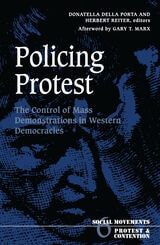
Policing Protest
The Control of Mass Demonstrations in Western DemocraciesDonatella della Porta Della Porta
University of Minnesota Press, 1998
The first international examination of how police respond to political protests.
The way in which police handle political demonstrations is always potentially controversial. In contemporary democracies, police departments have two different, often conflicting aims: keeping the peace and defending citizens’ right to protest. This collection, the only resource to examine police interventions cross-nationally, analyzes a wide array of policing styles. The contributors look at cultures and political power to examine the methods, the trends and cycles, and the consequences of policing protest.
Focusing on Italy, France, Germany, Great Britain, Switzerland, Spain, the United States, and South Africa, the contributors explore the various police strategies of coercion, negotiation, and information surveillance. They discuss protest policing in relation to specific countries’ governments and consider public opinion, media, and the police’s perception of reality to illustrate the reciprocal ways in which police and protest are defined. Moreover, this volume considers the profound changes from the forceful 1960s to a “softer” 1990s, including the consequences of this move.Comparative and innovative, Policing Protest highlights the crucial influences of demonstration interventions and lends greater understanding to the study of social movements and their relationship to the state. Contributors: Rocco De Biasi, U of Genoa; Olivier Fillieule, Institute of Political Science, Paris; Oscar Jaime-Jiménez, Universidad Nacional de Educación a Distancia, Madrid; Fabien Jobard, U of Rouen, France; Hanspeter Kriesi, U of Geneva; Gary T. Marx, Massachusetts Institute of Technology and U of Colorado, Boulder; John McCarthy, Catholic U of America; Clark McPhail, U of Illinois; Fernando Reinares, Universidad Nacional de Educación a Distancia, Madrid; Robert Reiner, London School of Economics; David Schweingruber; P. A. J. Waddington, U of Reading, UK; Martin Winter, U of Halle, Germany; Dominique Wisler, U of Geneva.
Policing Space
Territoriality and the Los Angeles Police DepartmentSteve Herbert
University of Minnesota Press, 1996
Policing Space is a fascinating firsthand account of how the Los Angeles Police Department attempts to control its vast, heterogeneous territory. As such, the book offers a rare, ground-level look at the relationship between the control of space and the exercise of power.
Author Steve Herbert spent eight months observing one patrol division of the LAPD on the job. A compelling story in itself, his fieldwork with the officers in the Wilshire Division affords readers a close view of the complex factors at play in how the police define and control territory, how they make and mark space. A remarkable ethnography of a powerful police department, underscored throughout with telling on-the-scene vignettes, this book is also an unusually intensive analysis of the exercise of territorial power-and of territoriality as a key component of police power. Unique in its application of fieldwork and theory to this complex subject, it should prove valuable to readers in urban and political geography, urban and political sociology, and criminology, as well as those who wonder about the workings of the LAPD.
Policing Welfare
Punitive Adversarialism in Public AssistanceSpencer Headworth
University of Chicago Press, 2021
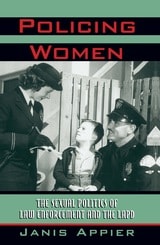
Policing Women
The Sexual Politics of Law Enforcement and the LAPDJanis Appier
Temple University Press, 1998
With a new vision of non-coercive police work and crime prevention, Progressive reformers exerted political and social pressure to create positions for female officers dedicated to guiding and protecting juveniles and women. Women reformers pointed to changing sexual mores among working-class female youth to emphasize the need for a new approach to policing.
The policewomen who undertook the work of counseling sexually active teenage girls and their families saw themselves as helping young people achieve moral equilibrium during a period in which standards of context were in flux. In the Los Angeles Police Department, the first to hire women, this social work was primarily the responsibility of the City Mother's Bureau; in other major cities, policewomen's roles were similarly constructed as maternalistic. Scrutinizing case records, public statements, and departmental policies governing policewomen, Appier shows how female officers handled the complex gender politics of their work with the public and within their departments.
Appier reveals that many of these pioneering policewomen succeeded in expanding the scope of policework and carving out a rewarding professional niche, despite continued attempts to oust them or limit their sphere of action. But this advancement was short-lived; within a generation a masculinized model of crime fighting took hold, and policewomen's authority eroded.
Policing and the Poetics of Everyday Life
Jonathan M. Wender
University of Illinois Press, 2008
This book reflects a conscious attempt to follow the general model of Martin Heidegger’s Zollikon Seminars, in which Heidegger engaged psychiatrists and psychologists in a sustained dialogue aimed at developing their critical awareness of the unexamined philosophical foundations informing their everyday clinical practice. Wender draws on Heidegger to argue that “praxis is poetry” and from this standpoint interprets all social action as intentional creation (or “poiesis”), which by its very nature is intrinsically meaningful. Using an interpretive framework that he calls a “phenomenological aesthetics of encounter,” Wender takes up a number of case studies of police-citizen encounters, including cases of domestic violence, contacts with juveniles, drug-related situations, instances of mental and emotional crisis, and death.

Policing in Natural Disasters
Stress, Resilience, and the Challenges of Emergency ManagementTerri M. Adams and Leigh R. Anderson
Temple University Press, 2019
When natural disasters and emergencies strike, the short- and long-term effects of these events on first responders—the very people society relies upon in the midst of a catastrophe—are often overlooked. Policing in Natural Disasters provides a comprehensive analysis of the major challenges faced by law enforcement officers during extreme crisis events. Terri Adams and Leigh Anderson examine the dilemmas police departments face as well as the impact of the disasters on the professional and personal lives of the officers. Case studies explore the response and recovery phases of emergencies including Hurricane Katrina, the 2010 earthquake and subsequent tsunami in Santiago, Chile, and the Superstorm Tornado Outbreak in 2011.
Policing in Natural Disasters was inspired by the personal accounts of triumph and tragedy shared by first responders. It provides an understanding of first-responder behaviors during disasters, as well as the preparedness, mitigation, response and recovery policy implications for first responders and emergency managers. As first responders must frequently cope with stress, uncertainty, and threats to their health and safety during high-consequence events, Adams and Anderson provide lessons from first-hand experiences of police officers that can lead to better management in times of crisis.
Policing the Project
State Violence and the Dismantling of Chicago Public HousingMadeleine Hamlin
University of Chicago Press, 2027
Shows how policing shaped the trajectory of public housing in Chicago and paved the way for its eradication and privatization.
Public housing should be a great public good, providing an essential basic need for people with lower incomes. Unfortunately, in the United States, policymakers turned their backs on public housing early on. Intended to be a utopia for the working poor, public housing in many cities became characterized by racial isolation, extreme poverty, and infrastructural breakdown, all of which left residents vulnerable to crime. State abandonment had one major exception, however: policing. In Policing the Project, geographer Madeleine Hamlin details how police played an important role in Chicago’s public housing from its origins in 1937 to the eve of its demolition at the turn of the millennium.
Based on archival data as well as extensive interviews with former residents and police officers, Hamlin describes the progressive institutional entanglement of public housing and policing as it unfurled over the course of the twentieth century. Policing the Project transcends mere description of how policing impacted everyday life for public housing residents, instead considering how policing shaped the institution of public housing as a whole. Hamlin argues that policing conditioned public housing’s downfall: draining housing budgets while exacerbating rather than mitigating crime and violence. Thus, policing played an important role in shaping the dramatic transformation of Chicago’s housing landscape, which entailed widespread privatization and the displacement of tens of thousands of Black Chicagoans.
Pressing the Police and Policing the Press
The History and Law of the U.S. Press-Police RelationshipScott Memmel
University of Missouri Press, 2024
What transpired during this troubled time cast a bright light on the contemporary relationship between the press and police in the United States. The relationship between these two fundamental institutions is, however, a long and complicated one, dating back to colonial British North America. In the mid-19th century, (1830s–1850s) both the press and the police began to take their modern forms, and since then have continued to develop, routinely interacting with each other as journalists and police officers often found themselves responding to the same crimes and events. At times, members of both institutions managed to co-exist or even cooperate and made efforts to help one another, while at other times they butted heads to the point of conflict, the professional boundaries between journalists and police officers seemingly blurred.
As both the press and the police have fallen under deep scrutiny in more modern times, the present moment marks what is, perhaps, an opportune time to focus on the political, economic, social, and technological problems they face. In “Pressing the Police and Policing the Press,” Scott Memmel offers the first book-length study of the history and legal landscape of the press-police relationship. Each chapter focuses on interactions between the press and the police during a particular era, introducing relevant societal context and how both institutions evolved and responded to that context. Memmel concludes his study with recommendations on how, going forward, the press and the police might work together to tackle some of the similar issues they face and better serve the public.
Pulled Over
How Police Stops Define Race and CitizenshipCharles R. Epp, Steven Maynard-Moody, and Donald P. Haider-Markel
University of Chicago Press, 2014
Pulled Over deftly traces the strange history of the investigatory police stop, from its discredited beginning as “aggressive patrolling” to its current status as accepted institutional practice. Drawing on the richest study of police stops to date, the authors show that who is stopped and how they are treated convey powerful messages about citizenship and racial disparity in the United States. For African Americans, for instance, the experience of investigatory stops erodes the perceived legitimacy of police stops and of the police generally, leading to decreased trust in the police and less willingness to solicit police assistance or to self-censor in terms of clothing or where they drive. This holds true even when police are courteous and respectful throughout the encounters and follow seemingly colorblind institutional protocols. With a growing push in recent years to use local police in immigration efforts, Hispanics stand poised to share African Americans’ long experience of investigative stops.