Results by title
642 books match the query 'Linguistics' and 37 start with p

Papers of the Fiftieth Algonquian Conference
Monica Macaulay
Michigan State University Press, 2021

Papers of the Fifty-Fifth Algonquian Conference
Actes du Cinquante-Cinquième Congrès des AlgonquinistesInge Genee
Michigan State University Press, 2026
Papers of the Algonquian Conference is a collection of peer-reviewed scholarship from an annual international forum that focuses on topics related to the languages and cultures of Algonquian peoples. This series touches on a variety of subject areas, including anthropology, archaeology, education, ethnography, history, Indigenous studies, language studies, literature, music, political science, psychology, religion, and sociology. Contributors often cite never-before-published data in their research, giving the reader a fresh and unique insight into the Algonquian peoples and rendering these papers essential reading for those interested in studying Algonquian society

Papers of the Fifty-First Algonquian Conference
Monica Macaulay
Michigan State University Press, 2022

Papers of the Fifty-Fourth Algonquian Conference
Actes du cinquante-quatrième Congrès des AlgonquinistesInge Genee
Michigan State University Press, 2025

Papers of the Fifty-Second Algonquian Conference
Monica Macaulay
Michigan State University Press, 2023

Papers of the Fifty-Sixth Algonquian Conference / Actes du Cinquante-sixième Congrès des Algonquinistes
Inge Genee
Michigan State University Press, 2027
Papers of the Algonquian Conference is a collection of peer-reviewed scholarship from an annual international forum that focuses on topics related to the languages and cultures of Algonquian peoples. This series touches on a variety of subject areas, including anthropology, archaeology, education, ethnography, history, Indigenous studies, language studies, literature, music, political science, psychology, religion, and sociology. Contributors often cite never-before-published data in their research, giving the reader a fresh and unique insight into the Algonquian peoples and rendering these papers essential reading for those interested in studying Algonquian society.

Papers of the Forty-Eighth Algonquian Conference
Monica Macaulay
Michigan State University Press, 2019
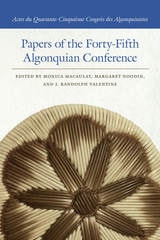
Papers of the Forty-Fifth Algonquian Conference
Monica Macaulay
Michigan State University Press, 2017

Papers of the Forty-Ninth Algonquian Conference
Monica Macaulay
Michigan State University Press, 2020

Papers of the Forty-Seventh Algonquian Conference
Monica Macaulay
Michigan State University Press, 2018

Papers of the Forty-Sixth Algonquian Conference
Monica Macaulay
Michigan State University Press, 2017

Parchment, Paper, Pixels
Law and the Technologies of CommunicationPeter M. Tiersma
University of Chicago Press, 2010
Technological revolutions have had an unquestionable, if still debatable, impact on culture and society—perhaps none more so than the written word. In the legal realm, the rise of literacy and print culture made possible the governing of large empires, the memorializing of private legal transactions, and the broad distribution of judicial precedents and legislation. Yet each of these technologies has its shadow side: written or printed texts easily become static and the textual practices of the legal profession can frustrate ordinary citizens, who may be bound by documents whose implications they scarcely understand.
Parchment, Paper, Pixels offers an engaging exploration of the impact of three technological revolutions on the law. Beginning with the invention of writing, continuing with the mass production of identical copies of legal texts brought about by the printing press, and ending with a discussion of computers and the Internet, Peter M. Tiersma traces the journey of contracts, wills, statutes, judicial opinions, and other legal texts through the past and into the future.
Though the ultimate effects of modern technologies on our legal system remain to be seen, Parchment, Paper, Pixels offers readers an insightful guide as to how our shifting forms of technological literacy have shaped and continue to shape the practice of law today.

Performing Afro-Cuba
Image, Voice, Spectacle in the Making of Race and HistoryKristina Wirtz
University of Chicago Press, 2014
Wirtz analyzes a variety of performances and the ways they construct Cuban racial and historical imaginations. She offers a sophisticated view of performance as enacting diverse revolutionary ideals, religious notions, and racial identity politics, and she outlines how these concepts play out in the ongoing institutionalization of folklore as an official, even state-sponsored, category. Employing Bakhtin’s concept of “chronotopes”—the semiotic construction of space-time—she examines the roles of voice, temporality, embodiment, imagery, and memory in the racializing process. The result is a deftly balanced study that marries racial studies, performance studies, anthropology, and semiotics to explore the nature of race as a cultural sign, one that is always in process, always shifting.
Perspectives in Phonology
Edited by Jennifer S. Cole and Charles Kisseberth
CSLI, 1997
Perspectives on Fluency
Heidi Riggenbach
University of Michigan Press, 2000
Section 1, What Is Fluency? presents papers that all describe fluency, but in different ways.
The articles in Section 2, Essential Components of Fluency, consider features or components that contribute to impressions of fluency.
Section 3, Cognitive Processes Underlying Fluency, is devoted to an exploration of the psycholinguistic factors underlying fluency.
Three studies are presented in Section 4, Empirical Studies on Nonnative Fluency, and they exemplify the range of approaches to characterizing learners as fluent or nonfluent in their target language.
One objective of Perspectives on Fluency is to provide a starting point for language researchers interested in exploring the concept of fluency, a foundation that, until the arrival of this volume, did not exist. The book can be useful to those approaching fluency from a language assessment perspective, and those interested in the relationship of fluency to oral proficiency.
Phonetic Symbol Guide
Geoffrey K. Pullum and William A. Ladusaw
University of Chicago Press, 1996
This fully revised second edition incorporates the major revisions to the International Phonetic Alphabet made in 1989 and 1993. Also covered are the American tradition of transcription stemming from the anthropological school of Franz Boas; the Bloch/Smith/Trager style of transcription; the symbols used by dialectologists of the English language; usages of specialists such as Slavicists, Indologists, Sinologists, and Africanists; and the transcription proposals found in all major textbooks of phonetics.
With sixty-one new entries, an expanded glossary of phonetic terms, added symbol charts, and a full index, this book will be an indispensable reference guide for students and professionals in linguistics, phonetics, anthropology, philology, modern language study, and speech science.
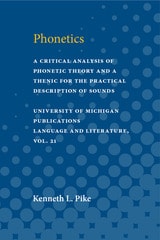
Phonetics
A Critical Analysis of Phonetic Theory and a Technique for the Practical Description of SoundsKenneth L. Pike
University of Michigan Press, 1943

Phonology as Human Behavior
Theoretical Implications and Clinical ApplicationsYishai Tobin
Duke University Press, 1997
Tobin describes the methodological connection between phonological theory and phonetics by way of a comprehensive and insightful survey of phonology’s controversial role in twentieth-century linguistics. He reviews the work of Saussure, Jakobson, Troubetzkoy, Martinet, Zipf, and Diver, among others, and discusses issues in distributional phonology through analyses of English, Italian, Latin, Hebrew, and Yiddish. Using his theory to explain various functional and pathological speech disorders, Tobin examines a wide range of deviant speech processes in aphasia, the speech of the hearing-impaired, and other syndromes of organic origin. Phonology as Human Behavior provides a unique set of principles connecting the phylogeny, ontogeny, and pathology of sound systems in human language.
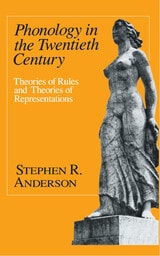
Phonology in the Twentieth Century
Theories of Rules and Theories of RepresentationsStephen R. Anderson
University of Chicago Press, 1985
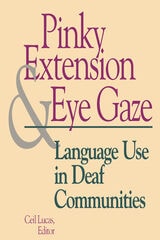
Pinky Extension and Eye Gaze
Language Use in Deaf CommunitiesCeil Lucas
Gallaudet University Press, 1998
The Sociolinguistics in Deaf Communities Series continues its detailed exploration of language dynamics among deaf people in the fourth entry, Pinky Extension and Eye Gaze: Language Use in Deaf Communities. This volume’s ten meticulously prepared chapters reflect the refinements of research in six major sociolinguistics areas. Rob Hoopes’ work, “A Preliminary Examination of Pinky Extension: Suggestions Regarding Its Occurrence, Constraints, and Function,” commences Part One: Variation with a sound explanation of this American Sign Language (ASL) phonological characteristic. Part Two: Languages in Contact includes findings by Jean Ann on contact between Taiwanese Sign Language and written Taiwanese.
Priscilla Shannon Gutierrez considers the relationship of educational policy with language and cognition in deaf children in Part Three: Language in Education, and in Part Four: Discourse Analysis, Melanie Metzger discusses eye gaze and pronominal reference in ASL. Part Five: Second-Language Learning presents the single chapter “An Acculturation Model for ASL Learners,” by Mike Kemp. Sarah E. Burns defines Irish Sign Language as Ireland’s second minority language after Gaelic, in Part Six: Language Attitudes, the final area of concentration in this rigorously researched volume. These studies and the others by the respected scholars featured in Pinky Extension and Eye Gaze make it an outstanding and eminently valuable addition to this series.

Piros and Prehistory
A Study in TanoanDavid Leedom Shaul
University of Utah Press, 2024
Shaul’s arguments use linguistic analyses coupled with historic and prehistoric records of migration and cultural interaction. Following the establishment of Piro as a Tanoan language, much of the linguistic analysis involves determining the aspects of Piro that were inherited from the earlier Proto-Tanoan versus those that were incorporated later as a result of borrowing from other languages through cultural interaction. This book lays out the linguistic argument that the similarities between Piro and Tiwan languages result from borrowing, not common ancestry, and it provides a record of contact between groups and linguistic evolution based on these movements.
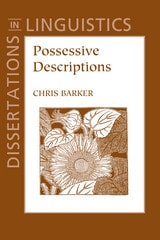
Possessive Descriptions
Chris Barker
CSLI, 1995

Postcards, Translators and Esperanto Pioneers
An Alternative History of International CommunicationGuilherme Fians, Bernhard Struck, and Claire Taylor
University of London Press, 2025
The early twentieth century was a time when steamships, international postal services and the telephone were setting the pace of an early wave of globalisation in Europe. In this increasingly international scenario, what role did language play? To address the geopolitical problem of cross-border linguistic (mis)understanding, international auxiliary languages like Esperanto were created. But what happened to a constructed language when it travelled to different places?
This book tackles these questions by exploring the letters, postcards and activities of John Beveridge (1857–1943) and his family. This Scottish clergyman was a proficient Esperanto speaker, translator and co-founder of several Esperanto organisations. His long-standing engagement with the language left a unique archive that reveals how many Esperanto speakers exchanged letters across borders, produced literature for an international readership, organised congresses and used this language as an entry point into modernity and globalisation from their ‘marginal’ positions in the world.
By tracing this language-based form of grassroots internationalism, the book uncovers wide-reaching networks connecting a corner of Scotland with rural settings and villages in Finland, Bulgaria and Brazil. Ultimately, it asks: what do we learn about international communication and globalisation through the lens of Esperanto and postcards? Focusing on a constructed language and communication technologies that preceded the dominance of global English and social media, this book offers an alternative vantage point on the history of international communication.

Postverbal Behavior
Thomas Wasow
CSLI, 2002
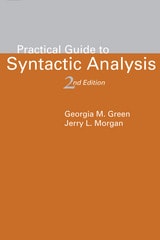
Practical Guide to Syntactic Analysis, 2nd Edition
Georgia M. Green and Jerry L. Morgan
CSLI, 2001

Prague English Studies and the Transformation of Philologies
Edited by Martin Procházka and Ondrej Pilný
Karolinum Press, 2012

Predicative Constructions
From the Fregean to a Montagovian TreatmentFrank Van Eynde
CSLI, 2015
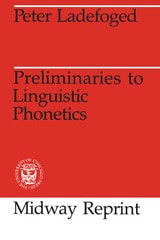
Preliminaries to Linguistic Phonetics
Peter Ladefoged
University of Chicago Press, 1971
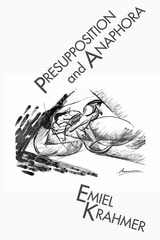
Presupposition and Anaphora
Emiel Krahmer
CSLI, 1998
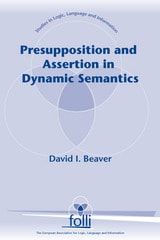
Presupposition and Assertion in Dynamic Semantics
A Critical Review of Linguistic Theories of Presupposition and a Dynamic AlternativeDavid I. Beaver
CSLI, 2001
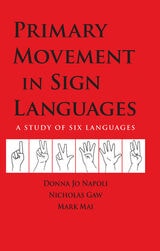
Primary Movement in Sign Languages
A Study of Six LanguagesDonna Jo Napoli
Gallaudet University Press, 2011
Is it possible to identify sign languages by their prosody, that is, the rhythm and stress of sign production, and then determine if they are related to each other or other sign languages? If so, reasoned authors Donna Jo Napoli, Mark Mai, and Nicholas Gaw, perhaps they could offer such identification as a new way to typologize, or categorize sign languages by their structural features. Their new collaboration Primary Movement in Sign Languages: A Study of Six Languages traces the process and findings from this unique investigation.
Resolving on the direction of movement as the prosodic factor to track, they began their research by comparing five sign languages: American Sign Language (ASL), British Sign Language (BSL), Italian Sign Language (LIS), French Sign Language (LSF), and Australian Sign Language (Auslan). They soon discovered that the languages in their study clustered with respect to several characteristics along genetic lines, with BSL and Auslan contrasting with LSF, LIS, and ASL. They learned that sign languages with the same geographic origin evolved differently when relocated, and they isolated differences in each individual sign language. They compared four of these established sign languages with the newly emerging Nicaraguan Sign Language (NSL), with the exception of ASL due to their past close contact, thereby validating their work as the first study to identify sign language relationships without depending on grammar.
Principles of Knowledge Representation
Gerhard Brewka
CSLI, 1996

Probabilistic Approaches to Linguistic Theory
Edited by Jean-Philippe Bernardy, Rasmus Blanck, Stergios Chatzikyriakidis, Shalom Lappin, and Aleksandre Maskharashvili
CSLI, 2022
During the last two decades, computational linguists, in concert with other researchers in AI, have turned to machine learning and statistical techniques to capture features of natural language and aspects of the learning process that are not easily accommodated in classical algebraic frameworks. These developments are producing a revolution in linguistics in which traditional symbolic systems are giving way to probabilistic and deep learning approaches. This collection features articles that provide background to these approaches, and their application in syntax, semantics, pragmatics, morphology, psycholinguistics, neurolinguistics, and dialogue modeling. Each chapter provides a self-contained introduction to the topic that it covers, making this volume accessible to graduate students and researchers in linguistics, NLP, AI, and cognitive science.

Projecting Morphology
Edited by Louisa Sadler and Andrew Spencer
CSLI, 2003
Prosodic Markers and Utterance Boundaries in American Sign Language Interpretation
Brenda Nicodemus
Gallaudet University Press, 2009
The Fifth Volume in the Studies in Interpretation Series
In interpreting, professionals must be able to convey to their clients the rhythm, stress, and length of phrases used by the communicating parties to indicate their respective emotional states. Such subtleties, which can signal sarcasm and irony or whether a statement is a question or a command, are defined in linguistics as prosody. Brenda Nicodemus’s new volume, the fifth in the Studies in Interpretation series, discusses the prosodic features of spoken and signed languages, and reports the findings of her groundbreaking research on prosodic markers in ASL interpretation.
In her study, Nicodemus videotaped five highly skilled interpreters as they interpreted a spoken English lecture into ASL. Fifty Deaf individuals viewed the videotaped interpretations and indicated perceived boundaries in the interpreted discourse. These identified points were then examined for the presence of prosodic markers that might be responsible for the perception of a boundary. Prosodic Markers and Utterance Boundaries reports on the characteristics of the ASL markers, including their frequency, number, duration, and timing. Among other findings, the results show that interpreters produce an average of seven prosodic markers at each boundary point. The markers are produced both sequentially and simultaneously and under conditions of highly precise timing. Further, the results suggest that the type of prosodic markers used by interpreters are both systematic and stylistic.

Prosodic Phrase in Spoken Czech
Jan Volín, Pavel Šturm, Radek Skarnitzl, and Tomáš Boril
Karolinum Press, 2025
The prosodic phrase is a crucial element in the sound structure of the Czech language, though oft overlooked. The properties of prosodic phrases, such as stress, intonation, and tonal pattern, show typical characteristics of prose. Prosodic Phrase in Spoken Czech provides a source for this missing information in an approachable format for all manner of readers. The core of the study draws on authentic speech material—storytelling, news reading, and poetry recitation—where prosodic phrases are analyzed in terms of their phonetic structure, acoustic characteristics, and associated syntactic features. Supported by the presentation of original perception experiments, this monograph delves into the perceptual significance of prosodic phrasing. Beyond offering intriguing insights into this core aspect of prosodic structure, it serves as a valuable resource for designing future experiments in natural language processing.
Putting Linguistics into Speech Recognition
The Regulus Grammar CompilerManny Rayner, Beth Ann Hockey, and Pierrette Bouillon
CSLI, 2006