Results by title
905 books match the query 'Literary' and 29 start with p
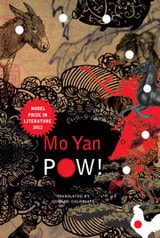
POW!
Mo Yan
Seagull Books, 2012
In this novel by the 2012 Nobel Laureate in Literature, Mo Yan, a benign old monk listens to a prospective novice’s tale of depravity, violence, and carnivorous excess while a nice little family drama—in which nearly everyone dies—unfurls. But in this tale of sharp hatchets, bad water, and a rusty WWII mortar, we can’t help but laugh. Reminiscent of the novels of dark masters of European absurdism like Günter Grass, Witold Gombrowicz, or Jakov Lind, Mo Yan’s POW! is a comic masterpiece.
In this bizarre romp through the Chinese countryside, the author treats us to a cornucopia of cooked animal flesh—ostrich, camel, donkey, dog, as well as the more common varieties. As his dual narratives merge and feather into one another, each informing and illuminating the other, Mo Yan probes the character and lifestyle of modern China. Displaying his many talents, as fabulist, storyteller, scatologist, master of allusion and cliché, and more, POW! carries the reader along quickly, hungrily, and giddily, up until its surprising dénouement.
Mo Yan has been called one of the great novelists of modern Chinese literature and the New York Times Book Review has hailed his work as harsh and gritty, raunchy and funny. He writes big, sometimes mystifying, sometimes infuriating, but always entertaining novels—and POW! is no exception.
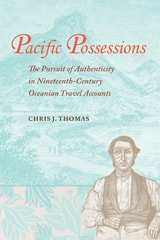
Pacific Possessions
The Pursuit of Authenticity in Nineteenth-Century Oceanian Travel AccountsChris J. Thomas
University of Alabama Press, 2021
Reimagining Oceania through the travel narratives that shaped the meaning of authenticity.
In Pacific Possessions: The Pursuit of Authenticity in Nineteenth-Century Oceanian Travel Accounts, Chris J. Thomas expands the literary canon on Polynesia and Melanesia beyond the giants, such as Herman Melville and Jack London, to include travel narratives by British and American visitors. These accounts were widely read and reviewed when they first appeared but have largely been ignored by scholars. For the first time, Thomas defines these writings as a significant literary genre.
Recovering these works allows us to reconceive of nineteenth-century Oceania as a vibrant hub of cultural interchange. Pacific Possessions recaptures the polyphony of voices that enlivened this space through the writing of these travelers, while also paying attention to their Oceanian interlocutors. Each chapter centers on a Pacific cultural marker, what Thomas refers to as each writer’s “possession”: the Tongan tattoo, the Hawaiian hula, the Fijian cannibal fork, and Robert Louis Stevenson’s cache of South Seas photographs.
Thomas analyzes how westerners formed narratives around these objects and what those objects meant within nineteenth-century Oceanian cultures. He argues that the accounts served to shape a version of Oceanian authenticity that persists today. The profiled traveler-writers had complex experiences, at times promoting exoticized exaggerations of so-called authentic Polynesian and Melanesian cultures and at other times genuinely engaging in cultural exchange. However, their views were ultimately compromised by a western lens. In Thomas’s words, “the authenticity is at once celebrated and written over.”
Pacific Tremors
Richard Stern
Northwestern University Press, 2001
Pacific Tremors
Richard Stern
Northwestern University Press, 2007
Paint
Grace Tiffany
Arizona Center for Medieval and Renaissance Studies, 2013
Papi
A NovelRita Indiana
University of Chicago Press, 2016
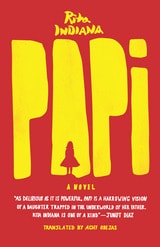
Drawing on her memories of a childhood split between Santo Domingo and visits with her father amid the luxuries of the United States, Rita Indiana mixes satire with a child’s imagination, horror with science fiction, in a swirling tale of a daughter’s love, the lure of crime and machismo, and the violence of the adult world. Expertly translated into English for the first time by Achy Obejas, who renders the rhythmic lyricism of Indiana’s Dominican Spanish in language that propels the book forward with the relentless beat of a merengue, Papi is furious, musical, and full of wit—a passionate, overwhelming, and very human explosion of artistic virtuosity.
Paradise Field
A Novel in StoriesPamela Ryder
University of Alabama Press, 2017
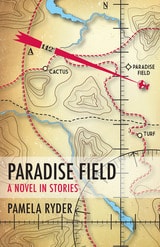
When life dwindles to its irrevocable conclusion, recollections are illuminated, even unto the grave. Such is the narrative of Paradise Field: A Novel in Stories, whose title is taken from a remote airfield in the American Southwest, and while the father recalls his flying days, his daughter—who nurses the old man—reflects as well.
Pamela Ryder’s stories vary in style and perspective, and time lines overlap as death advances and retreats. This unique and shifting narrative explores the complexities of a relationship in which the father—who has been a high-flying outsider—descends into frailty and becomes dependent upon the daughter he has never really known.
The opening story, “Interment for Yard and Garden,” begins as a simple handbook for Jewish burial and bereavement, although the narrator cannot help but reveal herself and her motives. From there, the telling begins anew and unfolds chronologically, returning to the adult daughter’s childhood: a family vacation in France, the grotesqueries of the dinner table, the shadowy sightings of a father who has flown away.
A final journey takes father and daughter back to the Southwest in search of Paradise Field. Their travels through that desolate landscape foreshadow the father’s ultimate decline, as portrayed in the concluding stories that tell of the uneasy transformation in the bond between them and in the transcendence of his demise. Taken together, the stories in Paradise Field are an eloquent but unsparing depiction of infirmity and death, as well as solace and provocation for anyone who has been left to stand graveside and confront eternity.
Passage to the Plaza
Sahar Khalifeh
Seagull Books, 2020
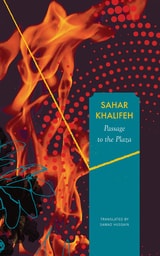
In the furnace of conflict at the heart of the 1987 Intifada, notions of freedom, love, respectability, nationhood, the rights of women, and Palestinian identity—both among the reluctant residents of the house and the inhabitants of the quarter at large—will be melted and re-forged. Vividly recounted through the eyes of its female protagonists, Passage to the Plaza is a groundbreaking story that shatters the myth of a uniform gendered experience of conflict.
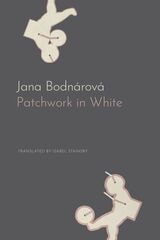
Patchwork in White
Jana Bodnárová
Seagull Books, 2026
An intimate story of otherness and care by a major voice in Slovak literature.
For more than three decades, Jana Bodnárová has been one of Slovak literature’s most distinctive voices, writing with a lyricism that is at once tender and unflinchingly harsh. Patchwork in White is a brief yet powerful novel that stitches together fragments of lives bound by intimacy, difference, and care, set against the social fabric of Czechoslovakia from the mid-1950s to the present.
At the center of the novel are Ota and Andrej, a couple whose shared memories unfold through shards of childhood, marriage, and parenthood. Their lives are irrevocably shaped by the decision to adopt albino twins—children marked by abuse and exclusion because of their otherness. As these fragments accumulate, the novel becomes a meditation on motherhood, femininity, love, and the quiet imminence of death.
Poetic, restrained, and brutally honest, Bodnárová’s prose finds resonance in what is left unsaid. Illustrations by Eva Moflárová deepen the book’s emotional texture, creating a work of rare intimacy and moral force.
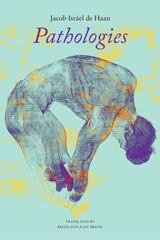
Pathologies
The Downfall of Johan van Vere de WithJacob Isräel de Haan
Seagull Books, 2024
At the start of the twentieth century, Jewish anti-Zionist Jacob Israël de Haan led an eventful life as a poet, journalist, teacher, and lawyer in the Netherlands. His autobiographical novella Pipelines caused a storm of controversy in 1904 with its portrayal of a subject that was considered scandalous at the time—a romantic relationship between two young men. He lost his teaching job, and the entire print run was pulped.
In his iconic 1908 novel Pathologies, he once again openly and radically explored the topic of homosexuality. The story centers around adolescent Johan, who lives a secluded life with his father and their elderly housekeeper in a large house. For a while, Johan has been plagued by erotic fantasies about his classmates. When, to make matters worse, he finds himself feeling attracted to his father—first in a dream, and then in real life—he grows desperate. Johan moves out, finding room and board with an older married couple in Haarlem, where he meets René, a young confident artist. Johan falls head-over-heels in love, and the two men enter a sadomasochistic relationship that soon begins to spiral out of control.
Johan is one of world literature’s most tragic, troubled young heroes, at par with Goethe’s Werther and Dostoevsky’s Raskolnikov. His struggle to come to terms with his fantasies and desires—rife with taboos that continue to resonate today—forms the beating heart of this daring novel. Written in De Haan’s precise, lyrical prose, Pathologies has lost none of its force more than a century after it was first published.
Peltse and Pentameron
Volodymyr Dibrova
Northwestern University Press, 1996
Peltse portrays the formation of an average apparatchik. Both funny and alarming, it provides a psychological portrait of an individual trapped in a system he simultaneously dislikes and depends upon for survival. Pentameron tells the story of one day in the life of five colleagues at a Soviet research institute. Each is dissatisfied, yet all are trapped in and by a system that has taken away their ability to act decisively.
Performance Art
StoriesDavid Kranes
University of Nevada Press, 2021

Performing Violence
Literary and Theatrical Experiments of New Russian DramaBirgit Beumers and Mark Lipovetsky
Intellect Books, 2009
The so-called “New Russian Drama” emerged at the end of the twentieth century, following a long period of decline in dramatic writing in the late Soviet and post-Soviet era. In Performing Violence, Birgit Beumers and Mark Lipovetsky examine the representation of violence in these new dramatic works by young Russian playwrights. Reflecting the disappointment in Yeltsin’s democratic reforms and Putin’s neoconservative politics, the plays focus on political and social representations of violence, its performances, and its justifications.
As the first English-language study of Russian drama and theatre in the twenty-first century, Performing Violence seeks a vantage point for the analysis of brutality in post-Soviet culture. While previous generations had preferred poetry and prose, this new breed of authors—the Presnyakov brothers, Evgeni Grishkovets, and Vasili Sigarev among them—have garnered international recognition for their fierce plays. This book investigates the violent portrayal of the identity crisis of a generation as represented in their theatrical works, and will be a key text for students and scholars of drama, Russian studies, and literature.
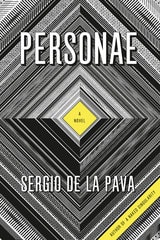
Personae
A NovelSergio De La Pava
University of Chicago Press, 2013
This book is nothing like that one. Just look at it: A Naked Singularity was a brick of a book, 678 pages, and this one’s slim--lean and focused. A Naked Singularity locked us into the unforgettable voice of its protagonist, Casi, while Personae shimmers and shifts among different perspectives, locations, and narrative techniques.
But sharp readers will quickly see that the two books are the work of the same hand. The sheer energy of De La Pava’s sentences, his eye for absurd humor, his commitment to the idea of justice--all will be familiar here as they carry us from the tale of an obsessive, damaged psychic detective consumed by a murder case, into a Sartrean drama that raises questions (and jokes) about responsibility, fate, death, and more. And when De La Pava eventually returns us to the investigation, this time seen from the other side, the lives and deaths bound up in it feel all the more real, and moving, even as solid answers slip away into mist.
Shelf Awareness declared that A Naked Singularity "heralded the arrival of a tremendous talent." In some ways, despite its brevity, Personae is even more surprising and challenging--and, in its ambition and fierce intelligence, it’s proof that Sergio De La Pava is here to stay.
Perverzion
Yuri Andrukhovych
Northwestern University Press, 2005
Or, then again, it may not.
Perverzion constructs Perfetsky's final days using a mishmash of relics, from official documents to recorded interviews to scraps of paper. Perfetsky, the personification of the Ukrainian artistic superman—he used his masterful musicianship in a collaboration with Elton John during the pop star's secret sojourn in Ukraine—is bound for Venice to participate in a seminar to save the world from absurdity. On the way he becomes a Ukrainian Orpheus descending into the decadence of the West, navigating through surrealistic adventures and no less surrealistic seminar topics as he charges head up (and pants down) toward his fate.
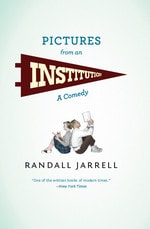
Pictures from an Institution
A ComedyRandall Jarrell
University of Chicago Press, 1952
A finalist for the National Book Award, this classic novel of midcentury campus life is demonically funny and brutally cutting
Beneath the unassuming surface of a progressive women’s college lurks a world of intellectual pride and pomposity awaiting devastation by the pens of two brilliant and appalling wits. Randall Jarrell’s classic novel was originally published to overwhelming critical acclaim in 1954, forging a new standard for campus satire—and instantly yielding comparisons to Dorothy Parker’s razor-sharp barbs. Like his fictional nemesis, Jarrell cuts through the earnest conversations at Benton College—mischievously, but with mischief nowhere more wicked than when crusading against the vitriolic heroine herself.
“A most literate account of a group of most literate people by a writer of power. . . . A delight of true understanding.”—Wallace Stevens
“I’m greatly impressed by the real fun, the incisive satire, the closeness of observation, and in the end by a kind of sympathy and human warmth. It’s a remarkable book.”—Robert Penn Warren
“Move over Dorothy Parker. Pictures . . . is less a novel than a series of poisonous portraits, set pieces, and endlessly quotable put-downs. Read it less for plot than sharp satire, Jarrell’s forte.”—Mary Welp
“One of the wittiest books of modern times.”—New York Times
“[T]he father of the modern campus novel, and the wittiest of them all. Extraordinary to think that ‘political correctness’ was so deliciously dissected 50 years ago.”—Noel Malcolm, Sunday Telegraph
“A sustained exhibition of wit in the great tradition. . . . Immensely and very devastatingly shrewd.”—Edmund Fuller, Saturday Review
“[A] work of fiction, and a dizzying and brilliant work of social and literary criticism. Not only ‘a unique and serious joke-book,’ as Lowell called it, but also a meditation made up of epigrams.”—Michael Wood
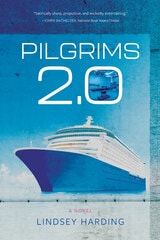
Pilgrims 2.0
A NovelLindsey Harding
Acre Books, 2023
PILGRIM, Canterbury Cruise Line’s flagship, promises its passengers not just a luxurious fortnight away but the opportunity for reinvention. This extraordinary journey is made possible by the captain and visionary plastic surgeon Dr. Walter Heston, by the vessel’s self-learning artificial intelligence called BECCA, and an all-male crew of room stewards, deck hands, technicians, and cosmetic practitioners.
Pilgrims 2.0 begins on the eve of Cruise #52 and follows four women eager for transformation. Meet Bianca, the aging athlete determined to resume the competitive tennis career that motherhood sidelined. Meet Nicole, whose mommy makeover will mean she can stop hiding herself, and her debt, from her husband. Meet Lyla, an infertile maternity-ward nurse desperate to experience pregnancy, and Annalie, who wants only to stop seeing her dead twin every time she looks in the mirror. At the center of the story is Dr. Heston himself, driven to do with bodies what his late wife, Rebecca, could do with computer code—make the impossible, possible.
But “excursions” like these aren’t always smooth sailing—especially on this voyage, where the hopes, histories, and obsessions of clients and crew members collide. When a disruptive crewman’s pranks turn dangerous, it becomes clear that some of those who embarked won’t return to the Port of Los Angeles—at least not fully, at least not as themselves, and maybe not with their lives.
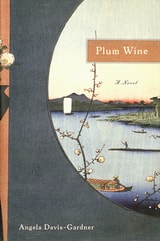
Plum Wine
A NovelAngela Davis-Gardner
University of Wisconsin Press, 2006
Barbara Jefferson, a young American teaching in Tokyo in the 1960s, is set on a life-changing quest when her Japanese surrogate mother, Michi, dies, leaving her a tansu of homemade plum wines wrapped in rice paper. Within the papers Barbara discovers writings in Japanese calligraphy that comprise a startling personal narrative. With the help of her translator, Seiji Okada, Barbara begins to unravel the mysteries of Michi's life, a story that begins in the early twentieth century and continues through World War II and its aftermath.
As Barbara and Seiji translate the plum wine papers they form an intimate bond, with Michi a ghostly third in what becomes an increasingly uneasy triangle. Barbara is deeply affected by the revelation that Michi and Seiji are hibakusha, survivors of the atomic bombing in Hiroshima, and even harder for her to understand are the devastating psychological effects wrought by war. Plum Wine examines human relationships, cultural differences, and the irreparable consequences of war in a story that is both original and timeless.
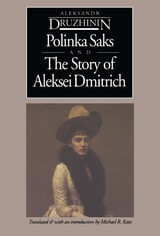
Polinka Saks and The Story of Aleksei
Aleksandr Druzhinin
Northwestern University Press, 1992
A far different tale, The Story of Aleksei Dmitrich is a complex social and psychological study of poverty, family disharmony, precocious children, and destructive self-sacrifice.
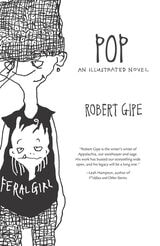
Pop
An Illustrated NovelRobert Gipe
Ohio University Press, 2024
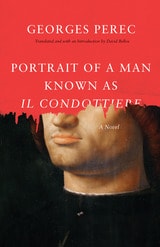
Portrait of a Man Known as Il Condottiere
Georges Perec
University of Chicago Press, 2015
Before embarking on these experiments, however, Perec tried his hand at a relatively straightforward novel, Portrait of a Man. His first book, it was rejected by publishers when he submitted it in 1960, after which he filed it away. Decades after Perec’s death, David Bellos discovered the manuscript, and through his translation we have a chance to enjoy it in English for the first time. What fans will find here is a thriller that combines themes that would remain prominent in Perec’s later work, such as art forgery, authenticity, and murder, as well as craftsman Gaspard Winckler, who whose namesakes play major roles in Life A User’s Manual and W or The Memory of Childhood.
Engaging and entertaining on its own merits, and gaining additional interest when set in the context of Perec’s career, Portrait of a Man is sure to charm the many fans of this postmodern master.
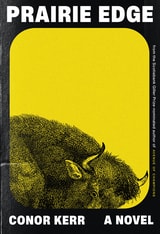
Prairie Edge
Conor Kerr
University of Minnesota Press, 2024
Set loose a herd of bison in downtown Edmonton: what could go wrong?
Métis cousins Isidore “Ezzy” Desjarlais and Grey Ginther have beef with their world. With the latest racist policy rolling out. With whatever new pipeline plowing through traditional territory. With the way a treaty (aka, the army) forced the Papaschase Cree off their home on the prairie. And, on the other hand, with how Grey’s friends think if they all just went back to the Rez or the settlement, life would be so much better—pretty, like an Instagram ad. Then there’s the warming planet. And their future, which they seem to be screwing up quite well on their own. Being alive can’t be all cribbage, Lucky Lager, and swiping the occasional catalytic converter.
One night, the cousins hatch a plan to capture a herd of bison from a nearby national park and release them in downtown Edmonton. They want to be seen, be heard, and to disrupt the settler routines of the city, yet they have no idea what awaits them or the fateful consequences their actions have. Balancing wit and sorrow in a work of satire, social commentary, and whip-smart storytelling, Prairie Edge follows Ezzy and Grey’s inspired misadventures as their zealous ideas about bringing about real change do indeed elicit change, just in unexpected and sometimes disastrous ways.
Conor Kerr imagines a web of Métis relationships strained by dislocation, poverty, violence, and cultural drift, but he also laces the ties that bind Ezzy and Grey—and forever bind the Métis to the land—to explore the radical possibility that a couple of inspired miscreants might actually have the power to make a difference.
Prairie Oyster
Robinson, Sophie
University of Iowa Press, 2026
Pearl is a thirty-something filmmaker balanced precariously on the edge of an addiction-fueled breakdown. But when she is invited to interview her idol and crush, lesbian cult filmmaker Mitch Meyer, her stilted life restarts.
Buoyed and seduced by Mitch’s interest in her and her work, Pearl swaps alcoholism for romantic obsession and London for a summer in New York with Mitch. All the while she is haunted by a project she has been toying with for years: a film about Veronica Lake, a 1940s film star who drank herself into obscurity.
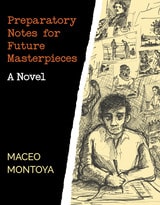
Preparatory Notes for Future Masterpieces
A NovelMaceo Montoya
University of Nevada Press, 2021
From critically acclaimed author Maceo Montoya comes an inventive and adventurous satirical novel about a Mexican-American artist’s efforts to fulfill his vision: to paint masterful works of art. His plans include a move to Paris to join the ranks of his artistic hero, Gustave Courbet—except it’s 1943, and he’s stuck in the backwoods of New Mexico. Penniless and prone to epileptic fits, even his mother thinks he’s crazy.
Ernie Lobato has just inherited his deceased uncle’s manuscript and drawings. At the urging of his colleague, an activist and history buff (Lorraine Rios), Ernie sends the materials to a professor of Chicanx literature (Dr. Samuel Pizarro). Throughout the novel, Dr. Pizarro shares his insights and comments on the uncle’s legacy in a series of annotations to his text and illustrations.
As Ernie’s uncle battles a world that is unkind to “starving artists,” he runs into other tormented twentieth-century artists, writers, and activists with ambitions to match his own: a young itinerant preacher (Reies López Tijerina); the “greatest insane artist” (Martín Ramirez); and Oscar Zeta Acosta who is hellbent on self-destruction. Will the fortuitous encounters with these prophetic figures result in his own genius being recognized? Or will his
uncompromising nature consign him to what he fears most?
Told through a combination of words and images in the tradition of classic works such as Don Quixote and Alice in Wonderland, Preparatory Notes for Future Masterpieces features fifty-one vivid black-and-white pen drawings. This complex and engaging story also doubles as literary criticism, commenting on how outsiders’ stories fit into the larger context of the Chicanx literary canon. A unique and multilayered story that embraces both contradiction and possibility, it also sheds new light on the current state of Chicanx literature while, at the same time, contributing to it.
Propulsive, humorous, and full of life, this candid novel will be loved not only by Beat fiction fans but by contemporary fiction lovers as well.
Pretend I'm Dead
A NovelJen Beagin
Northwestern University Press, 2015
Jen Beagin’s funny, moving, fearless debut novel introduces an unforgettable character, Mona—almost 24, cleaning houses to get by, emotionally adrift. Handing out clean needles to drug addicts, she falls for a recipient who proceeds to break her heart in unimaginable ways. She decamps to Taos, New Mexico, for a fresh start, where she finds a community of seekers and cast-offs. But they all have one or two things to teach her—the pajama-wearing, blissed-out New Agers, the slightly creepy client with peculiar tastes in controlled substances, the psychic who might really be psychic. Always just under the surface are her memories of growing up in a chaotic, destructive family from which she’s trying to disentangle herself. The story of her journey toward a comfortable place in the world and a measure of self-acceptance is psychologically acute, often surprising, and entirely human.
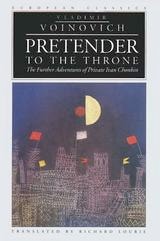
Pretender to the Throne
Further Adventures of Private Ivan ChonkinVladimir Voinovich
Northwestern University Press, 1995
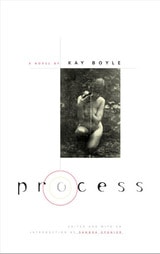
Process
A NovelKay Boyle. Edited and with an Introduction by Sandra Spanier
University of Illinois Press, 2006
Three quarters of a century after the manuscript of Kay Boyle’s first novel disappeared, a carbon copy of it was discovered by Sandra Spanier, the preeminent Boyle authority. Set off by Spanier’s substantial introduction, Process is published here for the first time in paperback.
A classic bildungsroman, Process tells the story of Kerith Day, who is in search of her own identity and place in the world. A keenly critical observer of the dreary industrial landscape and the beaten-down inhabitants of her native Cincinnati, Ohio, Kerith is determined to discover something better. She places her faith in art and politics and sets off for France, where workers and radicals are on the same side.
Professions
Conversations on the Future of Literary and Cultural StudiesEdited by Donald E. Hall
University of Illinois Press, 2001
This volume bares professional concerns, relationships, ambitions, and insecurities about working in academe. Professions provides hard-to-get insider information for students contemplating an academic career. It also challenges professional scholars to retrieve the intellectual curiosity that drew them to scholarship in the first place while demonstrating how disagreement on controversial issues can be conducted with respect, good humor, and an open mind.
Professions features:
Jane Tompkins and Gerald Graff
John McGowan and Regenia Gagnier
James Phelan and James Kincaid
Marjorie Perloff and Robert von Hallberg
Judith Jackson Fossett and Kevin Gaines
Dennis W. Allen and Judith Roof
Niko Pfund, Gordon Hutner, and Martha Banta
Geoffrey Galt Harpham
Donald E. Hall and Susan S. Lanser
J. Hillis Miller, Herbert Lindenberger, Sandra Gilbert, Bonnie Zimmerman, Nellie Y. McKay, and Elaine Marks
Prologue
A Novel for the Beginning of the 1860sMichael R. Katz
Northwestern University Press, 1994
Set in Petersburg in 1857, on the eve of the great reforms that would include the emancipation of the serfs, Prologue expresses the author's hostility toward Russian liberals, their halfhearted attempts to alleviate the sufferings of peasants, and their insufficient support of revolution, while also exploring the obstacles in the path of women's social and personal development in the Victorian era. Michael R. Katz's new translation makes this singular work available to the non-Russian reading public for the first time.