100 books match the query 'London' and 6 start with p
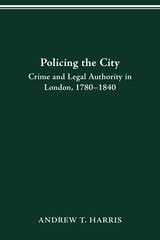
cover of POLICING THE CITY: CRIME & LEGAL AUTHORITY IN LONDON, 1780-1840

POLICING THE CITY

CRIME & LEGAL AUTHORITY IN LONDON, 1780-1840

ANDREW T. HARRIS

The Ohio State University Press, 2004
In Policing the City, Harris seeks to explain the transformation of criminal justice, particularly the transformation of policing, between the 1780s and 1830s in the City of London. As utilitarian legal reformers argued that criminal deterrence ought to be based on certain and rational punishment rather than random execution, they also had to control the discretionary authority of enforcement. This meant in theory and practice the centralization of policing in the 1830s, and the end of local policing, which was seen as corrupt, inefficient, and unsuitable for rational criminal justice. Revolutionary changes in policing began locally, however, in the 1780s. Such local changes preceded and inspired national reforms, and local policing up to the centralizing measures of the 1830s remained dynamic, responsive, and locally accountable right until its demise. Anxiety about policing had as much to do with the social origins of the police as it did about the origins of criminality, and control over the discretionary authority of watchmen and constables played a larger role in criminal justice reform than the nature of crime. The national, metropolitan, and City police reforms of the late 1830s were thus the culmination of a contentious argument over the meanings of justice, efficiency, and order, rather than its beginning. Harris's evidence reveals how what we've come to think of as “modern” policing evolved out of local practice and reflects shifts in wider debates about crime, justice, and discretionary authority.
[more]
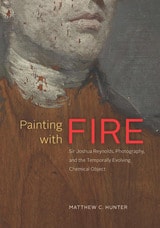
cover of Painting with Fire: Sir Joshua Reynolds, Photography, and the Temporally Evolving Chemical Object

Painting with Fire

Sir Joshua Reynolds, Photography, and the Temporally Evolving Chemical Object

Matthew C. Hunter

University of Chicago Press, 2019

Painting with Fire shows how experiments with chemicals known to change visibly over the course of time transformed British pictorial arts of the long eighteenth century—and how they can alter our conceptions of photography today. As early as the 1670s, experimental philosophers at the Royal Society of London had studied the visual effects of dynamic combustibles. By the 1770s, chemical volatility became central to the ambitious paintings of Sir Joshua Reynolds, premier portraitist and first president of Britain’s Royal Academy of Arts. Valued by some critics for changing in time (and thus, for prompting intellectual reflection on the nature of time), Reynolds’s unstable chemistry also prompted new techniques of chemical replication among Matthew Boulton, James Watt, and other leading industrialists. In turn, those replicas of chemically decaying academic paintings were rediscovered in the mid-nineteenth century and claimed as origin points in the history of photography.

Tracing the long arc of chemically produced and reproduced art from the 1670s through the 1860s, the book reconsiders early photography by situating it in relationship to Reynolds’s replicated paintings and the literal engines of British industry. By following the chemicals, Painting with Fire remaps familiar stories about academic painting and pictorial experiment amid the industrialization of chemical knowledge.
 
[more]
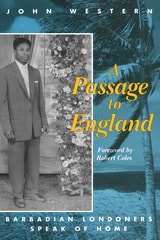
cover of Passage To England: Barbadian Londoners Speak of Home

Passage To England

Barbadian Londoners Speak of Home

John Western

University of Minnesota Press, 1992

Since World War II London has become a significantly multiracial city. Some of the earliest agents of its transformation were young men and women recruited in the late 1950s from Barbados, then a British colony, to work in the metropolis’s nationalized public transportation system and in its hospitals. These Barbadians met, married, settled in London, and raised Londoner children. In 1987-88 John Western conducted a series of interviews with twelve such families--both parents and children. Their vivid words fill A Passage to England with insight, human, and, often, poignancy. Here is a rich perspective on thirty years or more of London social history.

Western structured the interviews to allow the Barbadians a lot of freedom to discuss whatever came to mind concerning either their own life histories and achievements, or wider themes of culture, politics, and society. Topics covered range from matters of “race” to Margaret Thatcher and the change her decade in power has wrought in Britain. One development, for example, is the strikingly entrepreneurial spirit now embraced by some of the young British blacks, veritably “Mrs. Thatcher’s Children.” Ultimately, many of the interviewees focused on the changes they see in their ancestral island in the Caribbean, to which all of them have returned for visits. For this migrant generation especially, as the prospect of retirement begins to grow increasingly important, inevitable questions regard the definitions of “home” and “belonging” must be confronted: Does one stay in London--with one’s children and grandchildren--or does one return to Barbados, which for many seems no longer the same island as the one they left a working lifetime ago? Within the context of an ever-increasing complement of geographically mobile people worldwide, Western’s study provides unique insights into the particular ambiguities a particular set of person have wrestled with at a particular moment in history...but the import of the Barbadian Londoners’ story is universal.
[more]
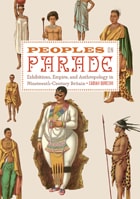
cover of Peoples on Parade: Exhibitions, Empire, and Anthropology in Nineteenth-Century Britain

Peoples on Parade

Exhibitions, Empire, and Anthropology in Nineteenth-Century Britain

Sadiah Qureshi

University of Chicago Press, 2011
In May 1853, Charles Dickens paid a visit to the “savages at Hyde Park Corner,” an exhibition of thirteen imported Zulus performing cultural rites ranging from songs and dances to a “witch-hunt” and marriage ceremony. Dickens was not the only Londoner intrigued by these “living curiosities”: displayed foreign peoples provided some of the most popular public entertainments of their day. At first, such shows tended to be small-scale entrepreneurial speculations of just a single person or a small group. By the end of the century, performers were being imported by the hundreds and housed in purpose-built “native” villages for months at a time, delighting the crowds and allowing scientists and journalists the opportunity to reflect on racial difference, foreign policy, slavery, missionary work, and empire.
 
Peoples on Parade provides the first substantial overview of these human exhibitions in nineteenth-century Britain. Sadiah Qureshi considers these shows in their entirety—their production, promotion, management, and performance—to understand why they proved so commercially successful, how they shaped performers’ lives, how they were interpreted by their audiences, and what kinds of lasting influence they may have had on notions of race and empire. Qureshi supports her analysis with diverse visual materials, including promotional ephemera, travel paintings, theatrical scenery, art prints, and photography, and thus contributes to the wider understanding of the relationship between science and visual culture in the nineteenth century.
 
Through Qureshi’s vibrant telling and stunning images, readers will see how human exhibitions have left behind a lasting legacy both in the formation of early anthropological inquiry and in the creation of broader public attitudes toward racial difference.
[more]
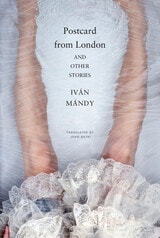
cover of Postcard from London: and Other Stories

Postcard from London

and Other Stories

Iván Mándy

Seagull Books, 2021

The first comprehensive volume in English from one of Hungary’s most popular twentieth-century writers. 

Iván Mándy (1918–1995) has been called “the prose poet of Budapest,” and this volume of short stories presents the first comprehensive collection of his work in English. His early oeuvre created an urban mythology full of picaresque characters inhabiting the seedier neighborhoods of the city: its flea-market stalls, second-run cinemas, and old-fashioned coffeehouses. The stories from the later decades of Mándy’s life, often bordering on the absurd, introduce many autobiographical elements spun around the author’s alter-ego, János Zsámboky, whose hapless adventures on a rare trip abroad constitute this group of stories, including “Postcard from London.” Mándy’s unique style at times borrows techniques from films and radio plays, his quirky cuts creating a flicker of images seen in the mind’s eye. Memory and perception, time and place spin in narrative legerdemain that invites and rewards the reader’s active participation.

[more]
cover of Precarious Motherhood: Navigating Relationships and Support Post-Migration in the UK

Precarious Motherhood

Navigating Relationships and Support Post-Migration in the UK

Rachel Benchekroun

University College London, 2025

When the state withdraws support, migrant mothers build their own safety nets—a look at the strategies and struggles of those raising children under immigration insecurity.

Precarious Motherhood is a deeply human investigation of the lives of racially minoritized mothers as they navigate the intersecting challenges of financial hardship and the UK’s hostile immigration policies. Based on thorough ethnographic research, Rachel Benchekroun examines how these mothers forge relationships to access support, maintain their children’s well-being, and carve out spaces of belonging in an often unwelcoming system. The book captures the resilience and the relentless precarity of motherhood in migration, where every relationship shapes social barriers and everyday survival.

Through the voices of over twenty migrant mothers, this work sheds light on the personal and political dimensions of motherhood. It provides critical insights into state policies and social infrastructures that shape migrant lives, making it a valuable resource for scholars of migration and social justice.
 
[more]