Results by title
133 books match the query 'Mammals' and 8 start with p
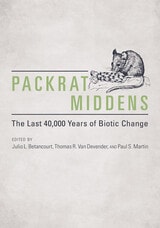
Packrat Middens
The Last 40,000 Years of Biotic ChangeEdited by Julio L. Betancourt, Thomas R. Van Devender, and Paul S. Martin
University of Arizona Press, 1990
This book brings together the findings and views of many of the researchers investigating fossil middens in the United States, Mexico, Africa, the Middle East, and Australia. The contributions serve to open a forum for methodological concerns, update the fossil record of various geographic regions, introduce new applications, and display the vast potential for fossil midden analysis in arid regions worldwide. The findings presented here will serve to foster regional research and to promote general studies devoted to global climate change. Included in the text are more than two hundred charts, photographs, and maps.
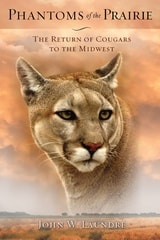
Phantoms of the Prairie
The Return of Cougars to the MidwestJohn W. Laundré
University of Wisconsin Press, 2012
Last seen in the 1880s, cougars (also known as pumas or mountain lions) are making a return to the plains regions of the Midwest. Their comeback, heralded by wildlife enthusiasts, has brought concern and questions to many. Will the people of the region make room for cougars? Can they survive the highly altered landscape of the Midwest? Is there a future for these intrepid pioneers if they head even farther east?
Using GIS technology, and historical data, among many other methods, Phantoms of the Prairie takes readers on a virtual journey, showing how the cougar might move over the landscape with minimal human contact. Drawing on his years of research on cougars, John W. Laundré offers an overview of what has been, what is, and what might be regarding the return of cougars to their ancestral prairie homeland.
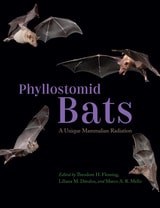
Phyllostomid Bats
A Unique Mammalian RadiationEdited by Theodore H. Fleming, Liliana M. Dávalos, and Marco A. R. Mello
University of Chicago Press, 2020
Coauthored by leading experts in the field and synthesizing the latest advances in molecular biology and ecological methods, Phyllostomid Bats is the first overview in more than forty years of the evolution of the many morphological, behavioral, physiological, and ecological adaptations in this family. Featuring abundant illustrations as well as details on the current conservation status of phyllostomid species, it is both a comprehensive reference for these ecologically vital creatures and a fascinating exploration of the evolutionary process of adaptive radiation.
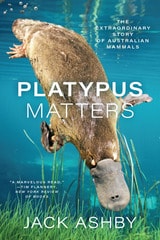
Platypus Matters
The Extraordinary Story of Australian MammalsJack Ashby
University of Chicago Press, 2022
Think of a platypus: They lay eggs (that hatch into so-called platypups), produce milk without nipples and venom without fangs, and can detect electricity. Or a wombat: Their teeth never stop growing, they poop cubes, and they defend themselves with reinforced rears. And what about antechinuses—tiny marsupial carnivores whose males don’t see their first birthday, as their frenzied sex lives take so much energy that their immune systems fail? Platypuses, possums, wombats, echidnas, devils, kangaroos, quolls, dibblers, dunnarts, kowaris: Australia has some truly astonishing mammals, with incredible, unfamiliar features. But how does the world regard these creatures? And what does that mean for their conservation?
In Platypus Matters, naturalist Jack Ashby shares his love for these often-misunderstood animals. Informed by his own experiences meeting living marsupials and egg-laying mammals during fieldwork in Tasmania and mainland Australia, as well as his work with thousands of zoological specimens collected for museums over the last two-hundred-plus years, Ashby’s tale not only explains historical mysteries and debunks myths (especially about the platypus), but also reveals the toll these myths can take. Ashby makes clear that calling these animals “weird” or “primitive”—or incorrectly implying that Australia is an “evolutionary backwater,” a perception that can be traced back to the country’s colonial history—has undermined conservation: Australia now has the worst mammal extinction rate of any place on Earth. Important, timely, and written with humor and wisdom by a scientist and self-described platypus nerd, this celebration of Australian wildlife will open eyes and change minds about how we contemplate and interact with the natural world—everywhere.
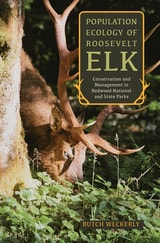
Population Ecology of Roosevelt Elk
Conservation and Management in Redwood National and State ParksButch Weckerly
University of Nevada Press, 2017
In a study spanning more than twenty years, Weckerly made key observations and conducted various investigations under a multitude of ecological conditions. Few authors have dedicated this much time and effort into a single research area. It is a testament to perseverance that his groundbreaking study of the Roosevelt elk was so successful. He was able to document the independent dynamics of several herds of female elk, experience the extinction of one of their subpopulations, and record scientific conclusions in the context of resiliency and redundancy of the elk population.
This book will be of considerable interest to those who investigate the ecology of big game animals, including naturalists, hunters, and individuals with particular interest in Redwood State and National Parks. It is an important book that contributes substantially to the persistence and viability of Roosevelt elk in the parks and the surrounding area.
Population Fluctuations in Rodents
Charles J. Krebs
University of Chicago Press, 2013
Primate Societies
Edited by Barbara B. Smuts, Dorothy L. Cheney, Robert M. Seyfarth, Richard W. Wr
University of Chicago Press, 1986
information on primate socioecology and its theoretical and
empirical significance, spanning the disciplines of behavioral
biology, ecology, anthropology, and psychology. It is a very rich
source of ideas about other taxa.
"A superb synthesis of knowledge about the social lives of
non-human primates."—Alan Dixson, Nature
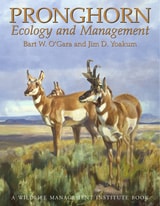
Pronghorn
Ecology & Mangemt: Ecology and ManagementBart W. O'Gara
University Press of Colorado, 2004
Full chapters are devoted to distribution, nutrition and food, diseases and parasites, ecosystem management, hunting, and much more. The principal authors—the world’s preeminent pronghorn biologists, Bart W. O’Gara and Jim D. Yoakum—conclude with a thorough discussion of the future of pronghorn and their management. With 23 chapters that include contributions by 10 other wildlife professionals and more than 850 illustrations, including original artwork by Edson Fichter and Daniel P. Metz, Pronghorn: Ecology and Management is the definitive work on the species.
A Wildlife Management Institute Book