Results by title
58 books match the query 'Media & Internet' and 4 start with p

Pandemic Crossings
Digital Technology, Everyday Experience, and Governance in the COVID-19 CrisisGuobin Yang
Michigan State University Press, 2024

Phantom Politics
Bots, Humans, AI, and Social MediaMina Momeni
Rutgers University Press, 2027
Phantom Politics develops a new framework for understanding how humans, bots, and AI systems interact on social media platforms and structure political communication. Focusing primarily on X (formerly Twitter), it analyzes three cases: the 2017 Women’s March, the 2019 “Build the Wall” discourse, and U.S. federal election discourse in 2024, to demonstrate how X functions not only as a mirror of political trends but also as a driver of change in the digital public sphere. The book shows how political participation is shaped by both authentic political expression and bot-driven narratives. It introduces new concepts to explain how AI-generated political speech can appear human while remaining detached from a human speaker, raising urgent questions about agency, accountability, and political voice. At a time when AI technologies are becoming increasingly integrated into public life, the book examines how emerging forms of automation are reshaping democratic discourse, challenging traditional understandings of participation, and transforming the ways political ideas circulate, gain visibility, and influence public debate.
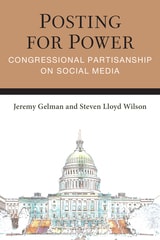
Posting for Power
Congressional Partisanship on Social MediaJeremy Gelman and Steven Lloyd Wilson
University of Michigan Press, 2026
In the US Congress, lawmakers regularly choose to bicker for political gain, whether or not they disagree on issues. By classifying millions of social media posts as partisan or not, Gelman and Wilson quantify a legislator’s partisan intensity through the time and effort they spend supporting their party and bickering with the opposition. The authors argue that the partisan personas politicians create are both a home style, to help them win reelection, and hill style, to help them become politically influential by showing off as good team players. Bringing together a wide range of data on leadership races, elections, voting records, cosponsorship patterns, and lawmaking outcomes, they demonstrate the nearly consequence-free way that legislators strategically deploy partisanship to impress their copartisans and voters. Gelman and Wilson closely examine what motivates members to differ so much in developing this part of their public personas and offer clear recommendations for how to turn down the partisan heat on Capitol Hill.
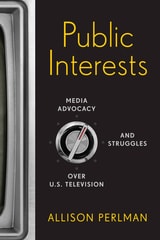
Public Interests
Media Advocacy and Struggles over U.S. TelevisionPerlman, Allison
Rutgers University Press, 2016
Nearly as soon as television began to enter American homes in the late 1940s, social activists recognized that it was a powerful tool for shaping the nation’s views. By targeting broadcast regulations and laws, both liberal and conservative activist groups have sought to influence what America sees on the small screen. Public Interests describes the impressive battles that these media activists fought and charts how they tried to change the face of American television.