Results by title
321 books match the query 'Mexican Americans' and 6 start with p
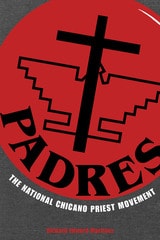
PADRES
The National Chicano Priest MovementBy Richard Edward Martínez
University of Texas Press, 2005
From the 1848 Treaty of Guadalupe Hidalgo to the 1960s, Mexican American Catholics experienced racism and discrimination within the U.S. Catholic church, as white priests and bishops maintained a racial divide in all areas of the church's ministry. To oppose this religious apartheid and challenge the church to minister fairly to all of its faithful, a group of Chicano priests formed PADRES (Padres Asociados para Derechos Religiosos, Educativos y Sociales, or Priests Associated for Religious, Educational, and Social Rights) in 1969. Over the next twenty years of its existence, PADRES became a powerful force for change within the Catholic church and for social justice within American society.
This book offers the first history of the founding, activism, victories, and defeats of PADRES. At the heart of the book are oral history interviews with the founders of PADRES, who describe how their ministries in poor Mexican American parishes, as well as their own experiences of racism and discrimination within and outside the church, galvanized them into starting and sustaining the movement. Richard Martínez traces the ways in which PADRES was inspired by the Chicano movement and other civil rights struggles of the 1960s and also probes its linkages with liberation theology in Latin America. He uses a combination of social movement theory and organizational theory to explain why the group emerged, flourished, and eventually disbanded in 1989.
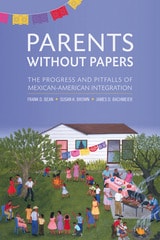
Parents Without Papers
The Progress and Pitfalls of Mexican American IntegrationFrank D. Bean is Distinguished Professor of Sociology and Director of the Center for Research on International Migration at the University of California, Irvine. Susan K. Brown is associate professor of sociology at the University of California, Irvine. James D. Bachmeier is assistant professor of sociology at Temple University.
Russell Sage Foundation, 2015
Parents Without Papers provides both a general conceptualization of immigrant integration and an in-depth examination of the Mexican American case. The authors draw upon unique retrospective data to shed light on three generations of integration. They show in particular that the “membership exclusion” experienced by unauthorized Mexican immigrants—that is, their fear of deportation, lack of civil rights, and poor access to good jobs—hinders the education of their children, even those who are U.S.-born. Moreover, they find that children are hampered not by the unauthorized entry of parents itself but rather by the long-term inability of parents, especially mothers, to acquire green cards.
When unauthorized parents attain legal status, the disadvantages of the second generation begin to disappear. These second-generation men and women achieve schooling on par with those whose parents come legally. By the third generation, socioeconomic levels for women equal or surpass those of native white women. But men reach parity only through greater labor-force participation and longer working hours, results consistent with the idea that their integration is delayed by working-class imperatives to support their families rather than attend college.
An innovative analysis of the transmission of advantage and disadvantage among Mexican Americans, Parents Without Papers presents a powerful case for immigration policy reforms that provide not only realistic levels of legal less-skilled migration but also attainable pathways to legalization. Such measures, combined with affordable access to college, are more important than ever for the integration of vulnerable Mexican immigrants and their descendants.
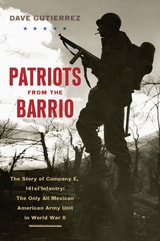
Patriots from the Barrio
The Story of Company E, 141st Infantry: The Only All Mexican American Army Unit in World War IIDave Gutierrez
Westholme Publishing, 2018
The Inspiring True Story of a Segregated Unit Whose Exploits Underscore the Forgotten Latino Contribution to the Allied Victory in World War II
As a child, Dave Gutierrez hung on every word his father recalled about his cousin Ramon, “El Sancudo” (the mosquito), and his service in World War II, where he earned a Silver Star, three Purple Hearts, and escaped from the Germans twice. Later, Dave decided to find out more about his father’s cousin, and in the course of his research he discovered that Ramon Gutierrez was a member of Company E, 141st Infantry, a part of the 36th “Texas” Division that was comprised entirely of Mexican Americans—the only such unit in the entire U.S. Army. The division landed at Salerno, Italy, in 1943, among first American soldiers to set foot in Europe. In the ensuing months, Company E and the rest of the 36th would battle their way up the mountainous Italian peninsula against some of Nazi Germany’s best troops. In addition to the merciless rain, mud, and jagged peaks, swift cold rivers crisscrossed the region, including the Rapido, where Company E would face its greatest challenge. In an infamous episode, the 36th Division was ordered to cross the Rapido despite reports that the opposite bank was heavily defended. In the ensuing debacle, the division was ripped apart, and Company E sustained appalling casualties. The company rebounded and made the storied landings at Anzio and ultimately invaded southern France for a final push into Germany. The men of Company E distinguished themselves as rugged fighters capable of warring amid the rubble of destroyed villages and in the devastated countryside.
Based on extensive archival research and veteran and family accounts, Patriots from the Barrio: The Story of Company E, 141st Infantry: The Only All Mexican American Army Unit in World War II brings to life the soldiers whose service should never have gone unrecognized for so long. With its memorable personalities, stories of hope and immigration, and riveting battle scenes, this beautifully written book is a testament to the shared beliefs of all who have fought for the ideals of the American flag.
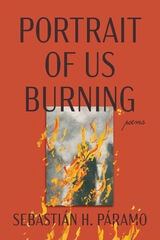
Portrait of Us Burning
PoemsSebastián H. Páramo
Northwestern University Press, 2024
Sebastián H. Páramo renders a semi-autobiographical collection, utilizing self-portraiture and memory to uncover how his Texan, working-class, Mexican American identity shapes his relationship to his half brother and to his family’s burning desire to become American.
Portrait of Us Burning begins with the humble picture of an immigrant American family. This picture starts to disintegrate—and, ultimately, burns—with the need to understand an inciting event that haunts the family throughout the second half of the collection. As the poems gather force and the picture dissolves further, Páramo asks us again and again: What does it mean to burn while becoming a part of a whole?
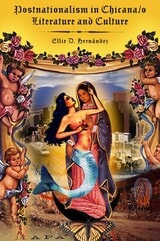
Postnationalism in Chicana/o Literature and Culture
By Ellie D. Hernández
University of Texas Press, 2009
In recent decades, Chicana/o literary and cultural productions have dramatically shifted from a nationalist movement that emphasized unity to one that openly celebrates diverse experiences. Charting this transformation, Postnationalism in Chicana/o Literature and Culture looks to the late 1970s, during a resurgence of global culture, as a crucial turning point whose reverberations in twenty-first-century late capitalism have been profound.
Arguing for a postnationalism that documents the radical politics and aesthetic processes of the past while embracing contemporary cultural and sociopolitical expressions among Chicana/o peoples, Hernández links the multiple forces at play in these interactions. Reconfiguring text-based analysis, she looks at the comparative development of movements within women's rights and LGBTQI activist circles. Incorporating economic influences, this unique trajectory leads to a new conception of border studies as well, rethinking the effects of a restructured masculinity as a symbol of national cultural transformation. Ultimately positing that globalization has enhanced the emergence of new Chicana/o identities, Hernández cultivates important new understandings of borderlands identities and postnationalism itself.
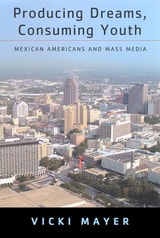
Producing Dreams, Consuming Youth
Mexican Americans and Mass MediaMayer, Vicki
Rutgers University Press, 2003
Latinos are the fastest-growing ethnic group in America and the ascendance of their popular culture has become a huge phenomenon. But beyond J. Lo and Shakira, there is a deeper story to tell about culture, class, and community identities.
Producing Dreams, Consuming Youth takes us behind the scenes in San Antonio, Texas, a major market for Mexican American popular culture. Vicki Mayer brings readers the perspectives of those who produce and consume mass media—including music, television, and newspapers. Through the voices of people ranging from Spanish-language advertising agency executives to English-speaking working-class teenagers, we see how the media brings together communities of Mexican Americans as they pursue cultural dreams, identification, and empowerment. At the heart of the book is a debate about the future of Mexican American media, and thus of the youth market. How and why do media professionals imagine ethnic youths? How do young Mexican Americans accept, negotiate, and resist these images of themselves? Producing Dreams, Consuming Youth emphasizes the paradoxes of media industries that seek to include youths of color while profiting from their creative energies.