Results by title
105 books match the query 'Mind' and 6 start with p
Peace and Mind
Part 3: Seriatim Symposium on Dispute, Conflict, and Enmity, Volume 8Jeffrey M. Perl, ed.
Duke University Press, 0
One contributor, a longtime president of the American Council of Learned Societies, calls for "intellectual philanthropy" and suggests that academics should transcend their ideological differences and form cooperative partnerships in the public service. A pair of essays, by key figures of the 1989 Velvet Revolution in Eastern Europe, analyze the ways that self-confidence and self-regard undercut efforts toward the resolution of complex social problems. The qualities of ideological self-subversion and even weakness, Common Knowledge maintains, are essential if the intellectual community is to become an agent for peace in a time of war.
Contributors. Wayne Andersen, Sissela Bok, Yves Bonnefoy, Caroline Walker Bynum, Clare Cavanagh, Charles-Albert Cingria, Caryl Emerson, Clifford Geertz, Stanley N. Katz, Aileen Kelly, Adam Michnik, Péter Nádas, Eugene Ostashevsky, Jeffrey M. Perl, Marjorie Perloff, Nina Pelikan Straus, Rei Terada, Gianni Vattimo, William Vesterman, Aleksandr Vvedensky, Adam Zagajewski.

Postures of the Mind
Essays on Mind and MoralsAnnette Baier
University of Minnesota Press, 1975
Postures of the Mind was first published in 1985. Minnesota Archive Editions uses digital technology to make long-unavailable books once again accessible, and are published unaltered from the original University of Minnesota Press editions.
Annette Baier develops, in these essays, a posture in philosophy of mind and in ethics that grows out of her reading of Hume and the later Wittgenstein, and that challenges several Kantian or analytic articles of faith. She questions the assumption that intellect has authority over all human feelings and traditions; that to recognize order we must recognize universal laws—descriptive or prescriptive; that the essential mental activity is representing; and that mental acts can be analyzed into discrete basic elements, combined according to statable rules of synthesis.
In the first group of essays—"Varieties of Mental Postures"—Baier evaluates the positions taken by philosophers ranging from Descartes to Dennett and Davidson. Among her topics are remembering, intending, realizing, caring, representing, changing one's mind, justifying one's actions and feelings, and having conflicting reasons for them. The second group of essays—"Varieties of Moral Postures" - explores the sort of morality we get when all of these capacities become reflective and self-corrective. Some deal with particular moral issues—our treatment of animals, our policies regarding risk to human life, our contractual obligations; others, with more general questions on the role of moral philosophers and the place of moral theory. These essays respond to the theories of Hobbes, Kant, Rawls, and MacIntyre, but Baier's most positive reaction is to David Hume; Postures of the Mind affirms and cultivates his version of a moral reflection that employs feeling and tradition as well as reason.
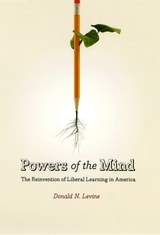
Powers of the Mind
The Reinvention of Liberal Learning in AmericaDonald N. Levine
University of Chicago Press, 2006
It is one thing to lament the financial pressures put on universities, quite another to face up to the poverty of resources for thinking about what universities should do when they purport to offer a liberal education. In Powers of the Mind, former University of Chicago dean Donald N. Levine enriches those resources by proposing fresh ways to think about liberal learning with ideas more suited to our times.
He does so by defining basic values of modernity and then considering curricular principles pertinent to them. The principles he favors are powers of the mind—disciplines understood as fields of study defined not by subject matter but by their embodiment of distinct intellectual capacities. To illustrate, Levine draws on his own lifetime of teaching and educational leadership, while providing a marvelous summary of exemplary educational thinkers at the University of Chicago who continue to inspire. Out of this vital tradition, Powers of the Mind constructs a paradigm for liberal arts today, inclusive of all perspectives and applicable to all settings in the modern world.
Prescribing the Life of the Mind
An Essay on the Purpose of the University, the Aims of Liberal Education, the Competence of Citizens, and the Cultivation of Practical ReasonCharles W. Anderson
University of Wisconsin Press, 1996
Propositional Attitudes
The Role of Content in Logic, Language, and MindEdited by C. Anthony Anderson and Joseph Owens
CSLI, 1990

Provinces of the Mind
The Modern Novel on Provincial TimeVictoria Baena
University of Chicago Press, 2027
How the provinces, rather than cities or capitals, became the key setting dramatized in—but also transformed by—modern novels in English and French.
To be provincial is to mistake one’s narrow milieu for the world: it is to fall prey to an error of scale. But it is also to feel behind, belated, and excluded from the possibilities of the modern world. In this elegant study of the novel “on provincial time,” Victoria Baena argues that the literary geography of “the provinces” played a key role in forging European narratives of modernity.
In the wake of French revolutionaries’ suppression of older provincial identities and as Britain expanded its imperial reach, the provinces were reinvented on various scales: from countryside to small town, from domestic region to faraway colony. Baena brings together Marxist and feminist spatial theory with a close attention to the politics of narrative form in order to show how the remarkably mobile concept of the provinces developed across social and cultural frameworks from 1800 to 1933. Offering new interpretations of novels of the realist tradition—by Honoré de Balzac, George Eliot, Emily Brontë, George Sand, Thomas Hardy, Marcel Proust, Alain-Fournier, James Joyce, and Claude McKay—she shows how the question of representing the provinces transformed the modern novel.
Provinces of the Mind illuminates some of the more pernicious fictions of provincialism. But it also describes, often movingly, the desire no longer to be provincial, along with the ambivalence and alienation that can entail. Ultimately, the book shows how literary critics can use the provinces to translate questions of literary geography across borders. By interrogating the provincialisms of our own time and place, Baena suggests, critics might make a better case for those worth retaining, as well as a better grasp of those to be left behind.