Results by title
89 books match the query 'Mind & Body' and 2 start with p
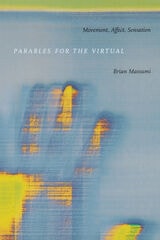
Parables for the Virtual
Movement, Affect, SensationBrian Massumi
Duke University Press, 2002
Renewing and assessing William James's radical empiricism and Henri Bergson's philosophy of perception through the filter of the post-war French philosophy of Deleuze, Guattari, and Foucault, Massumi links a cultural logic of variation to questions of movement, affect, and sensation. If such concepts are as fundamental as signs and significations, he argues, then a new set of theoretical issues appear, and with them potential new paths for the wedding of scientific and cultural theory. Replacing the traditional opposition of literal and figural with new distinctions between stasis and motion and between actual and virtual, Parables for the Virtual tackles related theoretical issues by applying them to cultural mediums as diverse as architecture, body art, the digital art of Stelarc, and Ronald Reagan's acting career. The result is an intriguing combination of cultural theory, science, and philosophy that asserts itself in a crystalline and multi-faceted argument.
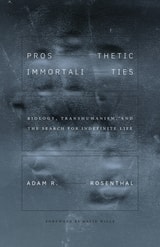
Prosthetic Immortalities
Biology, Transhumanism, and the Search for Indefinite LifeAdam R Rosenthal
University of Minnesota Press, 2024
Examining the links between today’s ideas of radical life extension and age-old notions of immortality
From Plato’s notion of generation to Derrida’s concept of survival to such modern phenomena as anti-aging treatments, cryogenics, cloning, and whole-brain uploads, Adam Rosenthal’s Prosthetic Immortalities shows how the dream of indefinite life has always been a technological one: a matter of prosthesis. He argues that every biological instance of perpetual life, from one-celled organisms to rejuvenating jellyfish to Henrietta Lacks’s “immortal” cancer cells, always results in the transformation of the original being. There can, therefore, be no certainty of immortality. Yet, because finite mortal life is already marked by difference, division, and change, as Rosenthal concludes: “the problem of immortality will not cease to haunt us.”
Prosthetic Immortalities examines the persistence of humans’ aspirations of deathlessness, showing that the link between immortalization and prostheticization is not unique to a single period but is, rather, a ubiquitous element of the discourse of immortality, encompassing both modern technoscientific efforts and religious discourses of an afterlife. Rosenthal asks to what extent the emergence of a virtual, posited, immortal presence follows from the tenets of empirical science—and not simply from the discourse of biology but also, and more radically still, from biological organization itself.
Rosenthal ultimately argues that the discovery of biological immortals—lifeforms that naturally have indefinitely long lifespans, such as cancer cells and bacteria—present novel conceptual difficulties for traditional philosophical approaches to mortality and selfhood, asking whether it is life itself that first births immortalizing prostheses.