187 books match the query 'Minorities' and 7 start with p
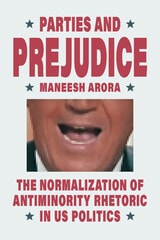
cover of Parties and Prejudice: The Normalization of Antiminority Rhetoric in US Politics

Parties and Prejudice

The Normalization of Antiminority Rhetoric in US Politics

Maneesh Arora

University of Chicago Press, 2025

An essential guide to how the interactions between social norms, party politics, and expressions of prejudice are driving contemporary politics.

Antiminority rhetoric in American politics has grown more overt. What were once fringe comments on Stormfront have now become typical campaign appeals from many mainstream politicians. If there was ever a doubt, this is a poignant reminder that the boundaries of what is “acceptable” and “unacceptable” to say and do are fluid and socially enforced.

In Parties and Prejudice, Maneesh Arora offers a broad framework for understanding this new political terrain. Arora argues that the interaction between social norms and party politics determines what the political consequence of prejudicial speech will be. He illuminates this nuanced relationship by showing that norms vary based on the targeted minority group and the intended audience.

Drawing on experiments, survey data, news coverage, and real-world examples, Parties and Prejudice examines the distinctive ways that egalitarian/inegalitarian norms have developed—within each party—for Black, Muslim, and LGBTQ+ Americans. It is essential reading for understanding Donald Trump’s rise to power, the modern conservative agenda (including opposition to critical race theory and transgender rights), and threats to the development of a multiracial democracy.
[more]
cover of Politics of Democratic Inclusion

Politics of Democratic Inclusion

Christina Wolbrecht

Temple University Press, 2005

The issue of political participation has been central to American politics since the founding of the United States. The Politics of Democratic Inclusion addresses the ways traditionally underrepresented groups have and have not achieved political incorporation, representation, and influence—or "democratic inclusion"—in American politics. Each chapter provides a "state of the discipline" essay that addresses the politics of diversity from a range of perspectives and in a variety of institutional arenas. Taken together, the essays in The Politics of Democratic Inclusion evaluate and advance our understanding of the ways in which the structure, processes, rules, and context of the American political order encourage, mediate, and hamper the representation and incorporation of traditionally disadvantaged groups.
[more]
cover of Postcolonial America

Postcolonial America

Edited by C. Richard King

University of Illinois Press, 2000

Scholars from a wide array of disciplines describe and debate postcolonialism as it applies to America in this authoritative and timely collection. Investigating topics such as law and public policy, immigration and tourism, narratives and discourses, race relations, and virtual communities, Postcolonial America clarifies and challenges prevailing conceptualizations of postcolonialism and accepted understandings of American culture.
 
Advancing multiple, even conflicted visions of postcolonial America, this important volume interrogates postcolonial theory and traces the emergence and significance of postcolonial practices and precepts in the United States. Contributors discuss how the unique status of the United States as the colony that became a superpower has shaped its sense of itself. They assess the global networks of inequality that have displaced neocolonial systems of conquest, exploitation, and occupation. They also examine how individuals and groups use music, the Internet, and other media to reconfigure, reinvent, and resist postcoloniality in American culture.
 
Candidly facing the inherent contradictions of "the American experience," this collection demonstrates the patterns, connections, and histories characteristic of postcoloniality in America and initiates important discussions about how these conditions might be changed.

 
[more]
cover of Postcolonial France: The Question of Race and the Future of the Republic

Postcolonial France

The Question of Race and the Future of the Republic

Paul Silverstein

Pluto Press, 2018

France has in recent years emerged as a bellwether for worldwide anxieties around postcolonialism and multiculturalism, and the rise of right-wing populism. This book offers a detailed exploration of the dynamics and dilemmas of the present moment of crisis and hope in France through an exploration of a number of recent moral panics. Paul Silverstein here examines urban racial violence, female Islamic dress and male public prayer, anti-system gangster rap, and sports—all of which have triggered major national debates over France’s multicultural future. Silverstein shows convincingly that these conflicts can be traced back to unresolved tensions around France's imperial project, the present-day effects of which are still being felt.
 
[more]
cover of Potential on the Periphery: College Access from the Ground Up

Potential on the Periphery

College Access from the Ground Up

Omari Scott Simmons

Rutgers University Press, 2019

Even high-performing students sometimes need assistance to transform their high school achievement into a higher education outcome that matches their potential, especially when those students come from vulnerable backgrounds. Without intervention, many of these students, lost in the transition between secondary school and higher education, would not attend selective colleges that provide greater opportunities. Potential on the Periphery profiles the Simmons Memorial Foundation (SMF), a grassroots non-profit organization co-founded by author Omari Scott Simmons, that promotes college access for students in North Carolina and Delaware. Simmons discusses how the organization has helped students secure admission and succeed in college, using this example to contextualize the broader realm of existing education practice, academic theory, and public policy. Using data gleaned from interviews with past student participants in the programs run by the SMF, Simmons illuminates the underlying factors thwarting student achievement, such as inadequate information about college options, limited opportunities for social capital acquisition, financial pressures, self-doubt, and political weakness. Simmons then identifies policy solutions and pragmatic strategies that college access organizations can adopt to address these factors. 
[more]
cover of Power-Sharing: Institutional and Social Reform in Divided Societies

Power-Sharing

Institutional and Social Reform in Divided Societies

Ian O'Flynn & David Russell, Editors

Pluto Press, 2005

It is widely assumed that internal power-sharing is a viable democratic means of managing inter-communal conflict in divided societies. In principle, this form of government enables communities that have conflicting identities to remedy longstanding patterns of discrimination and to co-exist peacefully. Key arguments in support of this view can be found in the highly influential works of Arend Lijphart and Donald Horowitz.

Power-Sharing seeks to explore the unintended consequences of power-sharing for the communities themselves, their individual members, and for others in society. More specifically, it is distinctive in questioning explicitly whether power sharing: perpetuates inter-communal conflict by institutionalising difference at the political level; inhibits conflict resolution by encouraging extremism; stifles internal diversity; and fails to leave sufficient space for individual autonomy.

This book not only provides a theoretical exploration and critique of these questions, but comprehensively examines specific test cases where power-sharing institutions have been established, including in Northern Ireland, Belgium, Bosnia-Herzegovina, Macedonia and Lebanon. It also explores such issues as the role of political leaders, human rights
instruments, the position of women, and the prospects for reconciliation within such societies.

Furthermore it provides a detailed set of policy recommendations to meet the challenges of transition in deeply-divided societies.
[more]
cover of Prismatic Metropolis: Inequality in Los Angeles

Prismatic Metropolis

Inequality in Los Angeles

Lawrence D. Bobo

Russell Sage Foundation, 2000

This book cuts through the powerful mythology surrounding Los Angeles to reveal the causes of inequality in a city that has weathered rapid population change, economic restructuring, and fractious ethnic relations. The sources of disadvantage and the means of getting ahead differ greatly among the city's myriad ethnic groups. The demand for unskilled labor is stronger here than in other cities, allowing Los Angeles's large population of immigrant workers with little education to find work in light manufacturing and low-paid service jobs. A less beneficial result of this trend is the increased marginalization of the city's low-skilled black workers, who do not enjoy the extended ethnic networks of many of the new immigrant groups and who must contend with persistent negative racial stereotypes. Patterns of residential segregation are also more diffuse in Los Angeles, with many once-black neighborhoods now split evenly between blacks, Hispanics, Asians, and other minorities. Inequality in Los Angeles cannot be reduced to a simple black-white divide. Nonetheless, in this thoroughly multicultural city, race remains a crucial factor shaping economic fortunes. A Volume in the Multi-City Study of Urban Inequality
[more]