Results by title
210 books match the query 'Missouri' and 6 start with p
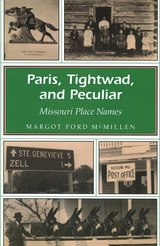
Paris, Tightwad, and Peculiar
Missouri Place NamesMargot Ford McMillen
University of Missouri Press, 1994
Paris, Tightwad, Peculiar, Neosho, Gasconade, Hannibal, Diamond, Quarantine, Zif, and Zig. These are just a few of the names Margot Ford McMillen covers in her lively book on the history of place names in Missouri. The origins behind the names range from humorous to descriptive:
•Tightwad, Missouri, is said to have been named after a store owner who cheated a mailman out of his rightful watermelon to make an extra fifty cents. •Plad, Missouri, was supposed to be named "Glad," but the post office printed the name wrong, and it was too much trouble to get it changed. •Some place names describe a location, such as Big Spring or Flat River. •Other names show the influence of immigrants to the state, like Hermann, which is a German name, or the Maries River, which was derived from the French. •Many places are named for people or wildlife found nearby, while others are backed up by legend or simply picked out of thin air.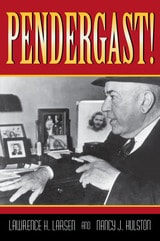
Pendergast!
Lawrence H. Larsen and Nancy J. Hulston
University of Missouri Press, 1997
Born in St. Joseph, Missouri, in 1872, Tom Pendergast moved to Kansas City around 1890 to work for his brother James, founder of the Pendergast "Goat" faction in Kansas City Democratic politics. In 1911, Pendergast became head of the Goats, and over the next fifteen years he created a powerful political machine that used illegal voting and criminal enforcers to gain power. Following a change in the city charter in 1925, Pendergast took control of Kansas City and ran it as his own personal business. In the 1930s, he received over $30 million annually from gambling, prostitution, and narcotics, putting him in the big leagues of American civic corruption. He also wielded great power in the National Democratic Party and started Harry S. Truman on the road to the presidency.
In this well-balanced biography, the authors examine Pendergast's rise to power, his successes as a political leader, his compassion for the destitute, and his reputation for keeping his word. They also examine Pendergast's character development and how his methods became more and more ruthless. Pendergast had no use for ideology in his "invisible government"—only votes counted.
In 1937 and 1938 the federal government broke the back of Pendergast's machine, convicting 259 of his campaign aides for vote fraud. In 1939 Pendergast, who was believed to be the largest bettor on horse racing in the United States, was jailed for income tax evasion, and he died in disgrace in 1945.
An insightful and comprehensive biography, Pendergast! will surely serve for years to come as the most thorough investigation of the life and infamous career of Tom Pendergast.
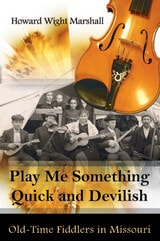
Play Me Something Quick and Devilish
Old-Time Fiddlers in MissouriHoward Wight Marshall
University of Missouri Press, 2012
Beginning with the French villages on the Mississippi River, Marshall leads us chronologically through the settlement of the state and how these communities established our cultural heritage. Other core populations include the “Old Stock Americans” (primarily Scotch-Irish from Kentucky, Tennessee, North Carolina, and Virginia), African Americans, German-speaking immigrants, people with American Indian ancestry (focusing on Cherokee families dating from the Trail of Tears in the 1830s), and Irish railroad workers in the post–Civil War period. These are the primary communities whose fiddle and dance traditions came together on the Missouri frontier to cultivate the bounty of old-time fiddling enjoyed today.
Marshall also examines regional styles in Missouri fiddling and comments on the future of this time-honored, and changing, tradition. Documentary in nature, this social history draws on various academic disciplines and oral histories recorded in Marshall’s forty-some years of research and field experience. Historians, music aficionados, and lay people interested in Missouri folk heritage—as well as fiddlers, of course—will find Play Me Something Quick and Devilish an entertaining and enlightening read.
With 39 tunes, the enclosed Voyager Records companion CD includes a historic sampler of Missouri fiddlers and styles from 1955 to 2012.
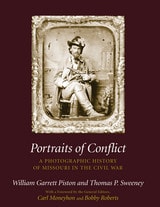
Portraits of Conflict
A Photographic History of Missouri in the Civil WarWilliam Garrett Piston
University of Arkansas Press, 2009
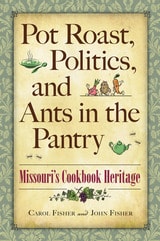
Pot Roast, Politics, and Ants in the Pantry
Missouri's Cookbook HeritageCarol Fisher & John Fisher
University of Missouri Press, 2008
When is a cookbook more than just a cookbook? When it’s a gateway to our culinary heritage. For well over a hundred years, Missouri’s cookbooks have helped readers serve up tasty dishes to the state’s tables, but these publications also document the evolution of our kitchens and households.
Pot Roast,Politics, and Ants in the Pantry, a treasure trove of anecdotes and nuggets of historical information about cookery in the Show-Me State, draws from more than 150 publications to reveal Missouri’s cookbook heritage and to deliver a generous sampling of recipes. Carol Fisher and John Fisher look back to manuscript cookbooks from 1821 St. Louis, then progress through the years and around Missouri before arriving at today’s online recipes. Along the way, they dish out servings of kitchen medicine, household hints, and cookbook literature gleaned from the state’s cache of culinary gems.
From handwritten family recipe collections and mimeographed publications to glossy color editions, the texts the Fishers have obtained from libraries and historical societies as well as their own extensive cookbook collection include such curiosities as the Julia Clark Household Memoranda Book from the William Clark papers, an 1880 production by the Ladies of St. Louis called My Mother’s Cookbook, Mary Foote Henderson’s Practical Cooking and Dinner Giving, and Albert E. Brumley’s All-Day Singin’ and Dinner on the Ground. They tell how various ethnic communities raised money by creating cookbooks, how the state’s Beef Council and Pork Association put recipes on the Internet, and how restaurants like the Blue Owl in Kimmswick and Stephenson’s Apple Farm Restaurant near Kansas City enhanced their reputations with their own cookbooks. Festival cookbooks, company cookbooks, even cookbooks tied to world events—they’re all here in one delightful book.
In this vastly entertaining review, readers will learn where to find recipes for dandelion wine, mock turtle soup (requiring a large calf’s head split open by the butcher), and vinegar pie—as well as the curative properties of potato water, tips for raising chickens in the basement, and even “how to cook a husband.” An extensive bibliography includes information to help readers track down the books discussed and also those on their own wish lists.
Pot Roast, Politics, and Ants in the Pantry: Missouri’s Cookbook Heritage shows how, instead of being just collections of recipes, cookbooks provide history lessons, document changing food ways, and demonstrate the cultural diversity of the state. From Julia Clark’s simple frontier recipes for puddings and preserves to Irma Rombauer’s encyclopedic Joy of Cooking—originally self-published in Missouri—Carol Fisher and John Fisher have laid out a smorgasbord of reading pleasure for cookbook collectors, nostalgia buffs, and gourmands alike.
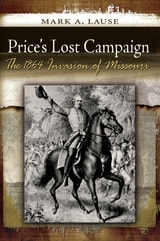
Price's Lost Campaign
The 1864 Invasion of MissouriMark A. Lause
University of Missouri Press, 2013