Results by title
149 books match the query 'Modernity' and 9 start with p
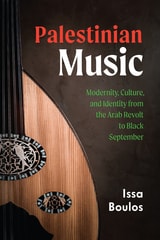
Palestinian Music
Modernity, Culture, and Identity from the Arab Revolt to Black SeptemberIssa Boulos
University of Texas Press, 2027
An exploration of how Palestinian music—from village songs to urban broadcasts—adapted to political upheaval, colonial pressure, and diaspora life, serving as both a cultural anchor and a vehicle for regional identity during the mid-twentieth century.
Palestinian music has long been embedded in everyday life, shaping and reflecting social, cultural, and political identities. It has served as a means of storytelling and news-sharing, a part of ritual and community life, and a connection to the broader musical traditions of the Near East. As displacement scattered Palestinians across Lebanon, Syria, Jordan, and beyond, musicians carried folk and urban musical traditions into new political and cultural contexts, blending them with various modernities and transforming the process of music-making. In the decades that followed, music and dance were increasingly folklorized and mobilized as symbols of Palestinian identity.
Palestinian Music traces these transformations from the British Mandate through the rise of the Palestine Liberation Organization in the 1970s. Drawing on rare recordings, oral histories, archival materials, and original musical transcriptions, ethnomusicologist Issa Boulos examines two dozen artists across five countries and follows the composers, producers, and performers whose innovations helped shape the musical scene of the entire region. Palestinian music emerges as a dynamic medium through which Palestinians continually negotiated identity, solidarity, and hope—balancing preservation and innovation, rootedness and displacement.
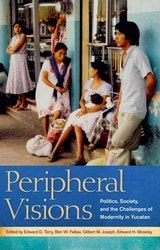
Peripheral Visions
Politics, Society, and the Challenges of Modernity in YucatanEdward D. Terry
University of Alabama Press, 2010
The essays in this collection illuminate both the processes of change and the negative reactions that they frequently elicited
Yucatan has been called “a world apart”—cut off from the rest of Mexico by geography and culture. Yet, despite its peripheral location, the region experienced substantial change in the decades after independence. As elsewhere in Mexico, apostles of modernization introduced policies intended to remold Yucatan in the image of the advanced nations of the day. Indeed, modernizing change began in the late colonial era and continued throughout the 19th century as traditional patterns of land tenure were altered and efforts were made to divest the Catholic Church of its wealth and political and intellectual influence. Some changes, however, produced fierce resistance from both elites and humbler Yucatecans and modernizers were frequently forced to retreat or at least reach accommodation with their foes.
Covering topics from the early 19th century to the late 20th century, the essays in this collection illuminate both the processes of change and the negative reactions that they frequently elicited. The diversity of disciplines covered by this volume—history, anthropology, sociology, economics—illuminates at least three overriding challenges for study of the peninsula today. One is politics after the decline of the Institutional Revolutionary Party: What are the important institutions, practices, and discourses of politics in a post-postrevolutionary era? A second trend is the scholarly demystification of the Maya: Anthropologists have shown the difficulties of applying monolithic terms like Maya in a society where ethnic relations are often situational and ethnic boundaries are fluid. And a third consideration: researchers are only now beginning to grapple with the region’s transition to a post-henequen economy based on tourism, migration, and the assembly plants known as maquiladoras. Challenges from agribusiness and industry will no doubt continue to affect the peninsula’s fragile Karst topography and unique environments.
Contributors: Eric N. Baklanoff, Helen Delpar, Paul K. Eiss, Ben W. Fallaw, Gilbert M. Joseph, Marie Lapointe, Othón Baños Ramírez, Hernán Menéndez Rodríguez, Lynda S. Morrison, Terry Rugeley, Stephanie J. Smith
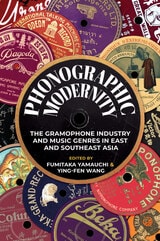
Phonographic Modernity
The Gramophone Industry and Music Genres in East and Southeast AsiaEdited by Fumitaka Yamauchi and Ying-fen Wang
University of Illinois Press, 2024
A roster of experts on countries from Japan to Indonesia explores the complicated relationship between the gramophone industry and music genres in East and Southeast Asia. Extending the boundaries of their research across multiple disciplines, the contributors connect the gramophone industry to theories surrounding phonography and modernity. Their focus on phonography combines an interest in discs with an interest in the sounds contributing to the recent sonic-auditory turn in sound studies.
Ambitious and expansive, Phonographic Modernity examines the bloc of East and Southeast Asia within the larger global history of sound recording.

Poiesis and Modernity in the Old and New Worlds
Anthony J. Cascardi
Vanderbilt University Press, 2012
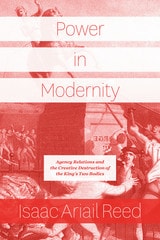
Power in Modernity
Agency Relations and the Creative Destruction of the King’s Two BodiesIsaac Ariail Reed
University of Chicago Press, 2020
He mobilizes this theory to investigate the onset of modernity in the Atlantic world, with a focus on rebellion, revolution, and state formation in colonial North America, the early American Republic, the English Civil War, and French Revolution. Modernity, Reed argues, dismantled the “King’s Two Bodies”—the monarch’s physical body and his ethereal, sacred second body that encompassed the body politic—as a schema of representation for forging power relations. Reed’s account then offers a new understanding of the democratic possibilities and violent exclusions forged in the name of “the people,” as revolutionaries sought new ways to secure delegation, build hierarchy, and attack alterity.
Reconsidering the role of myth in modern politics, Reed proposes to see the creative destruction and eternal recurrence of the King’s Two Bodies as constitutive of the modern attitude, and thus as a new starting point for critical theory. Modernity poses in a new way an eternal human question: what does it mean to be the author of one’s own actions?
Powers of Distinction
On Religion and ModernityNancy Levene
University of Chicago Press, 2017
In readings from Abraham to the present, Levene recovers this richer dualism in its difference from the alternatives—other dualisms, nondualism, multiplication. From Abraham we get the biblical call to give up tribal belonging for a promised land of covenantal relation. Yet modernity, inclusive of this call, is also the principle that critiques the promise when it divides self from other, us from them.
Drawing on a long tradition of thinkers and scholars even as she breaks new ground, Levene offers here nothing less than a new way of understanding modernity as an ethical claim about our world, a philosophy of the powers of distinction to include rather than to divide.

Print Matters
Media and Modernity in Illustrated Magazines, 1910–1970Maria Antonella Pelizzari
J. Paul Getty Trust, The, 2025
In the early to mid-twentieth century, the vast majority of printed photographs appeared in the pages of illustrated magazines. Publications such as Life, China Pictorial, Drum, Picture Post, and Ebony did more than showcase photographs; they crafted visual narratives by combining images, text, and graphics into influential cultural artifacts. These periodicals shaped public perception and mass media consensus like the Internet does today, bringing a shared visual experience to homes and newsstands around the world.
The essays in this volume delve into the technologies and visual strategies behind these publications, showing how their layouts were affected by political, commercial, editorial, and artistic factors leading up to World War II. The commentaries also explore how democracy, dictatorships, colonization, and modernity at large gave rise to experimental magazine designs, turning avant-garde art and lifestyle reporting into popular formats. Featuring over 150 images, Print Matters traces how illustrated magazines evolved across countries and continents, offering new insights into their history and enduring impact on culture and society.
Properties of Modernity
Romantic Spain, Modern Europe, and the Legacies of EmpireMichael Iarocci
Vanderbilt University Press, 2006
Through a close study of Cadalso, Saavedra, and Larra, Iarocci argues that Spanish writers were intensely concerned with the same issues taken up by more famous Romantics and that the ways in which they address these issues provides us with a richer notion, not only of Spain, but of all of Europe.

Psychiatric Encounters
Madness and Modernity in Yucatan, MexicoReyes-Foster, Beatriz M.
Rutgers University Press, 2019