Results by title
100 books match the query 'Monographs' and 8 start with p

Pastoral’s End
Art, Ecology, and Catastrophe in Renaissance ItalyJames Pilgrim
University of Chicago Press, 2026
In the sixteenth century, Italian artist Jacopo Bassano painted pictures of herdsmen and animals moving through dark and muddy landscapes. But he also participated in the agricultural development of the region in which he lived, producing topographical maps of local mountains and forests, inventing new methods of drainage and irrigation, and studying the latest techniques of crop rotation and fertilization. The relationship between Bassano’s rustic art and his participation in environmental transformation has, however, never been explored.
One of the first studies of Italian Renaissance art to grapple with the connections between visual culture and the environment, Pastoral’s End explores this crucial, formative relationship. James Pilgrim looks at Bassano’s career holistically, demonstrating how his involvement in a world marked by agricultural expansion, industrialization, resource extraction, environmental degradation, social transformation, and radical philosophical development informed his paintings of country life. Introducing new archival and visual evidence of Bassano’s knowledge of hydrology, agronomy, husbandry, and architecture, Pastoral’s End argues that he transformed the more placid rustic imagery of previous Renaissance artists into visions of dangerous ecological instability.
Peter DeCamp Haines
Sculpture, 1975–2024Peter DeCamp Haines
The Artist Book Foundation, 2025
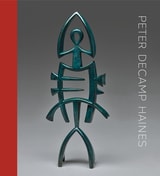
The first major monograph on Peter DeCamp Haines, this title explores how the sculptor's interest in psychology and anthropology deeply informed his art.
This book is the first major monograph on the work of Peter DeCamp Haines (March 27, 1942–October 25, 2024), which builds on the evolution of Modernism as much as it harkens back to the Bronze Age. The clearest expression of this is a series of 1,000 elemental bronze “artifacts” he created over the course of nearly fifty years, to which he contributed yearly, ranging from palm-size pieces to colossal outdoor works. He called this output “a personal archaeology,” or “an archaeology of the subconscious,” referencing ancient tools, animal and human shapes, and the synchronicity of antique forms with the purely abstract.
Haines’s interest in psychology and anthropology deeply informed his art. Working in a Modernist tradition, his career pursued a continuing exploration of the formal attributes of sculpture: form, scale, negative space, and composition. As Haines saw it, one of the satisfactions of sculpture is that ideas such as wholeness, beauty, and timelessness can be expressed without words and one of the critical elements of this wordless communication is negative space. Thus, the doorways, windows, and silhouettes of his sculptures can suggest an area larger than the sculpture itself.

Phantom Skies and Shifting Ground
Landscape, Culture, and Rephotography in Eadweard Muybridge's Illustrations of Central AmericaByron Wolfe and Scott Brady
Temple University Press, 2017
In 1875, after being acquitted for the murder of his wife’s lover, Eadweard Muybridge spent a year photographing along the Central American Pacific Coast, particularly in Guatemala and Panamá. Upon his return to California in 1876, he published a very limited number of albums of the photographs (11 are known), each of which was unique in size and scope. In 2007, photographer Byron Wolfe (born 1967) tracked down and cataloged every known Muybridge Central American photograph. Then, with cultural geographer Scott Brady, he traveled to many of Muybridge’s sites to rephotograph them. Through photographic collage, interpretive rephotography, illustrations and essays, this book examines an exceptionally rare series by Muybridge. Also included is a catalogue of every known Muybridge Central American picture.
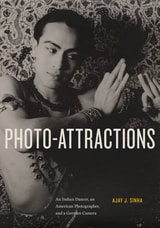
Photo-Attractions
An Indian Dancer, an American Photographer, and a German CameraAjay Sinha
Rutgers University Press, 2022
Art historian Ajay Sinha uses these hitherto unpublished photographs and archival research to raise provocative and important questions about photographic technology, colonial histories, race, sexuality and transcultural desires. Challenging the assumption that Gopal was merely objectified by Van Vechten’s Orientalist gaze, he explores the ways in which the Indian dancer co-authored the photos. In Sinha’s reading, Van Vechten’s New York studio becomes a promiscuous contact zone between world cultures, where a “photo-erotic” triangle is formed between the American photographer, Indian dancer, and German camera.
A groundbreaking study of global modernity, Photo-Attractions brings scholarship on American photography, literature, race and sexual economies into conversation with work on South Asian visual culture, dance, and gender. In these remarkable historical documents, it locates the pleasure taken in cultural difference that still resonates today.

Photographs from Detroit, 1975–2019
Bruce Harkness
Ohio University Press, 2022
A retrospective survey of Bruce Harkness’s striking social documentary photographs and an invaluable historical record that bears witness to irrevocably lost swaths of Detroit’s social and urban fabric.
In 1980, the cities of Detroit and Hamtramck, Michigan, exercised eminent domain to develop nearly five hundred acres of land for a new industrial park and General Motors assembly plant. But the land was not vacant. Some thirty-five hundred people lived there in Poletown—some of them for their entire lives. They attended neighborhood schools and churches, worked for and patronized small businesses, walked the sidewalks, drove the streets, and tended to lawns and gardens. Harkness began photographing the area in February 1981. He recorded street scenes, intersections, panoramic views, homes, businesses, churches, and people. Ten months, ninety visits, and six hundred photographs later, it all disappeared forever.
The Poletown series established Harkness as a major Detroit documentarian. It came on the heels of late-1970s projects located in and around the city’s skid row: Cass Corridor. The images include gritty streetscapes, a portrait series depicting residents living in a crumbling apartment building, and the lively cultural milieu of a local gay and transgender bar. Most of this old portion of inner-city Detroit since has been supplanted by urban redevelopment and gentrification.
During the late 1980s, Harkness collaborated with urban historian John J. Bukowczyk on a major documentary project, Urban Interiors. While the Poletown project had documented the exteriors of buildings and streetscapes on Detroit’s East Side, Urban Interiors captured the insides of inner-city Detroit homes and businesses and included extended oral history interviews.
While Harkness has always found human dignity and resilience in his subjects, the tone of his work brightened in the 1990s alongside Detroit’s revival. Photographs from this era include blues musicians performing in clubs and at outdoor concerts and the distinctive, robust youth culture that flourished in Dearborn’s now-defunct Zone Coffee House.
Featuring images from these and other projects, Photographs from Detroit, 1975–2019 includes Harkness’s extensive notes, which describe and contextualize the encounters he shared with the people and places he photographed, and offer insight into his working methods and equipment. The volume and quality of Harkness’s work merits him recognition as one of Detroit’s most important documentary photographers during this pivotal, transitional era in the city’s history.
Harkness’s images depict the struggles and resilience of ordinary individuals and families in working-class communities who together have indelibly shaped the spirit of Detroit. This book is a must-have for Detroiters past and present as well as historians, anthropologists, social documentary advocates, and photobook collectors everywhere.

Photography and American Coloniality
Eliot Elisofon in Africa, 1942–1972Raoul J. Granqvist
Michigan State University Press, 2017
Picasso's Demoiselles
The Untold Origins of a Modern MasterpieceSuzanne Preston Blier
Duke University Press, 2019
Playing with Earth and Sky
Astronomy, Geography, and the Art of Marcel DuchampJames Housefield
Dartmouth College Press, 2016