Results by title
82 books match the query 'Motherhood' and 5 start with p
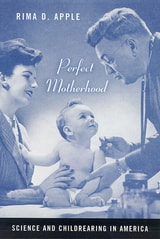
Perfect Motherhood
Science and Childrearing in AmericaApple, Rima
Rutgers University Press, 2006
Parenting today is virtually synonymous with worry. We want to ensure that our children are healthy, that they get a good education, and that they grow up to be able to cope with the challenges of modern life. In our anxiety, we are keenly aware of our inability to know what is best for our children. When should we toilet train? What is the best way to encourage a fussy child to eat? How should we protect our children from disease and injury?
Before the nineteenth century, maternal instinct—a mother’s “natural know-how”—was considered the only tool necessary for effective childrearing. Over the past two hundred years, however, science has entered the realm of motherhood in increasingly significant ways. In Perfect Motherhood, Rima D. Apple shows how the growing belief that mothers need to be savvy about the latest scientific directives has shifted the role of expert away from the mother and toward the professional establishment. Apple, however, argues that most women today are finding ways to negotiate among the abundance of scientific recommendations, their own knowledge, and the reality of their daily lives.
Poverty, Charity, and Motherhood
Maternal Societies in Nineteenth-Century FranceChristine Adams
University of Illinois Press, 2010
Precarious Motherhood
Navigating Relationships and Support Post-Migration in the UKRachel Benchekroun
University College London, 2025
Precarious Motherhood is a deeply human investigation of the lives of racially minoritized mothers as they navigate the intersecting challenges of financial hardship and the UK’s hostile immigration policies. Based on thorough ethnographic research, Rachel Benchekroun examines how these mothers forge relationships to access support, maintain their children’s well-being, and carve out spaces of belonging in an often unwelcoming system. The book captures the resilience and the relentless precarity of motherhood in migration, where every relationship shapes social barriers and everyday survival.
Through the voices of over twenty migrant mothers, this work sheds light on the personal and political dimensions of motherhood. It provides critical insights into state policies and social infrastructures that shape migrant lives, making it a valuable resource for scholars of migration and social justice.
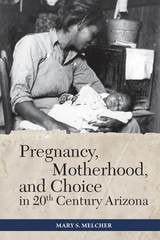
Pregnancy, Motherhood, and Choice in Twentieth-Century Arizona
Mary S. Melcher
University of Arizona Press, 2012
Early twentieth-century Arizona was a life-threatening place for new and expectant mothers. Towns were small and very far apart, and the weather and harsh landscape often delayed midwives. It was not uncommon for a woman to give birth without medical care and with the aid of only family members. By the 1920s, Arizona was at the top of the list for the highest number of infant deaths.
Mary Melcher’s Pregnancy, Motherhood, and Choice in Twentieth-Century Arizona provides a deep and diverse history of the dramatic changes in childbirth, birth control, infant mortality, and abortion over the course of the last century. Using oral histories, memoirs, newspaper accounts, government documents, letters, photos, and biographical collections, this fine-grained study of women’s reproductive health places the voices of real women at the forefront of the narrative, providing a personal view into some of the most intense experiences of their lives.
Tackling difficult issues such as disparities in reproductive health care based on race and class, abortion, and birth control, this book seeks to change the way the world looks at women’s health. An essential read for both historians and public health officials, this book reveals that many of the choices and challenges that women once faced remain even today.
Progressive Mothers, Better Babies
Race, Public Health, and the State in Brazil, 1850-1945By Okezi T. Otovo
University of Texas Press, 2016
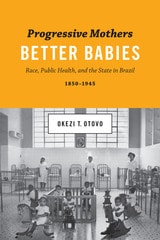
In Bahia, Brazil, the decades following emancipation saw the rise of reformers who sought to reshape the citizenry by educating Bahian women in methods for raising “better babies.” The idealized Brazilian would be better equipped to contribute to the labor and organizational needs of a modern nation. Backed by many physicians, politicians, and intellectuals, the resulting welfare programs for mothers and children mirrored complex debates about Brazilian nationality. Examining the local and national contours of this movement, Progressive Mothers, Better Babies investigates families, medical institutions, state-building, and social stratification to trace the resulting policies, which gathered momentum in the aftermath of abolition (1888) and the declaration of the First Republic (1889), culminating during the administration of President Getúlio Vargas (1930–1945).
Exploring the cultural discourses on race, gender, and poverty that permeated medical knowledge and the public health system for almost a century, Okezi T. Otovo draws on extensive archival research to reconstruct the implications for Bahia, where family patronage politics governed poor women’s labor as the mothers who were the focus of medical interventions were often the nannies and nursemaids of society’s wealthier families. The book reveals key transition points as the state of Bahia transformed from being a place where poor families could expect few social services to becoming the home of numerous programs targeting the poorest mothers and their children. Negotiating crucial questions of identity, this history sheds new light on larger debates about Brazil’s past and future.