Results by title
62 books match the query 'Musicians' and 2 start with p
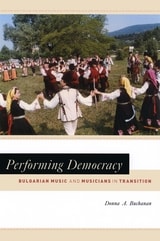
Performing Democracy
Bulgarian Music and Musicians in TransitionDonna A. Buchanan
University of Chicago Press, 2005
Based on fieldwork conducted between 1988 and 1996 with professional Bulgarian folk musicians, Donna A. Buchanan's PerformingDemocracy argues that the performances of traditional music groups may be interpreted not only as harbingers but as agents of Bulgaria's political transition. Many of the musicians in socialist Bulgaria's state folk ensembles served as official cultural emissaries for several decades. Through their reminiscences and repertoires, Buchanan reveals the evolution of Bulgarian musical life as it responded to and informed the political process. By modifying their art to accommodate changing political ideologies, these musicians literally played out regime change on the world's stages, performing their country's democratization musically at home and abroad.
Performing Democracy and its accompanying CD-ROM, featuring traditional Bulgarian music, lyrics, notation, and photos, will fascinate any reader interested in the many ways art echoes and influences politics.
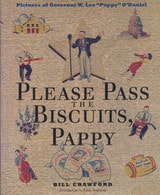
Please Pass the Biscuits, Pappy
Pictures of Governor W. Lee "Pappy" O'DanielBy Bill Crawford
University of Texas Press, 2004
Long before movie stars Ronald Reagan and Arnold Schwarzenegger became governors of California, a popular radio personality with no previous political experience—who wasn't even registered to vote—swept into the governor's office of Texas. W. Lee "Pappy" O'Daniel was a 1930s businessman who discovered the power of radio to sell flour. His musical shows with the Light Crust Doughboys (which launched the career of Bob Wills) and his radio homilies extolling family and Christian values found a vast, enthusiastic audience in Depression-era Texas. When Pappy decided to run for governor in 1938 as a way to sell more flour—a fact he proudly proclaimed throughout the campaign—the people of Texas voted for him in record numbers. And despite the ineptitude for politics he displayed once in office, Texans returned him to the governorship in 1940 and then elected him to the U.S. Senate in 1941 in a special election in which he defeated Lyndon Johnson, as well as to a full term as senator in 1942.
While the hit film O Brother, Where Art Thou? celebrated a fictional "Please Pass the Biscuits, Pappy" O'Daniel, this book captures the essence of the real man through photographs taken by employees of the Texas Department of Public Safety, most of which are previously unpublished. Reminiscent of the work of WPA photographers such as Russell Lee and Dorothea Lange, these photos record the last unscripted era of politics when a charismatic candidate could still address a crowd from an unpainted front porch or a mobile bandstand in the back of a truck. They strikingly confirm that Pappy O'Daniel's ability to connect with people was as great in person as on the radio.
To set the photos in context, Bill Crawford has written an entertaining text that discusses the political landscape in Texas and the United States in the 1930s, as well as the rise of radio as mass medium for advertising and entertainment. He also provides extensive captions for each picture. John Anderson, Photo Archivist of the Texas State Archives, discusses the work of Joel Tisdale and the other DPS photographers who left this extraordinary record of the greatest vote-getter in Texas history, who became one of America's first celebrities to cross the line from entertainment to political office.