Results by title
208 books match the query 'Nation' and 7 start with p
Paths toward the Nation
Islam, Community, and Early Nationalist Mobilization in Eritrea, 1941–1961Joseph L. Venosa
Ohio University Press, 2014

Performing Unification
History and Nation in German Theater after 1989Matt Cornish
University of Michigan Press, 2017
Performing the Nation
Swahili Music and Cultural Politics in TanzaniaKelly Askew
University of Chicago Press, 2002
As Askew shows, the genres of ngoma (traditional dance), dansi (urban jazz), and taarab (sung Swahili poetry) have played prominent parts in official articulations of "Tanzanian National Culture" over the years. Drawing on over a decade of research, including extensive experience as a taarab and dansi performer, Askew explores the intimate relations among musical practice, political ideology, and economic change. She reveals the processes and agents involved in the creation of Tanzania's national culture, from government elites to local musicians, poets, wedding participants, and traffic police. Throughout, Askew focuses on performance itself—musical and otherwise—as key to understanding both nation-building and interpersonal power dynamics.
Perilous States
Conversations on Culture, Politics, and NationEdited by George E. Marcus
University of Chicago Press, 1993
politics, history, comparative literature, and
philosophy—the unprecedented annual publication Late
Editions exposes unsettling dilemmas and unprecedented
challenges facing cultural studies on the brink of the
twenty-first century. Successive volumes will appear
annually until the year 2000, each engaging the predicaments
of particular institutions, nations, and persons at this
point of social, cultural, and political change. The
project will test the limits of scholarly conventions by
finding new ways to expose cultural formations emerging from
the maturation or exhaustion of once-powerful ideas whose
validity is now deeply in question.
Perilous States, the first volume of Late
Editions, presents conversations between American
scholars, most of whom are anthropologists, and individuals
situated amidst political and social upheaval. Pimarily but
not exclusively from Eastern Europe, the cast includes
Russian writers, Hungarian scientists and academics, Armenian
politicians, Siberian religious and medical leaders, a Gypsy
leader, a Polish poet, a French politician, and a white South
African musician who is a self-styled Zulu. Their voices
unite around themes of democracy, market economy, individual
rights, and the reawakened force of suppressed ethnic and
racial identities.
To obtain fresh perspectives on these cultural and social
transformations, the volumes will consist of in-depth
conversations, relayed in essay form, between scholars and
individuals in other cultures with whom they share
affinities. This novel approach blends the immediacy of
interviews, the objectivity of journalism, and the
intellectual rigor of scholarship.
Contributors to this volume are Marjorie Balzer, Sam
Beck, David B. Coplan, Michael M. J. Fischer, Nia Georges,
Bruce Grant, Douglas R. Holmes, Stella Gregorian, George E.
Marcus, Kathryn Milun, Eleni Papagaroufali, Paul Rabinow,
Julie Taylor, and Tom White.
Pillars of the Nation
Child Citizens and Ugandan National DevelopmentKristen E. Cheney
University of Chicago Press, 2007
How can children simultaneously be the most important and least powerful people in a nation? In her innovative ethnography of Ugandan children—the pillars of tomorrow’s Uganda, according to the national youth anthem—Kristen E. Cheney answers this question by exploring the daily contradictions children face as they try to find their places amid the country’s rapidly changing social conditions.
Drawing on the detailed life histories of several children, Cheney shows that children and childhood are being redefined by the desires of a young country struggling to position itself in the international community. She moves between urban schools, music festivals, and war zones to reveal how Ugandans are constructing childhood as an empowering identity for the development of the nation. Moreover, through her analysis of children’s rights ideology, national government strategy, and children’s everyday concerns, Cheney also shows how these young citizens are vitally linked to the global political economy as they navigate the pitfalls and possibilities for a brighter tomorrow.
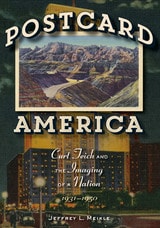
Postcard America
Curt Teich and the Imaging of a Nation, 1931-1950By Jeffrey L. Meikle
University of Texas Press, 2016
Extensively illustrated with representative images, this unique book illuminates the cultural significance of the highly colorized “linen” postcards that depicted a glowing America in the 1930s and 1940s and that fascinate collectors today.
From the Great Depression through the early postwar years, any postcard sent in America was more than likely a “linen” card. Colorized in vivid, often exaggerated hues and printed on card stock embossed with a linen-like texture, linen postcards celebrated the American scene with views of majestic landscapes, modern cityscapes, roadside attractions, and other notable features. These colorful images portrayed the United States as shimmering with promise, quite unlike the black-and-white worlds of documentary photography or Life magazine. Linen postcards were enormously popular, with close to a billion printed and sold.
Postcard America offers the first comprehensive study of these cards and their cultural significance. Drawing on the production files of Curt Teich & Co. of Chicago, the originator of linen postcards, Jeffrey L. Meikle reveals how photographic views were transformed into colorized postcard images, often by means of manipulation—adding and deleting details or collaging bits and pieces from several photos. He presents two extensive portfolios of postcards—landscapes and cityscapes—that comprise a representative iconography of linen postcard views. For each image, Meikle explains the postcard’s subject, describes aspects of its production, and places it in social and cultural contexts. In the concluding chapter, he shifts from historical interpretation to a contemporary viewpoint, considering nostalgia as a motive for collectors and others who are fascinated today by these striking images.
Projecting the Nation
History and Ideology on the Israeli ScreenEran Kaplan
Rutgers University Press, 2020