Results by title
52 books match the query 'Nature in literature' and 4 start with p
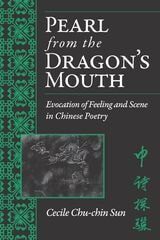
Pearl from the Dragon’s Mouth
Evocation of Scene and Feeling in Chinese PoetryCecile C. C. Sun
University of Michigan Press, 1995
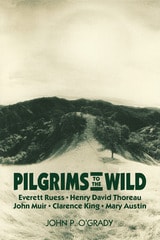
Pilgrims To The Wild
John P O'Grady
University of Utah Press, 1993
Pilgrims to the Wild is a survey of American writers who have responded to their encounters with the natural world. Ranging in its treatment from Thoreau’s important but neglected essay, 'Walking,' to the exuberant letters of the young artist Everett Ruess (who disappeared in the Escalante canyonlands), this is a broadly based exploration that brings to bear Eastern and Western classical philosophy, as well as contemporary critical theory, on a distinctive tradition of American Writing—those works concerned with the human relationship to the nonhuman world.
In addition to offering a fresh interpretation of classic authors such a Thoreau and Muir, this book introduces readers to the less widely known but equally fascinating writers Clarence King and Mary Austin.
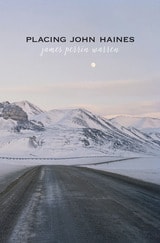
Placing John Haines
James Perrin Warren
University of Alaska Press, 2017
John Haines arrived in Alaska, fresh out of the Navy, in 1947, and established a homestead seventy miles southeast of Fairbanks. He stayed there nearly twenty-five years, learning to live off the country: hunting, trapping, fishing, gathering berries, and growing vegetables. Those years formed him as a writer—the interior of Alaska, and especially its boreal forest—marking his poetry and prose and helping him find his unique voice.
Placing John Haines, the first book-length study of his work, tells the story of those years, but also of his later, itinerant life, as his success as a writer led him to hold fellowships and teach at universities across the country. James Perrin Warren draws out the contradictions inherent in that biography—that this poet so indelibly associated with place, and authentic belonging, spent decades in motion—and also sets Haines’s work in the context of contemporaries like Robert Bly, Donald Hall, and his close friend Wendell Berry. The resulting portrait shows us a poet who was regularly reinventing himself, and thereby generating creative tension that fueled his unforgettable work. A major study of a sadly neglected master, Placing John Haines puts his achievement in compelling context.
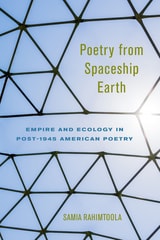
Poetry from Spaceship Earth
Empire and Ecology in Post-1945 American PoetrySamia Rahimtoola
University of Iowa Press, 2026
In the early decades of the postwar period, the planetary metaphor of “spaceship Earth” was everywhere in the West. It exerted its power on sites as various as Caribbean research stations, the shipping lanes of the U.S.-occupied Pacific, Palestinian refugee camps, and the internal colonies of segregated nations. At its heart was a new ideology and infrastructure of managing, administering, and rationalizing nature through which Western powers sought to maintain their grip on a decolonizing planet.
Poetry from Spaceship Earth retrieves a diverse array of postwar American poets—Robert Duncan, June Jordan, Joanne Kyger, Lorine Niedecker, and Charles Olson—who contested and cultivated alternatives to this emergent mode of environmentalism. By placing the major innovations of postwar poetry into conversation with environmental politics, Cold War science and technology studies, and postcolonial and Black studies, Samia Rahimtoola develops an original theoretical and historical account of the racial and colonial logics that underpin the supposedly neutral project of managing nature.