Results by title
110 books match the query 'New Mexico' and 5 start with p
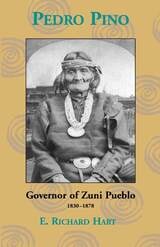
Pedro Pino
Governor of Zuni Pueblo, 1830-1878E. Richard Hart
Utah State University Press, 2003
Pedro Pino, or Lai-iu-ah-tsai-lu (his Zuni name) was for many years the most important Zuni political leader. He served during a period of tremendous change and challenges for his people. Born in 1788, captured by Navajos in his teens, he was sold into a New Mexican household, where he obtained his Spanish name. When he returned to Zuni, he spoke three languages and brought with him a wealth of knowledge regarding the world outside the pueblo. For decades he ably conducted Zuni foreign relations, defending the pueblo's sovereignty and lands, establishing trade relationships, interacting with foreigners-from prominent military and scientific expeditions to common emigrants-and documenting all in a remarkable archive. Steeped in Zuni traditions, he was known among other things for his diplomatic savvy, as a great warrior, for his oratory, and for his honesty and hospitality.
More than a biography, Richard Hart's work provides a history of Zuni during an especially significant period. Also the author of Zuni and the Courts: A Struggle for Sovereign
Land Rights and the co-author of A Zuni Atlas, Hart originally wrote the manuscript in 1979 after a decade of historical work for Zuni Pueblo. He then set it aside but continued to pursue research about and for Zuni. Its publication, at last, inscribes an important contribution to Pueblo history and biography and a testimonial to a remarkable Native American leader. In an afterword written for this publication, Hart discusses his original intentions in writing about Pedro Pino and Zuni and situates the biography in relation to current scholarship.
Piros and Prehistory
A Study in TanoanDavid Leedom Shaul
University of Utah Press, 2024
Shaul’s arguments use linguistic analyses coupled with historic and prehistoric records of migration and cultural interaction. Following the establishment of Piro as a Tanoan language, much of the linguistic analysis involves determining the aspects of Piro that were inherited from the earlier Proto-Tanoan versus those that were incorporated later as a result of borrowing from other languages through cultural interaction. This book lays out the linguistic argument that the similarities between Piro and Tiwan languages result from borrowing, not common ancestry, and it provides a record of contact between groups and linguistic evolution based on these movements.
Population, Contact, and Climate in the New Mexican Pueblos
Ezra B. W. Zubrow
University of Arizona Press, 1974
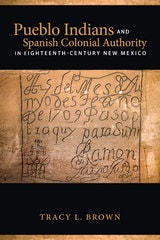
Pueblo Indians and Spanish Colonial Authority in Eighteenth-Century New Mexico
Tracy L. Brown
University of Arizona Press, 2013
Brown addresses an understudied period of Pueblo Indian/Spanish colonial history of New Mexico with a work that paints a portrait of pre-contact times through the colonial period with a special emphasis on the eighteenth century. The Pueblo communities that the Spaniards encountered were divided by language, religion,and political and kinship organization. Brown highlights the changes to, but also the maintenance of, social practices and beliefs in the economic, political, spiritual and familial and intimate realms of life that resulted from Pueblo attempts to negotiate Spanish colonial power.
The author combines an analysis of eighteenth century Spanish documentation with archaeological findings concerning Pueblo beliefs and practices that spans the pre-contact period to the eighteenth century in the Southwest. Brown presents a nonlinear view of Pueblo life that examines politics, economics, ritual, and personal relationships. The book paints a portrait of the Pueblo peoples and their complex responses to Spanish colonialism by making sense of little-researched archival documents and archaeological findings that cast light on the daily life of Pueblo peoples.
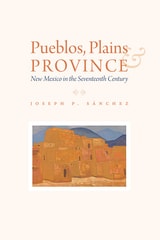
Pueblos, Plains, and Province
New Mexico in the Seventeenth CenturyJoseph P. Sánchez
University Press of Colorado, 2024
In Pueblos, Plains, and Province Joseph P. Sánchez offers an in-depth examination of sociopolitical conflict in seventeenth-century New Mexico, detailing the effects of Spanish colonial policies on settlers’, missionaries’, and Indigenous peoples’ struggle for economic and cultural control of the region. Sánchez explores the rich archival documentation that provides cultural, linguistic, and legal perspectives of the values of the period.
Spanish dual Indian policies for Pueblo and Plains tribes challenged Indigenous political and social systems to conform to the imperial structure for pacification purposes. Meanwhile, missionary efforts to supplant Indigenous religious beliefs with a Christian worldview resulted, in part, in a syncretism of the two worlds. Indigenous resentment of these policies reflected the contentious disagreements between Spanish clergymen and civil authorities, who feuded over Indigenous labor and encroachment on tribal sovereignties with demands for sworn loyalty to Spanish governance. The little-studied “starvation period” adversely affected Spanish-Pueblo relationships for the remainder of the century and contributed significantly to the battle at Acoma, the Jumano War, and the Pueblo Revolt of 1680.
Pueblos, Plains, and Province shows how history, culture, and tradition in New Mexico shaped the heritage shared by Spain, Mexico, the United States, and Native American tribes and will be of interest to scholars and students of Indigenous, colonial, and borderlands history.