Results by title
176 books match the query 'New Testament' and 6 start with p
Paul Unbound
Other Perspectives on the ApostleMark D. Given
SBL Press, 2022
"As long as there are readers of Paul, there will be always be other perspectives."
The essays in this second edition of Paul Unbound: Other Perspectives on the Apostle provide introductions to Paul's relationship to and views on the Roman Empire, first-century economic stratification, his opponents, ethnicity, the law, Judaism, women, and Greco-Roman rhetoric. Contributors Warren Carter, Charles H. Cosgrove, A. Andrew Das, Steven J. Friesen, Mark D. Given, Deborah Krause, Mark D. Nanos, and Jerry L. Sumney have added addendums to their original essays and updated the bibliography to take into account scholarship produced in the decade since the publication of the first edition. The collection provides essential background and sets out new directions for study useful to students of the New Testament and Paul's letters.
Paul and Scripture
Extending the ConversationChristopher D. Stanley
SBL Press, 2012
Paul and the Resurrected Body
Social Identity and Ethical PracticeMatt O'Reilly
SBL Press, 2020
A new reading of Pauline theology, ethics, and eschatology grounded in social-identity theory and sociorhetorical criticism
Readers often think of Paul’s attitude toward the resurrection of the body in individual terms: a single body raised as the climax of an individual’s salvation. In Paul and the Resurrected Body: Social Identity and Ethical Practice, Matt O’Reilly makes the case that, for Paul, the social dimension of future bodily resurrection is just as important, if not more so. Through a close reading of key texts in the letters to the Corinthians, Romans, and Philippians, O’Reilly argues that resurrection is integral to Paul’s understanding of Christian social identity. In Paul’s theological reasoning, a believer’s hope for the future depends on being identified as part of the people of God who will be resurrected.
Features
- A clarification of the eschatological basis for Paul’s ethical expectations
- Exploration of the social significance of Paul’s theological reasoning
- An integration of ancient rhetorical theory with contemporary social-identity theory
Paul as Infant and Nursing Mother
Metaphor, Rhetoric, and Identity in 1 ThessaJennifer Houston McNeel
SBL Press, 2014
Explore the significance of maternal metaphors in the writings of a first-century male missionary and theologian
Paul employed metaphors of childbirth or breastfeeding in four out of the seven undisputed epistles. In this book, McNeel uses cognitive metaphor theory and social identity analysis to examine the meaning and function of these maternal metaphors. She asserts that metaphors carry cognitive content and that they are central to how humans process information, construct reality, and shape group identity.
Features:
- A focus on “identity” as the way in which people understand themselves in relation to one another, to society, and to those perceived as outsiders
- Examination of metaphor as part of Paul’s rhetorical strategy
- Integration of the work of philosopher Max Black with the work of cognitive linguists George Lakoff and Mark Johnson
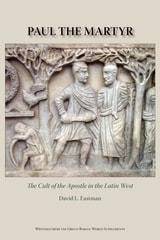
Paul the Martyr
The Cult of the Apostle in the Latin WestDavid L. Eastman
SBL Press, 2011
Ancient iconography of Paul is dominated by one image: Paul as martyr. Whether he is carrying a sword—the traditional instrument of his execution—or receiving a martyr's crown from Christ, the apostle was remembered and honored for his faithfulness to the point of death. As a result, Christians created a cult of Paul, centered on particular holy sites and characterized by practices such as the telling of stories, pilgrimage, and the veneration of relics. This study integrates literary, archaeological, artistic, and liturgical evidence to describe the development of the Pauline cult within the cultural context of the late antique West.
Profaning Paul
Cavan W. Concannon
University of Chicago Press, 2021
The letters of Paul have been used to support and condone a host of evils over the span of more than two millennia: racism, slavery, imperialism, misogyny, and anti-Semitism, to name a few. Despite, or in some cases because of, this history, readers of Paul have felt compelled to reappropriate his letters to fit liberal or radical politics, seeking to set right the evils done in Paul’s name. Starting with the language of excrement, refuse, and waste in Paul’s letters, Profaning Paul looks at how Paul’s “shit” is recycled and reconfigured. It asks why readers, from liberal Christians to academic biblical scholars to political theorists and philosophers, feel compelled to make Paul into a hero, mining his words for wisdom. Following the lead of feminist, queer, and minoritized scholarship, Profaning Paul asks what would happen if we stopped recycling Paul’s writings. By profaning the status of his letters as sacred texts, we might open up new avenues for imagining political figurations to meet our current and coming political, economic, and ecological challenges.