Results by title
242 books match the query 'Old Testament' and 16 start with p
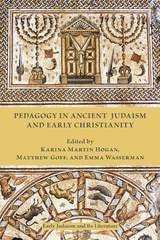
Pedagogy in Ancient Judaism and Early Christianity
Karina Martin Hogan
SBL Press, 2017
Engage fourteen essays from an international group of experts
There is little direct evidence for formal education in the Bible and in the texts of Second Temple Judaism and early Christianity. At the same time, pedagogy and character formation are important themes in many of these texts. This book explores the pedagogical purpose of wisdom literature, in which the concept of discipline (Hebrew musar) is closely tied to the acquisition of wisdom. It examines how and why the concept of musar came to be translated as paideia (education, enculturation) in the Greek translation of the Hebrew Bible (Septuagint), and how the concept of paideia was deployed by ancient Jewish authors writing in Greek. The different understandings of paideia in wisdom and apocalyptic writings of Second Temple Judaism are this book's primary focus. It also examines how early Christians adapted the concept of paideia, influenced by both the Septuagint and Greco-Roman understandings of this concept.
Features
Philo of Alexandria's Exposition on the Tenth Commandment
Hans Svebakken
SBL Press, 2012
Plant Metaphors in Prophetic Condemnations of Israel and Judah
Tina M. Sherman
SBL Press, 2023
Tina M. Sherman offers a first-of-its-kind, detailed analysis of prophetic passages that depict people as plants—from grasses and grains to fruit trees and grapevines—examining how the biblical authors exploited these metaphors to portray the condemnation and punishment of Israel and Judah in terms of the everyday work of crop farming and plant husbandry. Additionally, she explores how the prophetic authors employed plant imagery to construct national identities that emphasize the people’s collective responsibility for the kingdoms’ fate. Plant Metaphors in Prophetic Condemnations of Israel and Judah demonstrates the usefulness of combining conceptual metaphor theory with aspects of frame semantics in the analysis of patterns of thought and expression in biblical metaphor.
Plant Metaphors in the Old Greek of Isaiah
Benjamin M. Austin
SBL Press, 2019
A thorough analysis of metaphor translation techniques used in Isaiah
In this study Benjamin M. Austin analyzes all the plant metaphors in Isaiah and classifies them according to the metaphor translation techniques used by the Septuagint translator. Austin illustrates how the translator took the context of each metaphor into account and demonstrates how the natural features of the plants under discussion at times influenced their translation. He argues that the translator tried to render metaphors vividly and with clarity, sometimes adjusting them to match the experience of his audience living in Egypt. Austin also examines metaphors in terms of their vehicles (the objects of comparison), so that the translation of similar metaphors can be compared.
Features
- A comparison of the Masoretic Text to the Septuagint and Targum
- A classification of metaphor translation strategies
- An introduction to the Hellenistic and the Jewish conception of metaphors
Postclassical Greek and Septuagint Lexicography
William A. Ross
SBL Press, 2022
Postcolonialism and the Hebrew Bible
The Next StepRoland Boer
SBL Press, 2013
Poverty, Law, and Divine Justice in Persian and Hellenistic Judah
Johannes Unsok Ro
SBL Press, 2018
A view of Persian and Hellenistic Judean communities through theological and socioeconomic lenses
Johannes Unsok Ro employs philological, historical, and sociological approaches to investigate the close connections between socioeconomic structures, social inequality, and theological developments in the Judean communities in Persian- and Hellenistic-era Palestine. Ro contends that competing points of view from communities of lay returnees, priestly returnees, and communities of resident Judeans and Samaritans were juxtaposed within the Hebrew Bible, which took shape during the postexilic period. By exploring issues such as the relationship between the shaping of the canon and literacy in the Judean community, the term strangers in the biblical law codes, the socioeconomic structures of Judean communities reflected in the biblical law codes, the development of the theological concept of divine punitive justice, the piety of the poor in certain psalms, and the concept of poverty in the Dead Sea Scrolls, Ro illustrates that the communities behind each text and its redactions can be ascertained through sociological and theological lenses.
Features
- Demonstration that a theology of the poor materialized orally among the poor but found written expression among Levites
- Insight into the socioeconomic and theological concerns of the authorial groups behind various biblical law codes
- A case that biblical “poverty” sometimes refers to humility and a theologically reflected consciousness of lowliness toward God
Prayers and the Construction of Israelite Identity
Susanne Gillmayr-Bucher
SBL Press, 2019
Substantial insights into various identity discourses reflected in the biblical prayers
This collection of essays from an international group of scholars focuses on how biblical prayers of the Persian and early Hellenistic periods shaped identity, evoked a sense of belonging to specific groups, and added emotional significance to this affiliation. Contributors draw examples from different biblical texts, including Genesis, Samuel, Kings, Chronicles, Ezra and Nehemiah, Psalms, Jonah, and Daniel.
Features
- Thorough study of prayers that play a key role for a biblical book’s (re)construction of the people’s history and identity
- An examination of ways biblical figures are remodeled by their prayers by introducing other, sometimes even contradictory, discourses on identity
- An exploration of different ways in which psalms from postexilic times shaped, reflected, and modified identity discourses
Praying Legally
Shalom E. Holtz
SBL Press, 2019
Explore the lengthy history of legal metaphors in ancient prayer
In biblical and other ancient Near Eastern sources, prayer is an opportunity to make one’s case before divine judges. Prayers were formulated using courtroom or trial language, including demands for judgment, confessions, and accusations. The presence of these legal concepts reveals ancient Near Eastern thoughts about what takes place when one prays. Holtz highlights legal concepts that appear in prayers, including the motif of the speakers' oppression in Psalms the possibility of countersuit against God through prayer, and divine attention and inattention as legal responses. By reading ancient prayers together with legal texts, this book shows how speakers took advantage of prayer as an opportunity to have their day in the divine court and even sue against divine injustice.
Features
- Identification of legal vocabulary and concepts that appear in ancient prayers
- Analysis of legal metaphors in prayer examples in Akkadian and postbiblical rabbinic texts
- Interpretations of trial records and texts from Psalms and Lamentations
Predicting the Past in the Ancient Near East
Mantic Historiography in Ancient Mesopotamia, Judah, and the Mediterranean WorldMatthew Neujahr
SBL Press, 2012

Priests and Cults in the Book of the Twelve
Lena-Sofia Tiemeyer
SBL Press, 2016
Key essays that explore a range of attitudes toward clergy and ritual
This book discusses the depictions of the cult and its personnel in the twelve prophetic books commonly referred to as the Book of the Twelve or the Minor Prophets. The articles in the volume explore the following questions: How did these prophetic writers envision the priests and the Levites? What did they think about the ritual aspects of ancient Israelite faith, including not only the official temple cult in Jerusalem but also cultic expressions outside the capital? What, in their views, characterized a faithful priest and what should the relationship be between his cultic performance and the ways in which he lived his life? How does the message of each individual author fit in with the wider Israelite traditions? Finally, who were these prophetic authors, in which historical contexts did they live and work, and what stylistic tools did they use to communicate their message?
Features:
Prophecy and Gender in the Hebrew Bible
L. Juliana Claassens
SBL Press, 2021
Multifaceted insights into female life in prophetic contexts
Both prophets and prophetesses shared God’s divine will with the people of Israel, yet the voices of these women were often forgotten due to later prohibitions against women teaching in public. This latest volume of the Bible and Women series focuses on the intersection of gender and prophecy in the Former Prophets (Joshua to 2 Kings) as well as in the Latter Prophets of the Hebrew Bible. Essays examine how women appear in the iconography of the ancient world, the historical background of the phenomenon of prophecy, political and religious resistance by women in the biblical text, and gender symbolism and constructions in prophetic material as well as the metaphorical discourse of God. Contributors Michaela Bauks, Athalya Brenner-Idan, Ora Brison, L. Juliana Claassens, Marta García Fernández, Irmtraud Fischer, Maria Häusl, Rainer Kessler, Nancy C. Lee, Hanne Løland Levinson, Christl M. Maier, Ilse Müllner, Martti Nissinen, Ombretta Pettigiani, Ruth Poser, Benedetta Rossi, Silvia Schroer, and Omer Sergi draw insight into the texts from a range of innovative gender-oriented approaches.
Prophetic Voices
Renewing and Reimagining HaftarahRabbi Barbara AB Symons
Central Conference of American Rabbis, 2023
Prophets Male and Female
Gender and Prophecy in the Hebrew Bible, the Eastern Mediterranean, and theJonathan Stökl
SBL Press, 2013
Psalm Studies, Volume 1
Sigmund Mowinckel
SBL Press, 2014
Sigmund Mowinckel is widely recognized as one of the leading forces in Psalms research during the twentieth century. Indeed, the culmination of Mowinckel’s thought and work, The Psalms in Israel’s Worship, continues to play a significant role in Psalms scholarship today. Not as well known are the seminal studies that prepared the ground for Mowinckel’s later work, the six Psalmenstudien that are translated here into English for the first time. In these studies Mowinckel explores with care and in detail such topics as: “'Awen and the Psalms of Individual Lament”; “YHWH’s Enthronement Festival and the Origin of Eschatology”; “Cultic Prophecy and Prophetic Psalms”; “The Technical Terms in the Psalm Superscriptions”; “Blessing and Curse in Israel’s Cult and Psalmody”; and “The Psalmists.” Anyone interested in Psalms study, especially the possible role of the New Year’s enthronement festival within Israel’s cult and its relation to the Psalter, will find much to consider in these classic works.
Psalm Studies, Volume 2
Sigmund Mowinckel
SBL Press, 2014
Sigmund Mowinckel is widely recognized as one of the leading forces in Psalms research during the twentieth century. Indeed, the culmination of Mowinckel’s thought and work, The Psalms in Israel’s Worship, continues to play a significant role in Psalms scholarship today. Not as well known are the seminal studies that prepared the ground for Mowinckel’s later work, the six Psalmenstudien that are translated here into English for the first time. In these studies Mowinckel explores with care and in detail such topics as: “'Awen and the Psalms of Individual Lament”; “YHWH’s Enthronement Festival and the Origin of Eschatology”; “Cultic Prophecy and Prophetic Psalms”; “The Technical Terms in the Psalm Superscriptions”; “Blessing and Curse in Israel’s Cult and Psalmody”; and “The Psalmists.” Anyone interested in Psalms study, especially the possible role of the New Year’s enthronement festival within Israel’s cult and its relation to the Psalter, will find much to consider in these classic works.