Results by title
74 books match the query 'Paleontology' and 5 start with p
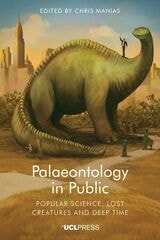
Palaeontology in Public
Popular Science, Lost Creatures and Deep TimeEdited by Chris Manias
University College London, 2025
From towering dinosaurs to early human ancestors, paleontology has long captured the public imagination, yet its scientific standing has often been precarious. Palaeontology in Public studies how paleontology’s public presence has shaped both the field itself and broader cultural understandings of science and nature. Through case studies spanning two centuries, this book explores the deep entanglement between vertebrate paleontology and popular culture, from early fossil discoveries to modern cinematic depictions.
Dinosaurs naturally take center stage, taking Spinosaurus, Jurassic Park, and Winsor McCay’s Gertie the Dinosaur, for instance. However, equally important are the stories of Glyptodons, Mesozoic mammals, and early human fossils like Neanderthals and Australopithecus. The book draws from history, art, literature, archaeology, and science communication to depict how public fascination has fueled scientific discovery while also shaping our collective vision of life’s ancient past.
A compelling read for historians of science, paleontologists, and those with a special interest in prehistoric creatures, Palaeontology in Public highlights the enduring power of fossils also as cultural icons that continue to inspire and spark debate.

Paleoenvironments in the Namib Desert
The Lower Tumas Basin in the Late CenozoicM. Justin Wilkinson
University of Chicago Press, 1990
Paleontology
A Brief History of LifeIan Tattersall
Templeton Press, 2010
"Endlessly absorbing and informative. It would be hard to imagine a better introduction to this most important and fascinating field.”—Bill Bryson, author of A Short History of Nearly Everything
People, Plants, and Landscapes
Studies in PaleoethnobotanyKristen J. Gremillion
University of Alabama Press, 1997
Discover how ancient peoples and plants shaped one another across generations and landscapes.
People, Plants, and Landscapes showcases the potential of modern paleoethnobotany, an interdisciplinary field that explores the interactions between human beings and plants by examining archaeological evidence. Using different methods and theoretical approaches, the essays in this work apply botanical knowledge to studies of archaeological plant remains and apply paleoethnobotany to nonarchaeological sources of evidence. The resulting techniques often lie beyond the traditional boundaries of either archaeology or botany.
With this ground-breaking work, the technically and methodologically enhanced paleoethnobotany of the 1990s has joined forces with ecological and evolutionary theory to forge explanations of changing relationships between human and plant populations.
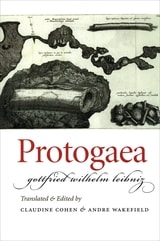
Protogaea
Gottfried Wilhelm Leibniz
University of Chicago Press, 2008
Though the works of Leibniz have been widely translated, Protogaea has languished in its original Latin for centuries. Now Claudine Cohen and Andre Wakefield offer the first English translation of this central text in natural philosophy and natural history. Written between 1691 and 1693, and first published after Leibniz’s death in 1749, Protogaea reemerges in this bilingual edition with an introduction that carefully situates the work within its historical context.