Results by title
59 books match the query 'Palestinian Arabs' and 10 start with p
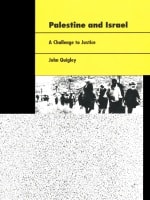
Palestine and Israel
A Challenge to JusticeJohn Quigley
Duke University Press, 1990
Beginning with the early Zionist settlement in Palestine that rose from the effort by Jews to escape long-standing discrimination in Europe, Qigley investigates the origins of the dispute, including the British occupation of Palestine, the British Mandate, and the involvement of the United Nations. He examines the 1948 War, the establishment of Israel, and explores the legal and political status of Jews there. After a detailed analysis of the 1967 War and Israel’s occupation of the West Bank and Gaza Strip, he concludes with recommendations for resolving the conflict, including discussions of the responsibility of other states for the persisting injustice, the role of other states in settling the dispute, and steps to a possible solution.
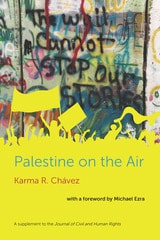
Palestine on the Air
Karma R. Chavez
University of Illinois Press, 2019
Palestine, Israel, and the Politics of Popular Culture
Rebecca L. Stein and Ted Swedenburg, eds.
Duke University Press, 2005
The volume is interdisciplinary, including the work of anthropologists, historians, sociologists, political scientists, ethnomusicologists, and Americanist and literary studies scholars. Contributors examine popular music of the Palestinian resistance, ethno-racial “passing” in Israeli cinema, Arab-Jewish rock, Euro-Israeli tourism to the Arab Middle East, Internet communities in the Palestinian diaspora, café culture in early-twentieth-century Jerusalem, and more. Together, they suggest new ways of conceptualizing Palestinian and Israeli political culture.
Contributors. Livia Alexander, Carol Bardenstein, Elliott Colla, Amy Horowitz, Laleh Khalili, Mary Layoun, Mark LeVine, Joseph Massad, Melani McAlister, Ilan Pappé, Rebecca L. Stein, Ted Swedenburg, Salim Tamari
Palestinian Arab Music
A Maqam Tradition in PracticeDalia Cohen and Ruth Katz
University of Chicago Press, 2005
Working initially with their own 1957 invention, the Cohen-Katz Melograph, and later with computers, Dalia Cohen and Ruth Katz recorded and digitized several hundred Palestinian music performances. The authors analyzed the musical tradition in light of its main variables. These include musical parameters, modal frameworks, the form and structure of the music, its poetic texts, and aspects of the social functions of the tradition. As a result of their study, the vexed aspect of intonation in practice is revealed to exist in a special relationship with the scale systems or maqamat, which are in turn of great importance to organizing the music and determining its modal systems.
Palestinian Lawyers and Israeli Rule
Law and Disorder in the West BankBy George Emile Bisharat
University of Texas Press, 1989
As frequent intermediaries between Israeli military authorities and Palestinian citizens, Palestinian lawyers stand close to the fault line dividing Israeli and Palestinian societies. The conflicts and tensions they experience in their profession mirror the larger conflicts between the two societies. Thus, as George Bisharat reveals in Palestinian Lawyers and Israeli Rule, a careful study of the work and lives of Palestinian lawyers ultimately helps to illuminate the causes of the intifada, or uprising, that began in December 1987.
The study revolves around the central question of why the Palestinian legal profession declined during twenty years of Israeli occupation when, in other Third World countries, the legal profession has often reached its peak during a period of Western colonization. Bisharat answers this question with a wide-ranging inquiry into the historical origins of the legal profession and court system in Palestine, the tenuous grounding of these institutions in Palestinian society and culture, and the structure, style, and policies of the late-twentieth-century Israeli military government in the West Bank.
For general readers interested in the Palestinian-Israeli conflict, as well as specialists in such fields as legal anthropology, sociology of the professions, Third World law and development, and Middle Eastern studies, Palestinian Lawyers and Israeli Rule will be required reading.

Palestinians Born in Exile
Diaspora and the Search for a HomelandBy Juliane Hammer
University of Texas Press, 2005
In the decade following the 1993 Oslo Peace Accords, some 100,000 diasporic Palestinians returned to the West Bank and Gaza. Among them were children and young adults who were born in exile and whose sense of Palestinian identity was shaped not by lived experience but rather through the transmission and re-creation of memories, images, and history. As a result, "returning" to the homeland that had never actually been their home presented challenges and disappointments for these young Palestinians, who found their lifeways and values sometimes at odds with those of their new neighbors in the West Bank and Gaza.
This original ethnography records the experiences of Palestinians born in exile who have emigrated to the Palestinian homeland. Juliane Hammer interviews young adults between the ages of 16 and 35 to learn how their Palestinian identity has been affected by living in various Arab countries or the United States and then moving to the West Bank and Gaza. Their responses underscore how much the experience of living outside of Palestine has become integral to the Palestinian national character, even as Palestinians maintain an overwhelming sense of belonging to one another as a people.

Palestinians in Israel
Segregation, Discrimination and DemocracyBen White
Pluto Press, 2012
Palestinians in Israel considers a key issue ignored by the official 'peace process' and most mainstream commentators: that of the growing Palestinian minority within Israel itself.
What the Israeli right-wing calls 'the demographic problem' Ben White identifies as 'the democratic problem' which goes to the heart of the conflict. Israel defines itself not as a state of its citizens, but as a Jewish state, despite the substantial and increasing Palestinian population. White demonstrates how the consistent emphasis on privileging one ethno-religious group over another cannot be seen as compatible with democratic values and that, unless addressed, will undermine any attempts to find a lasting peace.
Individual case studies are used to complement this deeply informed study into the great, unspoken contradiction of Israeli democracy. It is a pioneering contribution which will spark debate amongst all those concerned with a resolution to the Israel/Palestine conflict.
Peaceful Resistance
Building a Palestinian University Under OccupationGabi Baramki
Pluto Press, 2009
This book tells the remarkable story of Birzeit University, Palestine’s oldest university in the Occupied Territories.
Founded against the backdrop of occupation, it is open to all students, irrespective of income. Putting the study of democracy and tolerance at the heart of its curriculum, Birzeit continues to produce idealistic young people who can work to bring about a peaceful future. Gabi Baramki explains how the University has survived against shocking odds, including direct attacks where Israeli soldiers have shot unarmed students. Baramki himself has been dragged from his home at night, beaten and arrested. Yet Birzeit continues to thrive, putting peace at the heart of its teaching, and offering Palestinians the opportunities that only education can bring.
Popular Protest in Palestine
The History and Uncertain Future of Unarmed ResistanceMarwan Darweish and Andrew Rigby
Pluto Press, 2015
Princesses' Street
Baghdad MemoriesJabra Ibrahim Jabra
University of Arkansas Press, 2005