Results by title
104 books match the query 'Parenting' and 13 start with p

Parent Education
A Survey of the Minnesota ProgramEdith Davis
University of Minnesota Press, 1939
Parent Education
The Northwest Conference on Child Health and Parent EducationRichard Beard
University of Minnesota Press, 1927
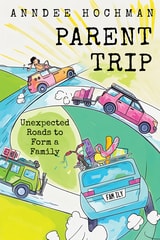
Parent Trip
Unexpected Roads to Form a FamilyAnndee Hochman
Temple University Press, 2026
Hochman recounts the fraught emotions of couples struggling with infertility, the joy of a single gay man becoming a father in his forties, and the anxiety of people waiting for the adoption worker to call with good news. Parent Trip tells of sperm donors and gestational surrogates, midwives and miscarriages; it chronicles how children prompt parents to recalibrate their lives.
In personal essays that weave throughout the profiles, Hochman connects her interviewees’ lives to the love, heartbreak, and uncertainty in her own path to parenthood. Through myriad mundane and extraordinary moments, Parent Trip not only chronicles the magic and labor of childrearing, it also celebrates the infinite ways real families come to be.
Parental Priorities and Economic Inequality
Casey B. Mulligan
University of Chicago Press, 1997
In Mulligan's model, parents determine the degree of their altruistic concern for their children and spend time with and resources on them accordingly—just as they might make choices about how they spend money. Mulligan tests his model against both old and new evidence on the intergenerational transmission of consumption, earnings, and wealth, including models that emphasize "financial constraints." One major prediction of Mulligan's model confirmed by the evidence is that children of wealthy parents typically spend more than they earn.
Mulligan's innovative approach can also help explain other important behavior, such as charitable giving and "corporate loyalty," and will appeal to a wide range of quantitatively oriented social scientists and sociobiologists.
Parenthood In America
Undervalued, Underpaid, Under SiegeJack C. Westman, M.D.
University of Wisconsin Press, 2001
Parenthood in America brings the insights of experts in child development, education, health, media studies, economics, history, sociology, and human services to bear on practical aspects of childrearing and on the kinds of policies that have a real effect on parenting. In response to the stresses of parenthood today, they call for:
o family-friendly workplaces and decent childcare options
o pediatric health care for all
o programs that aid children’s development as well as their physical health
o recognition by professionals of parents’ expert knowledge about their own children
o alternatives to vapid or violent games and TV programs
o prioritization of time for family meals, talks, chores, and activities
o valuing of caring relationships above wealth and possessions
o appreciation of cultural and religious diversity
o supportive networks among parents, teachers, pediatricians, and childcare providers.
Parenting Empires
Class, Whiteness, and the Moral Economy of Privilege in Latin AmericaAna Yolanda Ramos-Zayas
Duke University Press, 2020
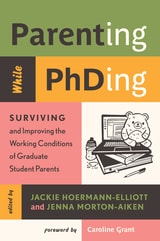
Parenting While PhDing
Surviving and Improving the Working Conditions of Graduate Student ParentsJackie Hoermann-Elliott
Rutgers University Press, 2025
Featuring contributions from more than forty current and former graduate students raising children, Parenting While PhDing offers valuable advice for students and administrators. Parents will get practical recommendations on both child care and self-care, learning how to form supportive personal and professional networks while establishing a healthy work/life balance. The collection also offers thoughtful suggestions on how to make graduate programs less toxic and more inclusive.
Recognizing that not all graduate students have similar backgrounds or needs, Parenting While PhDing features a diverse range of viewpoints, including queer, trans, disabled, BIPOC, immigrant, and first-generation college students. The authors represent a variety of disciplines, from the natural and social sciences to the humanities and health care professions. Together, they share fresh perspectives on the experiences of graduate students with children and offer strategies they can use to navigate the dual pressures of the academy and parenting.
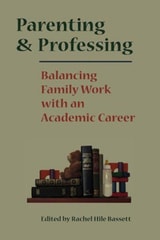
Parenting and Professing
Balancing Family Work with an Academic CareerRachel Hile Bassett
Vanderbilt University Press, 2005

Parenting on the Frontlines
Stories of Love, Loss, and WonderKelly Cooper Paradis
Michigan Publishing Services, 2023
Each day of working parenthood is a rollercoaster of success and failure. My child ate a carrot! Then spit it out on the dog. I got to work on time! But there is a mystery stain on my dress shirt and this Tide stick is definitely making it worse. Also yes, that was “Baby Shark” I was humming while accidentally unmuted on the Zoom call, and no, I am not going to be able to sew an octopus costume from scratch by Friday. Please tell me there is something available at Target.
As a parent, we live through levels of both joy and sorrow that we didn’t even know existed before. And we wonder—is it only me? Am I alone in this? In Parenting on the Frontlines, we explore both the lighter and heavier sides of working parenthood. The stories shared here are written by healthcare workers at Michigan Medicine, but all caregivers will find pieces to which they can relate. Most importantly, we want you to know that you are not alone on your journey, no matter where it takes you.
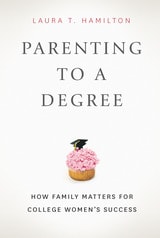
Parenting to a Degree
How Family Matters for College Women's SuccessLaura T. Hamilton
University of Chicago Press, 2016
Hamilton vividly captures the parenting approaches of mothers and fathers from all walks of life—from a CFO for a Fortune 500 company to a waitress at a roadside diner. As she shows, parents are guided by different visions of the ideal college experience, built around classed notions of women’s work/family plans and the ideal age to “grow up.” Some are intensively involved and hold adulthood at bay to cultivate specific traits: professional helicopters, for instance, help develop the skills and credentials that will advance their daughters’ careers, while pink helicopters emphasize appearance, charm, and social ties in the hopes that women will secure a wealthy mate. In sharp contrast, bystander parents—whose influence is often limited by economic concerns—are relegated to the sidelines of their daughter’s lives. Finally, paramedic parents—who can come from a wide range of class backgrounds—sit in the middle, intervening in emergencies but otherwise valuing self-sufficiency above all.
Analyzing the effects of each of these approaches with clarity and depth, Hamilton ultimately argues that successfully navigating many colleges and universities without involved parents is nearly impossible, and that schools themselves are increasingly dependent on active parents for a wide array of tasks, with intended and unintended consequences. Altogether, Parenting to a Degree offers an incisive look into the new—and sometimes problematic—relationship between students, parents, and universities.
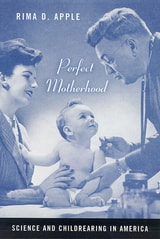
Perfect Motherhood
Science and Childrearing in AmericaApple, Rima
Rutgers University Press, 2006
Parenting today is virtually synonymous with worry. We want to ensure that our children are healthy, that they get a good education, and that they grow up to be able to cope with the challenges of modern life. In our anxiety, we are keenly aware of our inability to know what is best for our children. When should we toilet train? What is the best way to encourage a fussy child to eat? How should we protect our children from disease and injury?
Before the nineteenth century, maternal instinct—a mother’s “natural know-how”—was considered the only tool necessary for effective childrearing. Over the past two hundred years, however, science has entered the realm of motherhood in increasingly significant ways. In Perfect Motherhood, Rima D. Apple shows how the growing belief that mothers need to be savvy about the latest scientific directives has shifted the role of expert away from the mother and toward the professional establishment. Apple, however, argues that most women today are finding ways to negotiate among the abundance of scientific recommendations, their own knowledge, and the reality of their daily lives.
Persistence, Privilege, and Parenting
The Comparative Study of Intergenerational MobilityTimothy Smeeding
Russell Sage Foundation, 2012
Precarious Motherhood
Navigating Relationships and Support Post-Migration in the UKRachel Benchekroun
University College London, 2025
Precarious Motherhood is a deeply human investigation of the lives of racially minoritized mothers as they navigate the intersecting challenges of financial hardship and the UK’s hostile immigration policies. Based on thorough ethnographic research, Rachel Benchekroun examines how these mothers forge relationships to access support, maintain their children’s well-being, and carve out spaces of belonging in an often unwelcoming system. The book captures the resilience and the relentless precarity of motherhood in migration, where every relationship shapes social barriers and everyday survival.
Through the voices of over twenty migrant mothers, this work sheds light on the personal and political dimensions of motherhood. It provides critical insights into state policies and social infrastructures that shape migrant lives, making it a valuable resource for scholars of migration and social justice.