Results by title
93 books match the query 'Paris' and 14 start with p
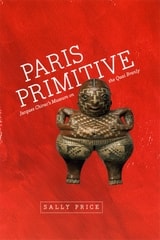
Paris Primitive
Jacques Chirac's Museum on the Quai BranlySally Price
University of Chicago Press, 2007
Paris Primitive recounts the massive reconfiguration of Paris’s museum world that resulted from Chirac’s dream, set against a backdrop of personal and national politics, intellectual life, and the role of culture in French society. Along with exposing the machinations that led to the MQB’s creation, Sally Price addresses the thorny questions it raises about the legacy of colonialism, the balance between aesthetic judgments and ethnographic context, and the role of institutions of art and culture in an increasingly diverse France. Anyone with a stake in the myriad political, cultural, and anthropological issues raised by the MQB will find Price’s account fascinating.
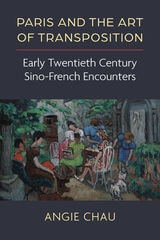
Paris and the Art of Transposition
Early Twentieth Century Sino-French EncountersAngie Chau
University of Michigan Press, 2023
While previous studies of Chinese modernism have focused on how Western modernist aesthetics were adapted or translated to the Chinese context, Angie Chau does the opposite by turning to Paris in the Chinese imaginary and discussing the literary and visual artwork of five artists who moved between France and China: the painter Chang Yu, the poet Li Jinfa, the art critic Fu Lei, the painter Pan Yuliang, and the writer Xu Xu. Chau draws the idea of transposition from music theory where it refers to shifting music from one key or clef to another, or to adapting a song originally composed for one instrument to be played by another. Transposing transposition to the study of art and literature, Chau uses the term to describe a fluid and strategic art practice that depends on the tension between foreign and familiar, new and old, celebrating both novelty and recognition—a process that occurs when a text gets placed into a fresh context.
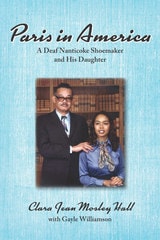
Paris in America
A Deaf Nanticoke Shoemaker and His DaughterClara Jean Mosley Hall
Gallaudet University Press, 2018
Hall was abandoned by her Deaf African American mother at a young age and forged a close bond with her father, James Paris Mosley, who communicated with her in American Sign Language. Although his family was Native American, they—like many other Nanticoke Native Americans of that region—had assimilated over time into Dover’s Black community. Hall vividly recounts the social and cultural elements that shaped her, from Jim Crow to the forced integration of public schools, to JFK and Motown. As a Coda (child of deaf adults) in a time when no accessibility or interpreting services were available, she was her father’s sole means of communication with the hearing world, a heavy responsibility for a child. After her turbulent teenage years, and with the encouragement of her future husband, she attended college and discovered that her skills as a fluent ASL user were a valuable asset in the field of education.
Hall went on to become a college professor, mentor, philanthropist, and advocate for Deaf students from diverse backgrounds. Her memoir is a celebration of her family, her faith, her journey, and her heritage.
Paris in Despair
Art and Everyday Life under Siege (1870-1871)Hollis Clayson
University of Chicago Press, 2002
But the crisis did not halt artistic production, as some have suggested. In fact, Clayson argues that the siege actually encouraged innovation, fostering changed attitudes and new approaches to representation among a wide variety of artists as they made art out of their individual experiences of adversity and change—art that has not previously been considered within the context of the siege. Clayson focuses especially on Rosa Bonheur, Edgar Degas, Jean-Alexandre-Joseph Falguière, Edouard Manet, and Henri Regnault, but she also covers a host of other artists, including Ernest Barrias, Gustave Courbet, Edouard Detaille, Pierre Puvis de Chavannes, Albert Robida, and James Tissot. Paris in Despair includes more than two hundred color and black-and-white images of works by these artists and others, many never before published.
Using the visual arts as an interpretive lens, Clayson illuminates the wide range of issues at play during the siege and thereafter, including questions of political and cultural identity, artistic masculinity and femininity, public versus private space, everyday life and modernity, and gender and class roles in military and civilian society. For anyone concerned with these issues, or with nineteenth-century French art in general, Paris in Despair will be a landmark work.
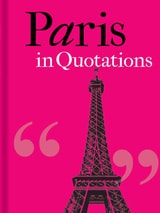
Paris in Quotations
Compiled by Jaqueline Mitchell
Bodleian Library Publishing, 2016
Paris in Quotations takes readers on a one-of-a-kind tour of the City of Lights, in which we hear from the likes of Molière and Thomas Gold Appleton, who thought that, “When good Americans die, they go to Paris.” For centuries, Paris has reigned over the popular imagination. For those planning a visit, this collection will be warmly welcomed.
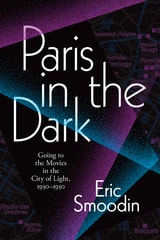
Paris in the Dark
Going to the Movies in the City of Light, 1930–1950Eric Smoodin
Duke University Press, 2020
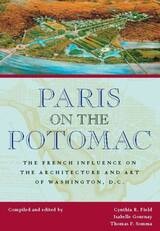
Paris on the Potomac
The French Influence on the Architecture and Art of Washington, D.C.Cynthia R. Field
Ohio University Press, 2007
In 1910 John Merven Carrère, a Paris-trained American architect, wrote, “Learning from Paris made Washington outstanding among American cities.” The five essays in Paris on the Potomac explore aspects of this influence on the artistic and architectural environment of Washington, D.C., which continued long after the well-known contributions of Peter Charles L’Enfant, the transplanted French military officer who designed the city’s plan.
Isabelle Gournay’s introductory essay provides an overview and examines the context and issues involved in three distinct periods of French influence: the classical and Enlightenment principles that prevailed from the 1790s through the 1820s, the Second Empire style of the 1850s through the 1870s, and the Beaux-Arts movement of the early twentieth century. William C. Allen and Thomas P. Somma present two case studies: Allen on the influence of French architecture, especially the Halle aux Blés, on Thomas Jefferson’s vision of the U.S. Capitol; and Somma on David d’Angers’s busts of George Washington and the Marquis de Lafayette. Liana Paredes offers a richly detailed examination of French-inspired interior decoration in the homes of Washington’s elite in the late nineteenth and early twentieth centuries. Cynthia R. Field concludes the volume with a consideration of the influence of Paris on city planning in Washington, D.C., including the efforts of the McMillan Commission and the later development of the Federal Triangle complex.
The essays in this collection, the latest addition to the series Perspectives on the Art and Architectural History of the United States Capitol, originated in a conference held by the U.S. Capitol Historical Society in 2002 at the French Embassy’s Maison Française.
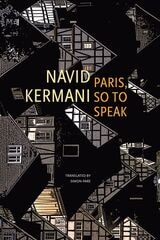
Paris, So to Speak
Navid Kermani
Seagull Books, 2022
A writer has penned a novel about the great love of his youth. After a public reading, he is approached by a woman he doesn’t recognize—but it’s his lover. He is the author; she, the figure in his novel. The young girl from back then has turned into an interesting and attractive woman—but she’s also married. Soon the situation becomes a little strange: they sit down together, have a glass of wine, talk about French romantic novels, ask each other what one expects of love when one grows older. And all the while her husband is sitting in the next room. How is this going to end? Navid Kermani has written a romantic novel like no other—surprising, witty, profound—and one can barely put it down.
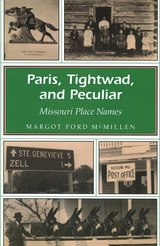
Paris, Tightwad, and Peculiar
Missouri Place NamesMargot Ford McMillen
University of Missouri Press, 1994
Paris, Tightwad, Peculiar, Neosho, Gasconade, Hannibal, Diamond, Quarantine, Zif, and Zig. These are just a few of the names Margot Ford McMillen covers in her lively book on the history of place names in Missouri. The origins behind the names range from humorous to descriptive:
•Tightwad, Missouri, is said to have been named after a store owner who cheated a mailman out of his rightful watermelon to make an extra fifty cents. •Plad, Missouri, was supposed to be named "Glad," but the post office printed the name wrong, and it was too much trouble to get it changed. •Some place names describe a location, such as Big Spring or Flat River. •Other names show the influence of immigrants to the state, like Hermann, which is a German name, or the Maries River, which was derived from the French. •Many places are named for people or wildlife found nearby, while others are backed up by legend or simply picked out of thin air.
Poor and Pregnant in Paris
Strategies for Survival in the Nineteenth CenturyRachel G Fuchs
Rutgers University Press, 1992
Rachel Fuchs shows how poor urban women in Paris negotiated their environment, and in some respects helped shape it, in their attempt to cope with their problems of poverty and pregnancy. She reveals who the women were and provides insight into the nature of their work and living arrangements. With dramatic detail, and drawing on actual court testimonies, Fuchs portrays poor women's childbirth experiences, their use of charity and welfare, and their recourse to abortion and infanticide as desperate alternatives to motherhood.
Fuchs also provides a comprehensive description of philanthropic and welfare institutions and outlines the relationship between the developing welfare state and official conceptions of womanhood. She traces the evolution of a new morality among policymakers in which secular views, medical hygiene, and a new focus on the protection of children replaced religious morality as a driving force in policy formation.
Combining social, intellectual, and medical history, this study of poor mothers in nineteenth-century society illuminates both class and gender relations in Paris, and illustrates the connection between social policy and the way ordinary women lived their lives.
Postcolonial Paris
Fictions of Intimacy in the City of LightLaila Amine
University of Wisconsin Press, 2021
Spanning the decades from the post–World War II era to the present day, Amine demonstrates that the postcolonial other is both peripheral to and intimately entangled with all the ideals so famously evoked by the French capital—romance, modernity, equality, and liberty. In their work, postcolonial writers and artists have juxtaposed these ideals with colonial tropes of intimacy (the interracial couple, the harem, the Arab queer) to expose their hidden violence. Amine highlights the intrusion of race in everyday life in a nation where, officially, it does not exist.
Pow! Right in the Eye!
Thirty Years behind the Scenes of Modern French PaintingBerthe Weill
University of Chicago Press, 2022
Berthe Weill, a formidable Parisian dealer, was born into a Jewish family of very modest means. One of the first female gallerists in the business, she first opened the Galerie B. Weill in the heart of Paris’s art gallery district in 1901, holding innumerable exhibitions over nearly forty years. Written out of art history for decades, Weill has only recently regained the recognition she deserves.
Under five feet tall and bespectacled, Weill was beloved by the artists she supported, and she rejected the exploitative business practices common among art dealers. Despite being a self-proclaimed “terrible businesswoman,” Weill kept her gallery open for four decades, defying the rising tide of antisemitism before Germany’s occupation of France. By the time of her death in 1951, Weill had promoted more than three hundred artists—including Henri Matisse, Pablo Picasso, Amedeo Modigliani, Diego Rivera, and Suzanne Valadon—many of whom were women and nearly all young and unknown when she first exhibited them.
Pow! Right in the Eye! makes Weill’s provocative 1933 memoir finally available to English readers, offering rare insights into the Parisian avant-garde and a lively inside account of the development of the modern art market.
Priceless Markets
The Political Economy of Credit in Paris, 1660-1870Philip T. Hoffman, Gilles Postel-Vinay, and Jean-Laurent Rosenthal
University of Chicago Press, 2000
The implications for historians and economists are substantial. The role of notaries operating in Paris that Priceless Markets uncovers has never before been recognized. In the wake of this pathbreaking new study, historians will also have to rethink the origins of the French Revolution. As the authors show, the crisis of 1787-88 did not simply ignite revolt; it was intimately bound up in an economic struggle that reached far back into the eighteenth century, and continued well into the 1800s.
Public City/Public Sex
Homosexuality, Prostitution, and Urban Culture in Nineteenth-Century ParisAndrew Israel Ross
Temple University Press, 2019
In the 1800s, urban development efforts modernized Paris and encouraged the creation of brothels, boulevards, cafés, dancehalls, and even public urinals. However, complaints also arose regarding an apparent increase in public sexual activity, and the appearance of “individuals of both sexes with depraved morals” in these spaces. Andrew Israel Ross’s illuminating study, Public City/Public Sex, chronicles the tension between the embourgeoisement and democratization of urban culture in nineteenth-century Paris and the commercialization and commodification of a public sexual culture, the emergence of new sex districts, as well as the development of gay and lesbian subcultures.
Public City/Public Sex examines how the notion that male sexual desire required suitable outlets shaped urban policing and development. Ross traces the struggle to control sex in public and argues that it was the very effort to police the city that created new opportunities for women who sold sex and men who sought sex with other men. Placing public sex at the center of urban history, Ross shows how those who used public spaces played a central role in defining the way the city was understood.