199 books match the query 'Peace' and 16 start with p

cover of Palestine's Horizon: Toward a Just Peace

Palestine's Horizon

Toward a Just Peace

Richard Falk

Pluto Press, 2017

After enduring years of violent occupation, the Palestinian community is now exploring different avenues for peace. These include the pursuit of rights under international law in venues such as the UN and International Criminal Court, while establishing a new emphasis on global solidarity and non-violent action through the Boycott Divestment Sanctions (BDS) movement, among others. Richard Falk has been working within and studying the Israel/Palestine conflict for several decades, and in Palestine's Horizon, he looks closely at these transformations, offering a close analysis of one of the most controversial issues of our times.
 
Falk explores the intricacies and interconnections within the history and politics of Israel and Palestine, while delving into the complicated relationships the conflict has created within the global community. He refutes the notion that the Palestinian struggle is a lost cause and offers new tactics and possibilities for change. He also puts the ongoing conflict in context, reflecting on the legacy of Edward Said and drawing on the importance of his ideas as a humanist model for peace that is mindful of the formidable difficulties that come with achieving a solution to the long struggle. One of the most established and authoritative voices on the conflict, Falk now presents his most sustained and focused historical overview to date.
 
[more]
cover of Palestinian Refugees: The Right of Return

Palestinian Refugees

The Right of Return

Edited by Naseer Aruri

Pluto Press, 2001

With renewed conflict in the Middle East, the prospect of a peaceful resolution looks more unlikely than ever. The Palestinian right of return to their homes has been upheld in international law and through United Nations' resolutions for fifty years. Equally the right of return has been denied by Israel and deferred to a "final status" issue in the Oslo Accords. It is on this right of return that the Palestinians are united. And it is this issue which is so frequently ignored by the international media.

With major contributions from a range of international experts, including Edward W. Said, Noam Chomsky, Ilan Pappe, Alain Gresh and Norman Finkelstein, this volume examines the Palestinians’ right of return. Chapters cover the historical roots of the Palestinian refugee question; the rights of the refugees under international law; the special case of Lebanon; Israeli perceptions of the refugee question; the practical feasibility of the return; the role of the United States and the European Union and the Refugee Question; the value of the refugee property; the principles of compensation; and a programme for an Independent Rights Campaign.
[more]
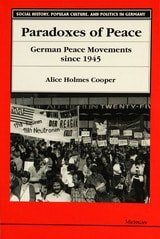
cover of Paradoxes of Peace: German Peace Movements Since 1945

Paradoxes of Peace

German Peace Movements Since 1945

Alice Holmes Cooper

University of Michigan Press, 1996
Given the militarism of the Empire and Nazi Germany, why did postwar West Germany experience massive waves of peace protest in the 1950s, 1960s, and 1980s? How have postwar peace movements shaped German political culture? Will the cultural norms that frown on the use of military force constrain foreign policy in the new, unified, Germany? In Paradoxes of Peace, Alice Holmes Cooper traces the evolution of peace movements in West Germany (1945-90) and in united Germany since 1990. Cooper examines the domestic and international constellations that gave rise to the peace movements, the sources of their multi-faceted ideologies and participants, and their organizational structures and strategies. The author then investigates the peace movement's response to the challenges of the post-Cold War world. Whereas previous work on German peace movements has concentrated on one period of mobilization or on elite security-policy debates, this comprehensive study examines all phases of mobilization since 1945, taking into account the full spectrum of actors, movement organization and strategy, and the broad political, social, and economic environments spawning peace protest. Arguing that theories of resource mobilization, changes in values, and crises of modernity are insufficient to explain peace movements, Paradoxes of Peace tailors a "political process" approach to postwar German movements. It investigates the political opportunities--the changing domestic and international constellation--which most favored peace mobilization since 1945. It examines the process through which the peace movement transformed popular consciousness and created a peace constituency. It analyzes how German peace movements gradually built an indispensable organizational infrastructure autonomous from parties and other social institutions. Cooper argues that the convergence of these factors determined the movement's capacity to mobilize and have political impact and allowed these to grow over time. Alice Holmes Cooper is Assistant Professor of Government, University of Virginia.
[more]
cover of Peace Politics: The United States Between Old and New World Orders

Peace Politics

The United States Between Old and New World Orders

Paul Joseph

Temple University Press, 1993
"Joseph's book is especially valuable and distinctive for its freshly mapped avenues into the sometimes dense field of international relations. His sophisticated analysis of 20th century U.S. peace movements is richly textured and analytically revealing." --Cynthia Enloe, Clark University, and author of Bananas, Beaches, and Bases The end of the Cold War promises a new era of global peace in which domestic reform could be achieved. Yet armed conflict persists throughout the world. Economic inequality, declining public services, environmental degradation, and other forms of domestic decay threaten the quality of life in the U.S. In Peace Politics, Paul Joseph develops a systematic comparison of the "old" and "new" world orders that links foreign and domestic affairs. By examining the issues that are central to any realignment of American politics, he offers a sweeping account of the possibilities and obstacles for progressive change over the 1990s. Acknowledging that all nations and people have a right to security, he argues for a global attack against a broad range of shared threats, including human rights violations, nuclear devastation, poverty and despair, politically repressive governments, and environmental threats. Joseph also addresses the links between the militarism in the U.S. and deforestation of the Amazon, the uncertain victory of the Gulf War, the effect of public opinion on security issues, the impact of peace movements, nuclear weapons policy, and the need for a peace dividend. Linking war and peace issues with environmental renewal, stronger democracy, economic justice, and citizen activism, Peace Politics is a rallying cry for rationality, genuine security, and mutual survival. "Paul Joseph offers a much needed, coherent, progressive U.S. foreign policy, based on an analysis of the emerging world and the realities of American society." --Louis Kriesberg, Director, Program on the Analysis and Resolution of Conflicts, Syracuse University "Peace Politics is the first book that I have found that fully and systematically explores the implications of the dramatic shift in the international system that we have witnessed in the past few years." --William A. Gamson, Professor of Sociology, Boston College "This book is a tour de force. Joseph has packed an enormous amount of material and thoughtful analyses in a very readable presentation. The book is comprehensive, balanced, and wise." --S.M. Miller, Visiting Professor, Boston College and Senior Fellow, Commonwealth Institute
[more]
cover of Peace and Bread in Time of War

Peace and Bread in Time of War

Jane Addams

University of Illinois Press, 2002

First published in 1922 during the "Red Scare," by which time Jane Addams's pacifist efforts had adversely affected her popularity as an author and social reformer, Peace and Bread in Time of War is Addams's eighth book and the third to deal with her thoughts on pacifism.
 
Addams's unyielding pacifism during the Great War drew criticism from politicians and patriots who deemed her the "most dangerous woman in America." Even those who had embraced her ideals of social reform condemned her outspoken opposition to U.S. entry into World War I or were ambivalent about her peace platforms. Turning away from the details of the war itself, Addams relies on memory and introspection in this autobiographical portrayal of efforts to secure peace during the Great War. "I found myself so increasingly reluctant to interpret the motives of other people that at length I confined all analysis of motives to my own," she writes. Using the narrative technique she described in The Long Road of Women's Memory, an extended musing on the roles of memory and myth in women's lives, Addams also recalls attacks by the press and defends her political ideals.
 
Katherine Joslin's introduction provides additional historical context to Addams's involvement with the Woman's Peace Party, the Women's International League for Peace and Freedom, and her work on Herbert Hoover's campaign to provide relief and food to women and children in war-torn enemy countries.
 
[more]
cover of Peace and Mind: Part 3: Seriatim Symposium on Dispute, Conflict, and Enmity, Volume 8

Peace and Mind

Part 3: Seriatim Symposium on Dispute, Conflict, and Enmity, Volume 8

Jeffrey M. Perl, ed.

Duke University Press, 0

Scholars must make their names, assert themselves, take credit for their original work, and stake claims to their positions to achieve credibility in their disciplines. Common Knowledge is dedicated to a mission that is often at odds with this academic protocol. The journal aims to break down boundaries between disciplines, find compromise and common ground, and move beyond dispute. Toward this end, it is publishing an ongoing symposium on dispute, conflict, and enmity titled "Peace and Mind." This third installment of the symposium focuses on a virtue rarely associated with academia: humility. By considering the idea of humility in intellectual work from a variety of perspectives—philosophical, historical, literary, moral, and political—this issue promises to add a surprising new voice to the dialogue on conflict resolution.
One contributor, a longtime president of the American Council of Learned Societies, calls for "intellectual philanthropy" and suggests that academics should transcend their ideological differences and form cooperative partnerships in the public service. A pair of essays, by key figures of the 1989 Velvet Revolution in Eastern Europe, analyze the ways that self-confidence and self-regard undercut efforts toward the resolution of complex social problems. The qualities of ideological self-subversion and even weakness, Common Knowledge maintains, are essential if the intellectual community is to become an agent for peace in a time of war.

Contributors. Wayne Andersen, Sissela Bok, Yves Bonnefoy, Caroline Walker Bynum, Clare Cavanagh, Charles-Albert Cingria, Caryl Emerson, Clifford Geertz, Stanley N. Katz, Aileen Kelly, Adam Michnik, Péter Nádas, Eugene Ostashevsky, Jeffrey M. Perl, Marjorie Perloff, Nina Pelikan Straus, Rei Terada, Gianni Vattimo, William Vesterman, Aleksandr Vvedensky, Adam Zagajewski.
[more]
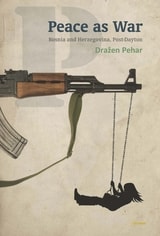
cover of Peace as War: Bosnia-Herzegovina Post-Dayton

Peace as War

Bosnia-Herzegovina Post-Dayton

Drazen Pehar

Central European University Press, 2019

The book is about the peace implementation process in Bosnia-Herzegovina viewed, or interpreted reasonably, as a continuation of war by other means. Twenty years after the beginning of the Dayton peace accords, we need to summarize the results: the author shares the general agreement in public opinion, according to which the process is a failure. Pehar presents a broad, yet sufficiently detailed, view of the entire peace agreement implementation that preserves 'the state of war,' and thus encourages the war-prone attitudes in the parties to the agreement. He examines the political and narratological underpinnings to the process of the imposed international (predominantly USA) interpretation of the Dayton constitution and peace treaty as a whole. The key issue is the – perhaps only semi-consciously applied – divide ut imperes strategy. After nearly twenty years, the peace in document was not translated into a peace on the ground because, with regard to the key political and constitutional issues and attitudes, Bosnia remains a deeply divided society. The book concludes that the international supervision served a counter-purpose: instead of correcting the aberration and guarding the meaning that was originally accepted in the Dayton peace treaty, the supervision approved the aberration and imposed it as a new norm under the clout of 'the power of ultimate interpretation.'
[more]
cover of Peace in the Thought of Thomas Aquinas: Philosophy, Theology, and Ethics

Peace in the Thought of Thomas Aquinas

Philosophy, Theology, and Ethics

John M. Meinert

Catholic University of America Press, 2024
What does Aquinas have to teach us on the topic of peace? Looking over the scholarly literature, one would think very little. Most Thomists ignore Aquinas’s thought on peace. Most peace researchers summarily dismiss Aquinas. Peace in the Thought of Thomas Aquinas challenges both these trends and offers the first book length study of peace in Aquinas’s thought. John Meinert outlines Aquinas's historical predecessors, then provides an exposition and interpretation of the full scope of Aquinas's thought on peace: metaphysics, Trinitarian theology, Christology, Pneumatology, ecclesiology, natural theology, ethics, and sacramental theology. What emerges from this extended study is a new vision of Aquinas’s work. Peace in the Thought of Thomas Aquinas establishes Aquinas as an indispensable dialogue partner for anyone thinking rigorously about the theology, philosophy, and ethics of peace. As Aquinas himself says, “observe peace and you will come to salvation.”
[more]
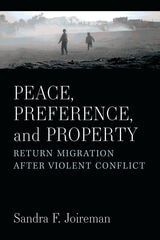
cover of Peace, Preference, and Property: Return Migration after Violent Conflict

Peace, Preference, and Property

Return Migration after Violent Conflict

Sandra F. Joireman

University of Michigan Press, 2022

Growing numbers of people are displaced by war and violent conflict. In Ukraine, Afghanistan, Ethiopia, Myanmar, Syria, and elsewhere violence pushes civilian populations from their homes and sometimes from their countries, making them refugees. In previous decades, millions of refugees and displaced people returned to their place of origin after conflict or were resettled in countries in the Global North. Now displacements last longer, the number of people returning home is lower, and opportunities for resettlement are shrinking. More and more people spend decades in refugee camps or displaced within their own countries, raising their children away from their home communities and cultures. In this context, international policies encourage return to place of origin.

Using case studies and first-person accounts from interviews and fieldwork in post-conflict settings such as Uganda, Liberia, and Kosovo, Sandra F. Joireman highlights the divergence between these policies and the preferences of conflict-displaced people. Rather than looking from the top down, at the rights that people have in international and domestic law, the perspective of this text is from the ground up—examining individual and household choices after conflict. Some refugees want to go home, some do not want to return, some want to return to their countries of origin but live in a different place, and others are repatriated against their will when they have no other options. Peace, Preference, and Property suggests alternative policies that would provide greater choice for displaced people in terms of property restitution and solutions to displacement.
[more]
cover of Peace: An Idea Whose Time Has Come

Peace

An Idea Whose Time Has Come

Anatol Rapoport

University of Michigan Press, 1992
In Peace: An Idea Whose Time Has Come, noted mathematician and peace researcher Anatol Rapoport explores the evolution of the idea of peace and explains why it is displacing war as a viable institution. Professor Rapoport ventures into uncharted philosophical territory by drawing on both the natural and the social sciences to trace the development of the ideas of war and peace. He argues that the theory of evolution and processes analogous to natural selection can explain not only biological events, but also the development of the institution of war. Thus the clashes of armed hordes at the dawn of history were the “ancestors” of our present battles using automated weapons, while Isaiah’s prophecy of total disarmament—“And they shall beat their swords into ploughshares”—anticipates the resolutions of the United Nations. Rapoport explains that although the institution of war enjoys a long history and continues to be a policy option today, it may soon fall into disuse, either by losing its relevance to modern life or by destroying the civilizations that practice it. He then calls attention to ideas that lie dormant until people’s “ideational environment” becomes receptive to their germination: peace, Anatol Rapoport believes, is one such idea. Peace continues in the interdisciplinary tradition that has taken root in inquiries at the nexus of science and philosophy. No specific technical knowledge is expected of the reader, only a willingness to venture into little-charted areas of thought.
[more]
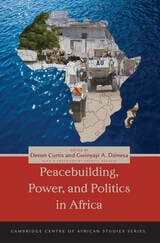
cover of Peacebuilding, Power, and Politics in Africa

Peacebuilding, Power, and Politics in Africa

Devon Curtis

Ohio University Press, 2012

Peacebuilding, Power, and Politics in Africa is a critical reflection on peacebuilding efforts in Africa. The authors expose the tensions and contradictions in different clusters of peacebuilding activities, including peace negotiations; statebuilding; security sector governance; and disarmament, demobilization, and reintegration. Essays also address the institutional framework for peacebuilding in Africa and the ideological underpinnings of key institutions, including the African Union, NEPAD, the African Development Bank, the Pan-African Ministers Conference for Public and Civil Service, the UN Peacebuilding Commission, the World Bank, and the International Criminal Court. The volume includes on-the-ground case study chapters on Sudan, the Great Lakes Region of Africa, Sierra Leone and Liberia, the Niger Delta, Southern Africa, and Somalia, analyzing how peacebuilding operates in particular African contexts.

The authors adopt a variety of approaches, but they share a conviction that peacebuilding in Africa is not a script that is authored solely in Western capitals and in the corridors of the United Nations. Rather, the writers in this volume focus on the interaction between local and global ideas and practices in the reconstitution of authority and livelihoods after conflict. The book systematically showcases the tensions that occur within and between the many actors involved in the peacebuilding industry, as well as their intended beneficiaries. It looks at the multiple ways in which peacebuilding ideas and initiatives are reinforced, questioned, reappropriated, and redesigned by different African actors.

A joint project between the Centre for Conflict Resolution in Cape Town, South Africa, and the Centre of African Studies at the University of Cambridge.
[more]
cover of Peasants In Arms: War and Peace in the Mountains of Nicaragua, 1979–1994

Peasants In Arms

War and Peace in the Mountains of Nicaragua, 1979–1994

Lynn Horton

Ohio University Press, 1999

Drawing on testimonies from contra collaborators and ex-combatants, as well as pro-Sandinista peasants, this book presents a dynamic account of the growing divisions between peasants from the area of Quilalí who took up arms in defense of revolutionary programs and ideals such as land reform and equality and those who opposed the FSLN.

Peasants in Arms details the role of local elites in organizing the first anti-Sandinista uprising in 1980 and their subsequent rise to positions of field command in the contras. Lynn Horton explores the internal factors that led a majority of peasants to turn against the revolution and the ways in which the military draft, and family and community pressures reinforced conflict and undermined mid-decade FSLN policy shifts that attempted to win back peasant support.

[more]
cover of Perspectives on War and Peace in Central America: Mis Lam#19

Perspectives on War and Peace in Central America

Mis Lam#19

Sung Ho Kim

Ohio University Press, 1992
This volume records the perspectives of a highly diverse group of prominent individuals who met late in 1988 in an important international symposium concerned with the continuing conflicts in Central America. Included are presentations by leading conservative and liberal scholar-authors; high ranking diplomats from the governments of Mexico, the United States, and Nicaragua; directors of conservative and liberal think tanks; a spokesperson for a state governor opposed to Ronald Reagan’s policy of sending National Guard troops to “train” in Central America; a centrally involved media practitioner; and a media critic. It also includes an unofficial translation of the final report of the International Verification and Follow-up Commission established by the Arias Peace Agreement. A preface and an introduction by the editors set this lively and historic debate in context.
[more]
cover of Prelude to Genocide: Arusha, Rwanda, and the Failure of Diplomacy

Prelude to Genocide

Arusha, Rwanda, and the Failure of Diplomacy

David Rawson

Ohio University Press, 2018

As the initial US observer, David Rawson participated in the 1993 Rwandan peace talks at Arusha, Tanzania. Later, he served as US ambassador to Rwanda during the last months of the doomed effort to make them hold. Despite the intervention of concerned states in establishing a peace process and the presence of an international mission, UNAMIR, the promise of the Arusha Peace Accords could not be realized. Instead, the downing of Rwandan president Habyarimana’s plane in April 1994 rekindled the civil war and opened the door to genocide.

In Prelude to Genocide, Rawson draws on declassified documents and his own experiences to seek out what went wrong. How did the course of political negotiations in Arusha and party wrangling in Kigali, Rwanda, bring to naught a concentrated international effort to establish peace? And what lessons are there for other international humanitarian interventions? The result is a commanding blend of diplomatic history and analysis that is a milestone read on the Rwandan crisis and on what happens when conflict resolution and diplomacy fall short.

Published in partnership with the ADST-DACOR Diplomats and Diplomacy Series.
[more]
cover of Prince Charoon et al: South East Asia

Prince Charoon et al

South East Asia

Andrew Dalby

Haus Publishing, 2010

Southeast Asia needs to be dealt with as a whole, because, although the one national delegation from the region (Siam) took a minor part, nationalist movements in several Southeast Asian countries reached an early climax - significant though inconclusive - in the years 1919-1920. The planned Peace Conference, Wilson's Fourteen Points, and the victory of Communism in Russia, all contributed to this activity, and in spite of national differences it needs to be seen as a whole. The focus of the book will be on developments around 1919; thus it will bring out for the first time the unexpected significance for South-east Asia of the 1919 milestone. It will also have a biographical bias - taking a special interest in the personalities of major figures in this important period, in order to show the influences and the patterns of thought that underlie their activities at the time of the Peace Conference. Following a brief introduction making the link between world events in 1919 and South-east Asia, the book sets the scene in the region. Succeeding chapters deal with the five countries - Siam, Vietnam, Burma, Indonesia, Philippines - in which the years 1919-21 were of special significance, as well as the impact of the peace conferences in relationships with their neighbours, the growth of international Communism and global politics in later years.
[more]
cover of Progressive Women in Conservative Times: Racial Justice, Peace, and Feminism

Progressive Women in Conservative Times

Racial Justice, Peace, and Feminism

Susan Lynn

Rutgers University Press, 1992

Susan Lynn explores women's progressive social reform efforts in the 1940s and 1950s, an era when women activists promoted a postwar vision of a society based on an expanded welfare state, a powerful labor movement, a strong tradition of civil liberties, racial equality, and a peaceful international order. Lynn focuses on two organizations, the YWCA and the American Friends Service Committee, to explore this agenda.

[more]
