Results by title
55 books match the query 'Pease, Donald E.' and 2 start with p
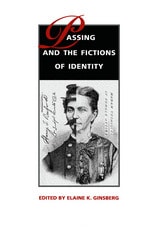
Passing and the Fictions of Identity
Elaine K. Ginsberg
Duke University Press, 1996
Passing refers to the process whereby a person of one race, gender, nationality, or sexual orientation adopts the guise of another. Historically, this has often involved black slaves passing as white in order to gain their freedom. More generally, it has served as a way for women and people of color to access male or white privilege. In their examination of this practice of crossing boundaries, the contributors to this volume offer a unique perspective for studying the construction and meaning of personal and cultural identities.
These essays consider a wide range of texts and moments from colonial times to the present that raise significant questions about the political motivations inherent in the origins and maintenance of identity categories and boundaries. Through discussions of such literary works as Running a Thousand Miles for Freedom, The Autobiography of an Ex–Coloured Man, Uncle Tom’s Cabin, The Hidden Hand, Black Like Me, and Giovanni’s Room, the authors examine issues of power and privilege and ways in which passing might challenge the often rigid structures of identity politics. Their interrogation of the semiotics of behavior, dress, language, and the body itself contributes significantly to an understanding of national, racial, gender, and sexual identity in American literature and culture.
Contextualizing and building on the theoretical work of such scholars as Judith Butler, Diana Fuss, Marjorie Garber, and Henry Louis Gates Jr., Passing and the Fictions of Identity will be of value to students and scholars working in the areas of race, gender, and identity theory, as well as U.S. history and literature.
Contributors. Martha Cutter, Katharine Nicholson Ings, Samira Kawash, Adrian Piper, Valerie Rohy, Marion Rust, Julia Stern, Gayle Wald, Ellen M. Weinauer, Elizabeth Young
[more]

Publishing the Family
June Howard
Duke University Press, 2001
In Publishing the Family June Howard turns a study of the collaborative novel The Whole Family into a lens through which to examine American literature and culture at the beginning of the twentieth century. Striving to do equal justice to historical particulars and the broad horizons of social change, Howard reconsiders such categories of analysis as authorship, genre, and periodization. In the process, she offers a new method for cultural studies and American studies at the beginning of the twenty-first century.
Publishing the Family describes the sources and controversial outcome of a fascinating literary experiment. Howard embeds the story of The Whole Family in the story of Harper & Brothers’ powerful and pervasive presence in American cultural life, treating the publisher, in effect, as an author.
Each chapter of Publishing the Family casts light on some aspect of life in the United States at a moment that arguably marked the beginning of our own era. Howard revises common views of the turn-of-the-century literary marketplace and discusses the perceived crisis in the family as well as the popular and expert discourses that emerged to remedy it. She also demonstrates how creative women like Bazar editor Elizabeth Jordan blended their own ideas about the “New Woman” with traditional values. Howard places these analyses in the framework of far-reaching historical changes, such as the transformation of the public meaning of emotion and “sentimentality.” Taken together, the chapters in Publishing the Family show how profoundly the modern mapping of social life relies on boundaries between family and business, culture and commerce, which The Whole Family and Publishing the Family constantly unsettle.
Publishing the Family will interest students and scholars of American history, literature, and culture, as well as those studying gender, sexuality, and the family.
[more]