Results by title
68 books match the query 'Performance art' and 11 start with p
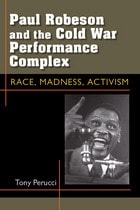
Paul Robeson and the Cold War Performance Complex
Race, Madness, ActivismTony Perucci
University of Michigan Press, 2012
Actor and singer Paul Robeson's performances in Othello, Show Boat, and The Emperor Jones made him famous, but his midcentury appearances in support of causes ranging from labor and civil rights to antilynching and American warmongering made him notorious. When Robeson announced at the 1949 Paris Peace Conference that it was "unthinkable" for blacks to go to war against the Soviet Union, the mainstream American press declared him insane.
Notions of Communism, blackness, and insanity were interchangeably deployed during the Cold War to discount activism such as Robeson's, just a part of an array of social and cultural practices that author Tony Perucci calls the Cold War performance complex. Focusing on two key Robeson performances---the concerts in Peekskill, New York, in 1949 and his appearance before the House Committee on Un-American Activities in 1956---Perucci demonstrates how these performances and the government's response to them are central to understanding the history of Cold War culture in the United States. His book provides a transformative new perspective on how the struggle over the politics of performance in the 1950s was also a domestic struggle over freedom and equality. The book closely examines both of these performance events as well as artifacts from Cold War culture---including congressional documents, FBI files, foreign policy papers, the popular literature on mental illness, and government propaganda films---to study the operation of power and activism in American Cold War culture.
Performance
Diana Taylor
Duke University Press, 2016

Performance Art in Ireland
A HistoryEdited by Áine Phillips
Intellect Books, 2015
Performance Art
StoriesDavid Kranes
University of Nevada Press, 2021
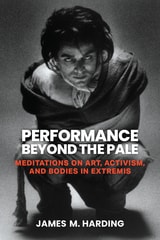
Performance Beyond the Pale
Meditations on Art, Activism, and Bodies in ExtremisJames M. Harding
University of Michigan Press, 2026
The metaphor “beyond the pale” refers to something that’s unacceptable and, as James M. Harding argues in this book, “almost always refers to something—an activity, an action, or an act—that is performed.” In this book, Harding recalls that historically the pale marked contested political boundaries and that what lay beyond the pale was considered to be a dangerous frontier. Siding with seemingly excessive and unreasonable acts and with the artists and activists who produce them, Harding brings together a series of ideas and performances that operate beyond the pale and asks readers to examine them on their own terms.
Drawing on political science, critical theory, and philosophy, Harding investigates instances of self-immolation, life-threatening journeys across deserts and seas, radical political hoaxes, extreme speech acts, and anti-police activism. The book’s five chapters consist of a series of meditations, each with an easily identifiable scholarly logic and clear argument, though the connections between the meditations are left up to the reader. Together these meditations urge readers to understand that “beyond the pale” acts are frequently the product of a sense of urgency that preempts the dictates of accepted reason, conventional logic, and safety.
Performances of Spiral Time
Leda Maria Martins. Translated by Bruna Barros and Jess Oliveira
Duke University Press, 2025
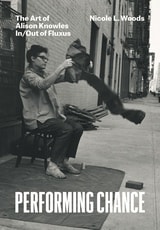
Performing Chance
The Art of Alison Knowles In/Out of FluxusNicole L. Woods
University of Chicago Press, 2026
Alison Knowles stands out as the sole female artist among the founders of Fluxus, yet she has remained an enigmatic, underrecognized figure in the history of art. Performing Chance fills a gap in the record, bringing to light Knowles’s transformative body of work as it evolved from abstract painting in the late 1950s, to silkscreens, print media, and performance in the early 1960s, to groundbreaking works in digital poetry, acoustical art, and large-scale installations in the late 1960s-70s.
Through her access to previously unpublished archival materials and direct interviews with the artist, Nicole L. Woods provides close readings of pivotal works, disclosing the ways Knowles instituted formal tactics that moved beyond modernist painting, championed principles of indeterminacy and chance, and fostered sociopolitical consciousness. Situating Knowles’s innovations in various media within the distinct cultural contexts of Wiesbaden, London, Paris, New York City, and Los Angeles, Performing Chance brings this key artist back to her rightful place as a leader of the postwar avant-garde and provides a nuanced history of the role of women artists in Fluxus and beyond.
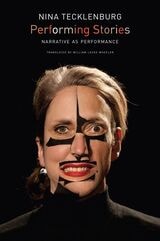
Performing Stories
Narrative as PerformanceNina Tecklenburg
Seagull Books, 2020
Nina Tecklenburg’s focus lies on narration less as literary composition than as sensate, embodied cultural practice—a participatory and open process that fosters social relationships. She gives central importance to the forces of narration that create and undo culture and politics. A foundational new book, Performing Stories presents a groundbreaking transdisciplinary perspective through new approaches that are stimulating to performance studies, narrative and cultural theory, literary criticism, and game and video studies.
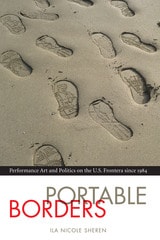
Portable Borders
Performance Art and Politics on the U.S. Frontera since 1984By Ila Nicole Sheren
University of Texas Press, 2015
After World War II, the concept of borders became unsettled, especially after the rise of subaltern and multicultural studies in the 1980s. Art at the U.S.-Mexico border came to a turning point at the beginning of that decade with the election of U.S. President Ronald Reagan. Beginning with a political history of the border, with an emphasis on the Chicano movement and its art production, Ila Sheren explores the forces behind the shift in thinking about the border in the late twentieth century.
Particularly in the world of visual art, borders have come to represent a space of performance rather than a geographical boundary, a cultural terrain meant to be negotiated rather than a physical line. From 1980 forward, Sheren argues, the border became portable through performance and conceptual work. This dematerialization of the physical border after the 1980s worked in two opposite directions—the movement of border thinking to the rest of the world, as well as the importation of ideas to the border itself. Beginning with site-specific conceptual artwork of the 1980s, particularly the performances of the Border Art Workshop/Taller de Arte Fronterizo, Sheren shows how these works reconfigured the border as an active site. Sheren moves on to examine artists such as Guillermo Gómez-Peña, Coco Fusco, and Marcos Ramirez “ERRE.” Although Sheren places emphasis on the Chicano movement and its art production, this groundbreaking book suggests possibilities for the expansion of the concept of portability to contemporary art projects beyond the region.
Precarious Forms
Performing Utopia in the Neoliberal AmericasCandice Amich
Northwestern University Press, 2020
The poets and artists surveyed in Precarious Forms enact gestures of solidarity and mutual care at sites of neoliberal dispossession. In her analysis of poems, body art, and multimedia installations that illuminate the persistence of a radical utopian imaginary in the Americas, Amich engages critical debates in performance studies, Latin American cultural studies, literature, and art history.
Presence and Resistance
Postmodernism and Cultural Politics in Contemporary American PerformancePhilip Auslander
University of Michigan Press, 1994