Results by title
55 books match the query 'Philosophy, Ancient' and 6 start with p
Philodemus in Italy
The Books from HerculaneumMarcello Gigante
University of Michigan Press, 2002
Plotinus Ennead I.5
On Whether Well-Being Increases with Time: Translation with an Introduction and CommentaryDanielle A. Layne
Parmenides Publishing, 2023
Plotinus Ennead II.4
On Matter: Translation with an Introduction and CommentaryA.A. Long
Parmenides Publishing, 2022
Plotinus
Myth, Metaphor, and Philosophical PracticeStephen R. L. Clark
University of Chicago Press, 2016
Clark examines a variety of Plotinus’s myths and metaphors within the cultural and philosophical context of his time, asking probing questions about their contemplative effects. What is it, for example, to “think away the spatiality” of material things? What state of mind is Plotinus recommending when he speaks of love, or drunkenness, or nakedness? What star-like consciousness is intended when he declares that we were once stars or are stars eternally? What does it mean to say that the soul goes around God? And how are we supposed to “bring the god in us back to the god in all”? Through these rich images and structures, Clark casts Plotinus as a philosopher deeply concerned with philosophy as a way of life.
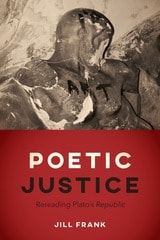
Poetic Justice
Rereading Plato's "Republic"Jill Frank
University of Chicago Press, 2018
With Poetic Justice, Jill Frank overturns the conventional view that the Republic endorses a hierarchical ascent to knowledge and the authoritarian politics associated with that philosophy. When learning to read is understood as the passive absorption of a teacher’s beliefs, this reflects the account of Platonic philosophy as authoritative knowledge wielded by philosopher kings who ruled the ideal city. When we learn to read by way of the method Socrates introduces in the Republic, Frank argues, we are offered an education in ethical and political self-governance, one that prompts citizens to challenge all claims to authority, including those of philosophy.

Prefaces To Unwritten Works
Friedrich Nietzsche
St. Augustine's Press, 2005
Prefaces to Unwritten Works is a collection of five essays, prefaces to books that Nietzsche never went on to write. Nietzsche himself put these prefaces together in the form of a small leather-bound, handwritten book, and gave that book to Cosima Wagner as a Christmas present in 1872. The dedicatory letter indicates that Nietzsche sent this little book to Cosima "in heartfelt reverence and as an answer to verbal and epistolary questions." As such, this work is a window into Nietzsche's relations with the Wagners at the height of their association, but it is also a continuation of Nietzsche's radical confrontation with Greek antiquity that had begun with the then-recently published Birth of Tragedy. The Wagners read Nietzsche's book of prefaces on the evening of New Year's Day 1873, and Cosima records in her diary five days later that at night, "again" she reflected about the essence of art as a consequence of Nietzsche's work. A month later, Cosima sent Nietzsche a letter encouraging him to write at least two of the books promised by his prefaces.
Nietzsche did not go to write the books heralded by these prefaces, but the prefaces themselves provide substantial challenges of their own and intriguing clues as to the form and content of the books Nietzsche may have intended. Some of these prefaces are better known to students of Nietzsche than others and have attracted significant attention from scholars. The first essay is entitled On the Pathos of Truth, and it considers the relative value of truth and art for human life. The second essay, Thoughts on the Future of Our Educational Institutions, is the only preface in this collection regarding which Nietzsche did actually go on to write a book, albeit a book he did not publish (entitled On the Future of Our Educational Institutions, now available from St. Augustine's Press). This essay is a revised version of the preface Nietzsche wrote for that book, and the changes Nietzsche made are indicative of the plans he had for an improved version. The topic of the essay is almost entirely the art of careful reading. The third essay is entitled The Greek State, and it treats of the relation of slavery to culture and of the genius to the state. This essay is also an interpretation of Plato's Republic, in which Nietzsche claims to reveal everything he has "divined of this secret writing." The fourth essay, The Relation of Schopenhauerian Philosophy to a German Culture, neither assumes that there is in fact, at present, a German Culture, nor hardly mentions Schopenhauer at all, except to suggest that he is one about whom a culture could be built. The final essay is entitled Homer's Contest and is an exploration of the place of jealousy, strife, and agonistic competition in Greek culture.
Together these five essays show Nietzsche's continuing exploration into the differences between modern human beings and the Greeks of classical antiquity. He boldly asks, "Why did the whole Greek world exult at the images of battle of the Iliad?" The answers he offers reveal the dark and harrowing insights of the ancient world and also the sometimes cruel and violent, but also perhaps psychically healthy, character of the ancient Greek. Nietzsche's attention to and concern with classical antiquity raises in each of these essays broad and universal questions about the relation of society and culture to genius. Culture, he says, "rests upon a terrifying ground." And underneath it all, and present with varying explicitness in all of the essays, lies the problem of humanity's relation to time. We see "every disappearing and perishing . . . with dissatisfaction" and yet, "Every moment devours the one that went before, every birth is the death of countless beings."
This volume benefits from presenting all five prefaces together, translated literally and consistently. The appendices present preliminary drafts of various portions of the respective prefaces and a prolonged fragment Nietzsche wrote extending his thoughts from the Birth of Tragedy and containing text intimately related to some of the five prefaces.