Results by title
572 books match the query 'Photography' and 64 start with p
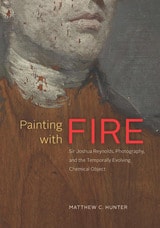
Painting with Fire
Sir Joshua Reynolds, Photography, and the Temporally Evolving Chemical ObjectMatthew C. Hunter
University of Chicago Press, 2019
Tracing the long arc of chemically produced and reproduced art from the 1670s through the 1860s, the book reconsiders early photography by situating it in relationship to Reynolds’s replicated paintings and the literal engines of British industry. By following the chemicals, Painting with Fire remaps familiar stories about academic painting and pictorial experiment amid the industrialization of chemical knowledge.
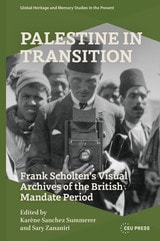
Palestine in Transition
Frank Scholten’s Visual Archive of the British Mandate PeriodKarène Sanchez Summerer
Amsterdam University Press, 2026
Palestine in Transition traces the significance of Frank Scholten’s documentation of the transformations occurring during the British Mandate period. By taking a geographical approach to the collection—like Scholten himself—this book revisits his incomplete project by presenting different regions through contributions by scholars specialized in each field, a century after his visit and the dramatic social, cultural, and political upheavals that the “Holy Land” has undergone since then.
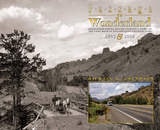
Passage to Wonderland
Rephotographing Joseph Stimson's Views of the Cody Road to Yellowstone National Park, 1903 and 2008Michael A. Amundson
University Press of Colorado, 2012
Amundson examines the physical changes along "the most scenic fifty miles in America" and explores the cultural and natural history behind them. This careful analysis of the paired images make Passage to Wonderland more than a "then and now" photography book--it is a unique exploration of the interconnectedness between the Old West and the New West. It will be a wonderful companion for those touring the Cody Road as well as those armchair tourists who can follow the road on Google Earth using the provided GPS coordinates.
The University Press of Colorado gratefully acknowledges the generous support of the Charles Redd Center for Western Studies at Brigham Young University toward the publication of this book.
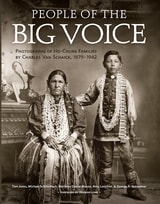
People of the Big Voice
Photographs of Ho-Chunk Families by Charles Van Schaick, 1879-1942Tom Jones
Wisconsin Historical Society Press, 2027
A stunning photographic portrayal of the Ho-Chunk people during a challenging period that presents the resilience of a community whose story continues to this day.
People of the Big Voice tells the visual history of Ho-Chunk families at the turn of the twentieth century and beyond as depicted through the lens of Black River Falls studio photographer Charles Van Schaick. The family relationships among those who sat for the photographer are clearly visible in these images. Sisters, friends, families, and young couples appear and reappear, fleshing out a narrative of the period, from 1879 to 1942, referred to as "the dark ages” in First Nations tribal history.
Following introductory essays from three of the authors are more than three hundred beautifully detailed photographs. Unique to the project are captions that identify over ninety percent of the individuals pictured—made possible by the continuing efforts of tribal members and genealogists—and include both English and Ho-Chunk names.
Also featured are candid shots of Ho-Chunk people on the streets of Black River Falls, outside family dwellings, and at powwows. As author and Ho-Chunk tribal member Amy Lonetree writes, "A significant number of the images were taken just a few short years after the darkest, most devastating period for the Ho-Chunk. Invasion, diseases, warfare, forced assimilation, loss of land, and repeated forced removals from our beloved homelands left the Ho-Chunk people in a fight for their culture and their lives."
A significant contribution to the history of Native peoples, People of the Big Voice is a breathtaking portrayal of a resilient community whose story continues today.

Perimeter
A Contemporary Portrait of Lake MichiganKevin J. Miyazaki
Wisconsin Historical Society Press, 2014
Miyazaki also photographed the water as he went, creating waterscapes of the ever-changing lake affected by weather and time. Perimeter gathers these images together, creating a diverse portrait of both people and a place, encapsulating Lake Michigan’s significance to those who are drawn to it.

Phantom Skies and Shifting Ground
Landscape, Culture, and Rephotography in Eadweard Muybridge's Illustrations of Central AmericaByron Wolfe and Scott Brady
Temple University Press, 2017
In 1875, after being acquitted for the murder of his wife’s lover, Eadweard Muybridge spent a year photographing along the Central American Pacific Coast, particularly in Guatemala and Panamá. Upon his return to California in 1876, he published a very limited number of albums of the photographs (11 are known), each of which was unique in size and scope. In 2007, photographer Byron Wolfe (born 1967) tracked down and cataloged every known Muybridge Central American photograph. Then, with cultural geographer Scott Brady, he traveled to many of Muybridge’s sites to rephotograph them. Through photographic collage, interpretive rephotography, illustrations and essays, this book examines an exceptionally rare series by Muybridge. Also included is a catalogue of every known Muybridge Central American picture.
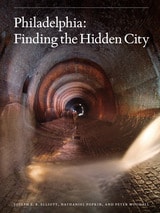
Philadelphia
Finding the Hidden CityJoseph E. B. Elliott
Temple University Press, 2017
Philadelphia possesses an exceptionally large number of places that have almost disappeared—from workshops and factories to sporting clubs and societies, synagogues, churches, theaters, and railroad lines. In Philadelphia: Finding the Hidden City, urban observers Nathaniel Popkin and Peter Woodall uncover the contemporary essence of one of America’s oldest cities. Working with accomplished architectural photographer Joseph Elliott, they explore secret places in familiar locations, such as the Metropolitan Opera House on North Broad Street, the Divine Lorraine Hotel, Reading Railroad, Disston Saw Works in Tacony, and mysterious parts of City Hall.
Much of the real Philadelphia is concealed behind facades. Philadelphia artfully reveals its urban secrets. Rather than a nostalgic elegy to loss and urban decline, Philadelphia exposes the city’s vivid layers and living ruins. The authors connect Philadelphia’s idiosyncratic history, culture, and people to develop an alternative theory of American urbanism, and place the city in American urban history. The journey here is as much visual as it is literary; Joseph Elliott’s sumptuous photographs reveal the city's elemental beauty.

Photo Obscura
The Photographic in Post-PhotographyNatasha Chuk
Intellect Books, 2025
Photo Obscura brings a much-needed reflection on the radical transformations of photography in the digital age, where AI, computational media, and hybrid art practices challenge traditional definitions of the photographic image. Moving beyond nostalgia for analog or the simple embrace of digital, this book positions post-photography as a movement reshaping our visual culture. It is a movement in which images may no longer look like photographs but remain deeply influenced by photography’s logic and history.
Through discussions of key artworks and a variety of artists, the book explores themes including AI-generated imagery and the blurred line between representation and perception. Grounded in art history and media studies, Photo Obscura offers a new outlook on photography’s evolving role in contemporary art. Particularly suited for students, artists, and scholars of photography, digital arts, and visual culture, this work redefines what it means to see and believe in an era of infinite images.
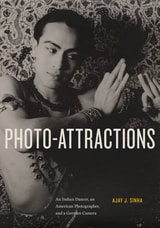
Photo-Attractions
An Indian Dancer, an American Photographer, and a German CameraAjay Sinha
Rutgers University Press, 2022
Art historian Ajay Sinha uses these hitherto unpublished photographs and archival research to raise provocative and important questions about photographic technology, colonial histories, race, sexuality and transcultural desires. Challenging the assumption that Gopal was merely objectified by Van Vechten’s Orientalist gaze, he explores the ways in which the Indian dancer co-authored the photos. In Sinha’s reading, Van Vechten’s New York studio becomes a promiscuous contact zone between world cultures, where a “photo-erotic” triangle is formed between the American photographer, Indian dancer, and German camera.
A groundbreaking study of global modernity, Photo-Attractions brings scholarship on American photography, literature, race and sexual economies into conversation with work on South Asian visual culture, dance, and gender. In these remarkable historical documents, it locates the pleasure taken in cultural difference that still resonates today.

Photo-Fiction, a Non-Standard Aesthetics
François Laruelle
University of Minnesota Press, 2012
Twenty years after cultivating a new orientation for aesthetics via the concept of non-photography, François Laruelle returns, having further developed his notion of a non-standard aesthetics. Published for the first time in a bilingual edition, Photo-Fiction, a Non-Standard Aesthetics expounds on Laruelle’s current explorations into a photographic thinking as an alternative to the worn-out notions of aesthetics based on an assumed domination of philosophy over art. He proposes a new philosophical photo-fictional apparatus, or philo-fiction, that strives for a discursive mimesis of the photographic apparatus and the flash of the Real entailed in its process of image making. “A bit like if an artisan, to use a Socratic example, instead of making a camera based off of diagrams found in manuals, on the contrary had as his or her project the designing of a completely new apparatus of philo-fiction, thus capable of producing not simply photos, but photo-fictions.” One must enter into a space for seeing the vectorial and the imaginary number. Laruelle’s philo-fictions become not art installations, but “theoretical installations” calling for the consideration of the possibility of a non-standard aesthetics being of an equal or superior power to art and philosophy, an aesthetics in-the-last-instance that is itself an inventive and creative act of the most contemporary kind.
Photocinema
The Creative Edges of Photography and FilmEdited by Neil Campbell and Alfredo Cramerotti
Intellect Books, 2013
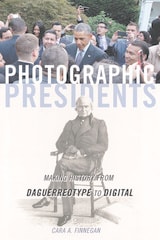
Photographic Presidents
Making History from Daguerreotype to DigitalCara A. Finnegan
University of Illinois Press, 2021
Lincoln’s somber portraits. Lyndon Johnson’s swearing in. George W. Bush’s reaction to learning about the 9/11 attacks. Photography plays an indelible role in how we remember and define American presidents. Throughout history, presidents have actively participated in all aspects of photography, not only by sitting for photos but by taking and consuming them. Cara A. Finnegan ventures from a newly-discovered daguerreotype of John Quincy Adams to Barack Obama’s selfies to tell the stories of how presidents have participated in the medium’s transformative moments. As she shows, technological developments not only changed photography, but introduced new visual values that influence how we judge an image. At the same time, presidential photographs—as representations of leaders who symbolized the nation—sparked public debate on these values and their implications.
An original journey through political history, Photographic Presidents reveals the intertwined evolution of an American institution and a medium that continues to define it.
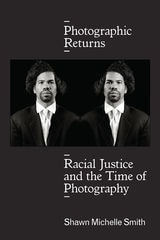
Photographic Returns
Racial Justice and the Time of PhotographyShawn Michelle Smith
Duke University Press, 2020
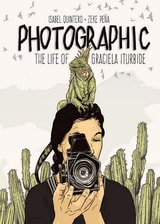
Photographic
The Life of Graciela IturbideIsabel Quintero
J. Paul Getty Trust, The, 2021
Renowned Mexican photographer Graciela Iturbide was born in Mexico City in 1942, the oldest of thirteen children. When tragedy strikes Graciela as a young mother, she turns to photography for solace and understanding.
From then on Graciela embarks on a photographic journey that takes her throughout her native Mexico, from the Sonora Desert to Juchitán to Frida Kahlo’s bathroom, and then to the United States, India, and beyond.
Photographic is a symbolic, poetic, and deeply personal graphic biography of this iconic photographer. Graciela’s journey will excite young adults and budding photographers, who will be inspired by her resolve, talent, and curiosity.
Ages twelve and up
Photographies East
The Camera and Its Histories in East and Southeast AsiaRosalind C. Morris, ed.
Duke University Press, 2009
The contributors analyze how in specific cultural and historical contexts, the camera has affected experiences of time and subjectivity, practices of ritual and tradition, and understandings of death. They highlight the links between photography and power, looking at how the camera has figured in the operations of colonialism, the development of nationalism, the transformation of monarchy, and the militarization of violence. Moving beyond a consideration of historical function or effect, the contributors also explore the forms of illumination and revelation for which the camera has offered itself as instrument and symbol. And they trace the emergent forms of alienation and spectralization, as well as the new kinds of fetishism, that photography has brought in its wake. Taken together, the essays chart a bravely interdisciplinary path to visual studies, one that places the particular knowledge of a historicized anthropology in a comparative frame and in conversation with aesthetics and art history.
Contributors. James L. Hevia, Marilyn Ivy, Thomas LaMarre, Rosalind C. Morris, Nickola Pazderic, John Pemberton, Carlos Rojas, James T. Siegel, Patricia Spyer
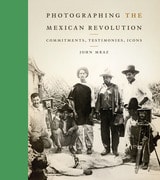
Photographing the Mexican Revolution
Commitments, Testimonies, IconsBy John Mraz
University of Texas Press, 2012
The Mexican Revolution of 1910–1920 is among the world’s most visually documented revolutions. Coinciding with the birth of filmmaking and the increased mobility offered by the reflex camera, it received extraordinary coverage by photographers and cineastes—commercial and amateur, national and international. Many images of the Revolution remain iconic to this day—Francisco Villa galloping toward the camera; Villa lolling in the presidential chair next to Emiliano Zapata; and Zapata standing stolidly in charro raiment with a carbine in one hand and the other hand on a sword, to mention only a few. But the identities of those who created the thousands of extant images of the Mexican Revolution, and what their purposes were, remain a huge puzzle because photographers constantly plagiarized each other’s images.
In this pathfinding book, acclaimed photography historian John Mraz carries out a monumental analysis of photographs produced during the Mexican Revolution, focusing primarily on those made by Mexicans, in order to discover who took the images and why, to what ends, with what intentions, and for whom. He explores how photographers expressed their commitments visually, what aesthetic strategies they employed, and which identifications and identities they forged. Mraz demonstrates that, contrary to the myth that Agustín Víctor Casasola was “the photographer of the Revolution,” there were many who covered the long civil war, including women. He shows that specific photographers can even be linked to the contending forces and reveals a pattern of commitment that has been little commented upon in previous studies (and completely unexplored in the photography of other revolutions).

Photographs from Detroit, 1975–2019
Bruce Harkness
Ohio University Press, 2022
A retrospective survey of Bruce Harkness’s striking social documentary photographs and an invaluable historical record that bears witness to irrevocably lost swaths of Detroit’s social and urban fabric.
In 1980, the cities of Detroit and Hamtramck, Michigan, exercised eminent domain to develop nearly five hundred acres of land for a new industrial park and General Motors assembly plant. But the land was not vacant. Some thirty-five hundred people lived there in Poletown—some of them for their entire lives. They attended neighborhood schools and churches, worked for and patronized small businesses, walked the sidewalks, drove the streets, and tended to lawns and gardens. Harkness began photographing the area in February 1981. He recorded street scenes, intersections, panoramic views, homes, businesses, churches, and people. Ten months, ninety visits, and six hundred photographs later, it all disappeared forever.
The Poletown series established Harkness as a major Detroit documentarian. It came on the heels of late-1970s projects located in and around the city’s skid row: Cass Corridor. The images include gritty streetscapes, a portrait series depicting residents living in a crumbling apartment building, and the lively cultural milieu of a local gay and transgender bar. Most of this old portion of inner-city Detroit since has been supplanted by urban redevelopment and gentrification.
During the late 1980s, Harkness collaborated with urban historian John J. Bukowczyk on a major documentary project, Urban Interiors. While the Poletown project had documented the exteriors of buildings and streetscapes on Detroit’s East Side, Urban Interiors captured the insides of inner-city Detroit homes and businesses and included extended oral history interviews.
While Harkness has always found human dignity and resilience in his subjects, the tone of his work brightened in the 1990s alongside Detroit’s revival. Photographs from this era include blues musicians performing in clubs and at outdoor concerts and the distinctive, robust youth culture that flourished in Dearborn’s now-defunct Zone Coffee House.
Featuring images from these and other projects, Photographs from Detroit, 1975–2019 includes Harkness’s extensive notes, which describe and contextualize the encounters he shared with the people and places he photographed, and offer insight into his working methods and equipment. The volume and quality of Harkness’s work merits him recognition as one of Detroit’s most important documentary photographers during this pivotal, transitional era in the city’s history.
Harkness’s images depict the struggles and resilience of ordinary individuals and families in working-class communities who together have indelibly shaped the spirit of Detroit. This book is a must-have for Detroiters past and present as well as historians, anthropologists, social documentary advocates, and photobook collectors everywhere.
Photography At The Dock
Essays on Photographic History, Institutions, and PracticesAbigail Solomon-Godeau
University of Minnesota Press, 1994
Photography after Photography
Gender, Genre, HistoryAbigail Solomon-Godeau
Duke University Press, 2017
Photography and American Coloniality
Eliot Elisofon in Africa, 1942–1972Raoul J. Granqvist
Michigan State University Press, 2017
Photography and Landscape
Rod Giblett and Juha Tolonen
Intellect Books, 2012

Photography and Work
Kevin Coleman, Daniel James, and Jayeeta Sharma, special issue editors
Duke University Press, 2018
Contributors: Siobhan Angus, Ian Bourland, Oliver Coates, Kevin Coleman, Clare Corbould, Adrian De Leon, Rick Halpern, Daniel James, Tong Lam, Walter Benn Michaels, Jessica Stites Mor, Carol Quirke, Jayeeta Sharma, Erica Toffoli, Daniel Zamora
Photography and the Optical Unconscious
Shawn Michelle Smith and Sharon Sliwinski, editors
Duke University Press, 2017
Contributors. Mary Bergstein, Jonathan Fardy, Kristan Horton, Terri Kapsalis, Sarah Kofman, Elisabeth Lebovici, Zoe Leonard, Gabrielle Moser, Mignon Nixon, Thy Phu, Mark Reinhardt, Shawn Michelle Smith, Sharon Sliwinski, Laura Wexler, Kelly Wood, Andrés Mario Zervigón
Photography from the Turin Shroud to the Turing Machine
Yanai Toister
Intellect Books, 2020
Photography on the Color Line
W. E. B. Du Bois, Race, and Visual CultureShawn Michelle Smith
Duke University Press, 2004
Smith reads Du Bois’s photographs in relation to other turn-of-the-century images such as scientific typologies, criminal mugshots, racist caricatures, and lynching photographs. By juxtaposing these images with reproductions from Du Bois’s exhibition archive, Smith shows how Du Bois deliberately challenged racist representations of African Americans. Emphasizing the importance of comparing multiple visual archives, Photography on the Color Line reinvigorates understandings of the stakes of representation and the fundamental connections between race and visual culture in the United States.
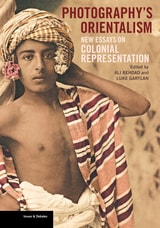
Photography's Orientalism
New Essays on Colonial RepresentationAli Behdad
J. Paul Getty Trust, The, 2013
Photography’s Orientalism offers the first in-depth cultural study of the works of European and non- European photographers active in the Middle East and India, focusing on the relationship between photographic, literary, and historical representations of this region and beyond. The essays explore the relationship between art and politics by considering the connection between the European presence there and aesthetic representations produced by traveling and resident photographers, thereby contributing to how the history of photography is understood.
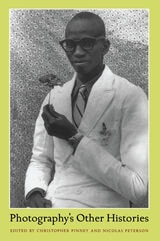
Photography's Other Histories
Christopher Pinney and Nicolas Peterson, eds.
Duke University Press, 2003
Richly illustrated with over 100 images, Photography’s Other Histories explores from a variety of regional, cultural, and historical perspectives the role of photography in raising historical consciousness. It includes two first-person pieces by indigenous Australians and one by a Seminole/Muskogee/Dine' artist. Some of the essays analyze representations of colonial subjects—from the limited ways Westerners have depicted Navajos to Japanese photos recording the occupation of Manchuria to the changing "contract" between Aboriginal subjects and photographers. Other essays highlight the visionary quality of much popular photography. Case studies centered in early-twentieth-century Peru and contemporary India, Kenya, and Nigeria chronicle the diverse practices that have flourished in postcolonial societies. Photography’s Other Histories recasts popular photography around the world, as not simply reproducing culture but creating it.
Contributors. Michael Aird, Heike Behrend, Jo-Anne Driessens, James Faris, Morris Low, Nicolas Peterson, Christopher Pinney, Roslyn Poignant, Deborah Poole, Stephen Sprague, Hulleah Tsinhnahjinnie, Christopher Wright

Photography, Cinema, Memory
The Crystal Image of TimeDamian Sutton
University of Minnesota Press, 2009
A philosophical investigation into the differing sensations of time in cinema and photography
Cinema and photography are both intimately associated with time—cinema with time in passing, the photograph with the lost moment. In Photography, Cinema, Memory, Damian Sutton explores time in both media to present a radical new understanding of the photographic image as always coming into being.
Drawing on Gilles Deleuze’s concept of the crystal image to move beyond the tropes of immobility, stasis, and death, Sutton’s analysis reveals the open-endedness of time expressed in the photograph, either as a potential for an abundant future or as a depth of meandering remembrance. He presents an innovative taxonomy of time in the photograph, considering particular representations of time in the work of Nan Goldin, Eugène Atget, Andy Warhol, and others. He contrasts this taxonomy with representations of time in cinema since 1895, offering fresh readings of the films of the Lumière brothers and Mitchell & Kenyon, as well as more recent works, including Eternal Sunshine of the Spotless Mind, Amélie, and A Matter of Life and Death. Throughout this work, Sutton connects and grounds cinema and photography as starting points to comprehend how we come to terms, ultimately, with time itself as pure, immanent change.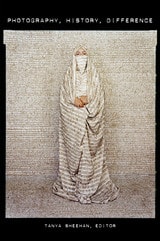
Photography, History, Difference
Edited by Tanya Sheehan
Dartmouth College Press, 2014
Photography, Narrative, Time
Imaging our Forensic ImaginationGreg Battye
Intellect Books, 2014

Photography, Trace, and Trauma
Margaret Iversen
University of Chicago Press, 2017
Examining photography and film, molds, rubbings, and more, Margaret Iversen considers how these artistic processes can be understood as presenting or simulating a residue, trace, or “index” of a traumatic event. These approaches, which involve close physical contact or the short-circuiting of artistic agency, are favored by artists who wish to convey the disorienting effect and elusive character of trauma. Informing the work of a number of contemporary artists—including Tacita Dean, Jasper Johns, Mary Kelly, Gabriel Orozco, and Gerhard Richter—the concept of the trace is shown to be vital for any account of the aesthetics of trauma; it has left an indelible mark on the history of photography and art as a whole.
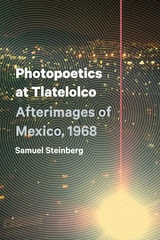
Photopoetics at Tlatelolco
Afterimages of Mexico, 1968By Samuel Steinberg
University of Texas Press, 2016
In the months leading up to the 1968 Olympic games in Mexico City, students took to the streets, calling for greater democratization and decrying crackdowns on political resistance by the ruling PRI party. During a mass meeting held at the Plaza of the Three Cultures in the Tlatelolco neighborhood, paramilitary forces opened fire on the gathering. The death toll from the massacre remains a contested number, ranging from an official count in the dozens to estimates in the hundreds by journalists and scholars. Rereading the legacy of this tragedy through diverse artistic-political interventions across the decades, Photopoetics at Tlatelolco explores the state’s dual repression—both the massacre’s crushing effects on the movement and the manipulation of cultural discourse and political thought in the aftermath.
Examining artifacts ranging from documentary photography and testimony to poetry, essays, chronicles, cinema, literary texts, video, and performance, Samuel Steinberg considers the broad photographic and photopoetic nature of modern witnessing as well as the specific elements of light (gunfire, flares, camera flashes) that ultimately defined the massacre. Steinberg also demonstrates the ways in which the labels of “massacre” and “sacrifice” inform contemporary perceptions of the state’s blatant and violent repression of unrest. With implications for similar processes throughout the rest of Latin America from the 1960s to the present day, Photopoetics at Tlatelolco provides a powerful new model for understanding the intersection of political history and cultural memory.
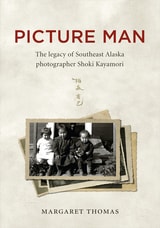
Picture Man
The Legacy of Southeast Alaska Photographer Shoki KayamoriMargaret Thomas
University of Alaska Press, 2015
In Picture Man, Margaret Thomas views Kayamori’s life through multiple lenses. Using Kayamori’s original photos, she explores the economic and political realities that sent Kayamori and thousands like him out of Japan toward opportunity and adventure in the United States, especially the Pacific Northwest. She reveals the tensions around Asian immigrants on the West Coast and the racism that sent many young men north to work in the canneries of Alaska. And she illuminates the intersecting—and at times conflicting—lives of villagers and migrants in a time of enormous change. Part history, part biography, part photographic showcase, Picture Man offers a fascinating new view of Alaska history.
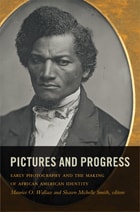
Pictures and Progress
Early Photography and the Making of African American IdentityMaurice O. Wallace and Shawn Michelle Smith, eds.
Duke University Press, 2012
Contributors. Michael A. Chaney, Cheryl Finley, P. Gabrielle Foreman, Ginger Hill, Leigh Raiford, Augusta Rohrbach, Ray Sapirstein, Suzanne N. Schneider, Shawn Michelle Smith, Laura Wexler, Maurice O. Wallace
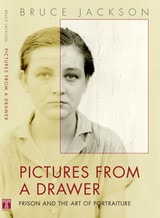
Pictures from a Drawer
Prison and the Art of PortraitureBruce Jackson
Temple University Press, 2009
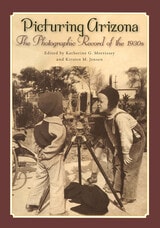
Picturing Arizona
The Photographic Record of the 1930sEdited by Katherine G. Morrissey and Kirsten Jensen
University of Arizona Press, 2005
This book places the work of local Arizonans alongside that of federal photographers both to illuminate the impact of the Depression on the state’s distinctive racial and natural landscapes and to show the influence of differing cultural agendas on the photographic record. The more than one hundred images—by well-known photographers such as Dorothea Lange and Laura Gilpin as well as by an array of less familiar photographers—represent a variety of purposes and perspectives, from public to personal, political to promotional. Six essays and three photo-essays bring together prominent authorities in history, the arts, and other fields who provide diverse perspectives on this period in Arizona and American history. Viewed together, the words and images capture a Depression-era Arizona bustling with activity as federally funded construction projects and seasonal agricultural jobs brought migrants and newcomers to the state. They convey the celebrations and the struggles of commercial photographers, archaeologists, city folks, farmers, tourists, native peoples and others in these hard times.
As the economic strains of the decade reverberated through the state, local photographers documented the lives of Arizona residents—including those frequently overlooked by historians. As this book persuasively shows, photographs can conceal as much as they reveal. A young Mexican American girl stands in front of a backdrop that hides the outhouse behind her, a deeply moving image for what it suggests about the efforts of her family to conceal their economic circumstances. Yet this image is a perfect metaphor for all the photographs in this book: stories remain hidden, but when viewers begin to question what they cannot see, pictures resonate more loudly than ever before.
This book is a history of Arizona written from the photographic record, offering a point of view that may differ from the written record. From the images and the insights of the authors, we can gain a new appreciation of how one state—and its indomitable people—weathered our nation’s toughest times.
Picturing Class
Lewis W. Hine Photographs Child Labor in New EnglandRobert Macieski
University of Massachusetts Press, 2015
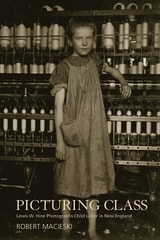
In this richly illustrated book, Robert Macieski examines Lewis W. Hine's art and advocacy on behalf of child laborers as part of the National Child Labor Committee (NCLC) between 1909 and 1917. A “social photographer”—as he called himself—Hine created images that documented children at work throughout New England, revealing their exploitation in the North as he had for rural working children in the South. Hine staged his images, highlighting particular types of labor in specific places: the “newsies” in Connecticut cities; sardine canners in Eastport, Maine; cranberry pickers in Cape Cod bogs; industrial homeworkers in Boston and Providence; and cotton textile workers throughout the region. His association with the NCLC connected him to a network of local and national reformers, social workers, and child welfare professionals, a broad coalition he supported in their fight to end this unethical labor practice. Macieski also chronicles Hine's efforts to mount major exhibitions that would help move public opinion against child labor.
In Picturing Class, Macieski explores the historical context of Hine's photographs and the social worlds of his subjects. He offers a detailed analysis of many of the images, unearthing the stories behind the creation of these photographs and the lives of their subjects. In telling the story of these photographs, their creation, and their reception, Macieski demonstrates how Hine worked to advance an unvarnished picture of a rapidly changing region and the young workers at the center of this important shift.

Picturing Empire
Photography and the Visualization of the British EmpireJames R. Ryan
University of Chicago Press, 1997
But as James R. Ryan argues in Picturing Empire, Victorian photographs reveal as much about the imaginative landscapes of imperial culture as they do about the "real" subjects captured within their frames. Ryan considers the role of photography in the exploration and domestication of foreign landscapes, in imperial warfare, in the survey and classification of "racial types," in "hunting with the camera," and in teaching imperial geography to British schoolchildren.
Ryan's careful exposure of the reciprocal relation between photographic image and imperial imagination will interest all those concerned with the cultural history of the British Empire.
Picturing Immigration
Photojournalistic Representation of Immigrants in Greek and Spanish PressAthanasia Batziou
Intellect Books, 2011
Picturing Indians
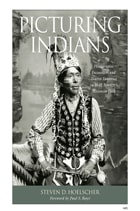
Photographic Encounters and Tourist Fantasies in H. H. Bennett's Wisconsin DellsSteven D. Hoelscher
University of Wisconsin Press, 2008
Winner, Book Award of Merit, Wisconsin Historical Society, Best Books for General Audiences, selected by the American Association of School Librarians, and Best Books for Regional Interests, selected by the Public Library Association
Picturing Men
A Century of Male Relationships in Everyday American PhotographyJohn Ibson
University of Chicago Press, 2006
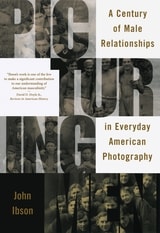
Such is the time John Ibson evokes in Picturing Men, a striking visual record of changes in attitudes about relationships between gentlemen, soldiers, cowboys, students, lumberjacks, sailors, and practical jokers. Spanning from 1850 to 1950, the 142 everyday photographs that richly illustrate Picturing Men radiate playfulness, humor, and warmth. They portray a lost world for American men: a time when their relationships with each other were more intimate than they commonly are today, regardless of sexual orientation. Picturing Men starkly contrasts the calm affection displayed in earlier photographs with the absence of intimacy in photos from the mid-1950s on. In doing so, this lively, accessible book makes a significant contribution to American history and cultural studies, gender studies, and the history of photography.
Picturing Model Citizens
Civility in Asian American Visual CultureThy Phu
Temple University Press, 2012
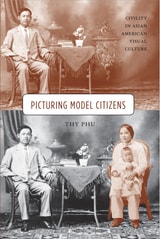
At the heart of the model minority myth—often associated with Asian Americans—is the concept of civility. In this groundbreaking book, Picturing Model Citizens, Thy Phu exposes the complex links between civility and citizenship, and argues that civility plays a crucial role in constructing Asian American citizenship.
Featuring works by Arnold Genthe, Carl Iwasaki, Toyo Miyatake, Nick Ut, and others, Picturing Model Citizens traces the trope of civility from the nineteenth to the twenty-first centuries. Through an examination of photographs of Chinese immigrants, Japanese internment camps, the Hiroshima Maidens project, napalm victims, and the SARS epidemic, Phu explores civility's unexpected appearance in images that draw on discourses of intimacy, cultivation, apology, and hygiene. She reveals how Asian American visual culture illustrates not only cultural ideas of civility, but also contests the contradictions of state-defined citizenship.
Picturing Ourselves
Photography and AutobiographyLinda Haverty Rugg
University of Chicago Press, 1997
Rugg tracks photography's impact on the formation of self-image through the study of four literary autobiographers concerned with the transformative power of photography. Obsessed with self-image, Mark Twain and August Strindberg both attempted (unsuccessfully) to integrate photographs into their autobiographies. While Twain encouraged photographers, he was wary of fakery and kept a fierce watch on the distribution of his photographic image. Strindberg, believing that photographs had occult power, preferred to photograph himself.
Because of their experiences under National Socialism, Walter Benjamin and Christa Wolf feared the dangerously objectifying power of photographs and omitted them from their autobiographical writings. Yet Benjamin used them in his photographic conception of history, which had its testing ground in his often-ignored Berliner Kindheit um 1900. And Christa Wolf's narrator in Patterns of Childhood attempts to reclaim her childhood from the Nazis by reconstructing mental images of lost family photographs.
Confronted with multiple and conflicting images of themselves, all four of these writers are torn between the knowledge that texts, photographs, and indeed selves are haunted by undecidability and the desire for the returned glance of a single self.
Picturing Texas Politics
A Photographic History from Sam Houston to Rick PerryBy Chuck Bailey; with historical text by Patrick Cox; introduction by John Anderson
University of Texas Press, 2015
With rare, previously unpublished photographs and iconic images of politicians from the state’s founders to Ann Richards, George W. Bush, and Rick Perry, here is the first-ever photographic album of Texas politicians and political campaigns.
The Republic of Texas was founded in 1839, around the time that photography was being invented. So while there were no photographers at the Alamo or San Jacinto, they arrived soon after to immortalize, on film, Sam Houston, David Burnett, Mirabeau Lamar, and many other founding fathers of the Lone Star State. Over the following nearly two centuries, Texas politics and politicians have provided reliable, often dramatic, and sometimes larger-than-life subjects for photographers to capture in the moment and add to the historical record.
Picturing Texas Politics presents the first photographic album of Texas politicians and political campaigns ever assembled. Chuck Bailey has searched archives, museums, libraries, and private collections to find photographs that have never been published, as well as iconic images, such as Russell Lee’s pictures of one of Ralph Yarborough’s campaigns. These photographs are arranged into four chronological sections, each one introduced by historian Patrick Cox, who also provides informative photo captions. The photographs display power and political savvy from the early Republic to Lyndon Johnson and Bob Bullock; unmatched dedication to Texas in the Hobby and Bush families; and the growing influence of women in politics, from Miriam “Ma” Ferguson to Barbara Jordan, Ann Richards, and Kay Bailey Hutchison. With Sam Houston’s jaguar vest, W. Lee “Pappy” O’Daniel’s hillbilly band, a famous governor with an ostrich, and prominent Texans eating watermelons, shooting guns, and riding horses, this is Texas politics at its liveliest and best.
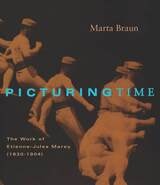
Picturing Time
The Work of Etienne-Jules Marey (1830-1904)Marta Braun
University of Chicago Press, 1992
Braun offers a fascinating look at how Marey's chronophotography was used to express the profound transformation in understanding and experiencing time that occurred in the late nineteenth century. Featuring 335 illustrations, Picturing Time includes many unpublished examples of Marey's chronophotographs and cinematic work. It also contains a complete bibliography of his writings and the first catalog of his films, photographic prints, and recently discovered negatives.

Picturing Utopia
Bertha Shambaugh and the Amana PhotographersAbigail Foerstner
University of Iowa Press, 2005

Picturing the Atmosphere
Photography and the Advancement of Atmospheric ScienceTerrence R. Nathan
American Meteorological Society, 2021
Picturing the Cosmos
A Visual History of Early Soviet Space EndeavorIina Kohonen
Intellect Books, 2017
Kohonen ably examines each image, elucidating how visual media helped to anchor otherwise abstract political and intellectual concepts of the future and modernization within the Soviet Union. The USSR mapped and named the cosmos, using new media to stake a claim to this new territory and incorporating it into the daily lives of its citizens. Soviet cosmonauts, meanwhile, were depicted as prototypes of the perfect Communist man, representing modernity, good taste, and the aesthetics of the everyday. Across five heavily illustrated chapters, Picturing the Cosmos navigates and critically examines these utopian narratives, highlighting the rhetorical tension between propaganda, censorship, art, and politics.
Picturing the Cosmos
Hubble Space Telescope Images and the Astronomical SublimeElizabeth A. Kessler
University of Minnesota Press, 2012
The vivid, dramatic images of distant stars and galaxies taken by the Hubble Space Telescope have come to define how we visualize the cosmos. In their immediacy and vibrancy, photographs from the Hubble show what future generations of space travelers might see should they venture beyond our solar system. But their brilliant hues and precise details are not simply products of the telescope’s unprecedented orbital location and technologically advanced optical system. Rather, they result from a series of deliberate decisions made by the astronomers who convert raw data from the Hubble into spectacular pictures by assigning colors, adjusting contrast, and actively composing the images, balancing the desire for an aesthetically pleasing representation with the need for a scientifically valid one.
In Picturing the Cosmos, Elizabeth A. Kessler examines the Hubble’s deep space images, highlighting the remarkable resemblance they bear to nineteenth-century paintings and photographs of the American West and their invocation of the visual language of the sublime. Drawing on art history and the history of science, as well as interviews with astronomers who work on the Hubble Heritage Project, Kessler traces the ways that the sublime, with its inherent tension between reason and imagination, not only forms the appearance of the images, but also operates on other levels. The sublime informs the dual expression—numeric and pictorial—of digital data and underpins the relevance of the frontier for a new era of exploration performed by our instruments rather than our bodies. Through their engagement with the sublime the Hubble images are a complex act of translation that encourages an experience of the universe as simultaneously beyond humanity’s grasp and within the reach of our knowledge.
Strikingly illustrated with full-color images, this book reveals the scientific, aesthetic, and cultural significance of the Hubble pictures, offering a nuanced understanding of how they shape our ideas—and dreams—about the cosmos and our places within it.

Pleasures Taken
Performances of Sexuality and Loss in Victorian PhotographsCarol Mavor
Duke University Press, 1995
Mavor’s original approach to these photographs emphatically sees sexuality where it has been previously rendered invisible. She insists that the sexuality of the girls in Carroll’s pictures is not only present, but deserves recognition, respect, and scrutiny. Similarly, she sees in Cameron’s photographs of sensual Madonnas surprising visions of motherhood that outstrip both Victorian and contemporary understandings of the maternal as untouchable and inviolate, without sexuality. Finally she shows how Hannah Cullwick, posing in various masquerades for her secret paramour, emerges as a subject with desires rather than simply a victim of her upper-class partner. Even when confronting the darker areas of these photographs, Mavor perseveres in her insistence on the pleasures taken—by the viewer, the photographer, and often by the model herself—in the act of imagining these sexualities. Inspired by Roland Barthes, and drawing on other theorists such as Julia Kristeva and Luce Irigaray, Mavor creates a text that is at once interdisciplinary, personal, and profoundly pleasurable.